Translate

mercoledì 27 aprile 2016

# s-acad: a curious academic circle: you have to fund, you have to pay to read, you have to pay to publish, you have to ...

<<  Innovation  can  come  from  anywhere—not  just  academics—but  only  if  we  allow  fornon-linear  and  unrestricted  approach  to  inquiry  and  discovery. >>

Ryan  Merkley  (@ryanmerkley ). You  Pay  to  Read  Research  You  FundThat’s Ludicrous. April 18, 2016

http://www.wired.com/2016/04/stealing-publicly-funded-research-isnt-stealing/

https://twitter.com/ryanmerkley/status/722029628777492482

martedì 26 aprile 2016

# s-brain: tracing Charlie ...

<< Do  you  like  surprisesIf  you  don’tit  might  be  because  our  nervous  system  works  very  hard  to avoid  being  surprisedThis  often  involves  the  nervous  system  trying  to  predict  or  “model”  its own  future  as  accurately  as  possibleFor  examplewhen  we  are  listening  to  a  string  of  sounds that  appears  to  be  unpredictablesuch  as  a  Charlie  Parker-esque  saxophone  solo,  our  brain  will still  try  to  predict  what  the  next  note  will  be >>

Jonas Obleser. PerceptionTell  me  something  I  don’t  know. DOI:  http://dx.doi.org/10.7554/eLife.15853 Published  April  19,  2016. eLife  2016;5:e15853

http://elifesciences.org/content/5/e15853v1

https://twitter.com/eLife/status/724269430989983744

lunedì 25 aprile 2016

# s-gst: subtle, interacting internal waves

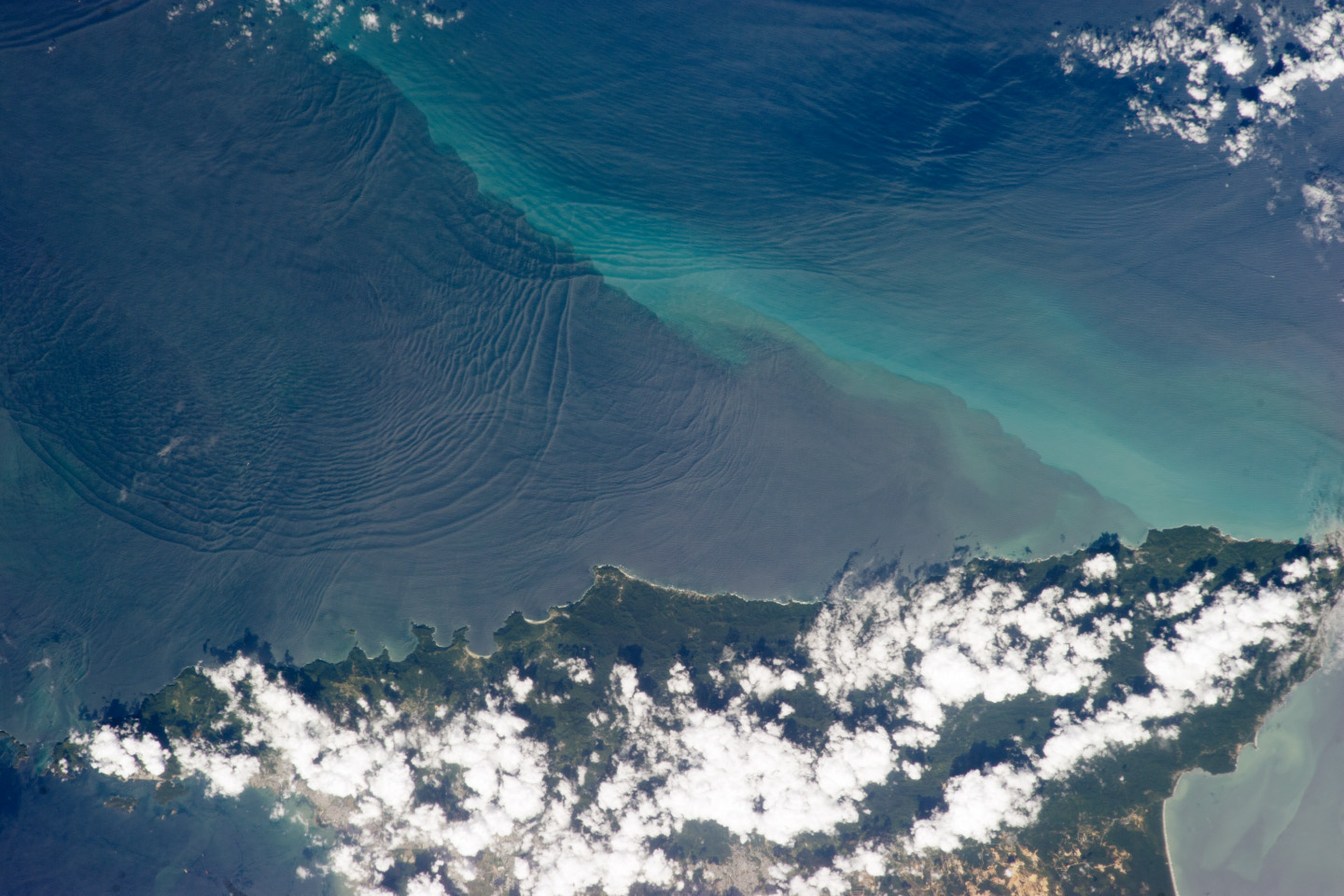
<< This  photographtaken  from  the  International  Space  Station  (ISS),  shows  the  north  coast  of  Trinidad  and  a  series  of  subtle, interacting  arcs  in  the  southeastern  Caribbean  Sea.  These  are  known  as  “internal  waves,”  the  surface  manifestation  of  slow waves  that  move  tens  of  meters  beneath  the  sea  surfaceInternal  waves  produce  enough  of  an  effect  on  the  sea  surface  to be  seen  from  space,  but  only  where  they  are  enhanced  due  to  reflection  of  sunlight,  or  sunglint,  back  towards  the  International Space  Station. The  image  shows  at  least  three  sets  of  internal  waves  interactingThe  most  prominent  set  (image  top  left)  shows  a  packet  of several  waves  moving  from  the  northwest  due  to  the  tidal  flow  towards  the  north  coast  of  Trinidad.  Two  less  prominent, younger  sets  can  be  seen  further  out  to  sea.  A  very  broad  set  enters  the  view  from  the  north  and  northeast,  and  interacts  at image  top  center  with  the  first  set.  All  the  internal  waves  are  probably  caused  by  the  shelf  break  near  Tobago  (outside  the image  to  top  right).  The  shelf  break  is  the  step  between  shallow  seas  (around  continents  and  islands)  and  the  deep  oceanIt is  the  line  at  which  tides  usually  start  to  generate  internal  waves. >>

NASA Earth Observatory.  Internal Waves off Northern Trinidad. February 4, 2013

http://m.earthobservatory.nasa.gov/IOTD/view.php?id=80337

image: download  large  image  (391  KB,  JPEG,  1440x960)

http://eoimages.gsfc.nasa.gov/images/imagerecords/80000/80337/ISS034-E-032377_lrg.jpg

domenica 24 aprile 2016

# s-gst-apopt: a particular form of "orchestrated death"

<< The most aggressive form of pancreatic cancer -- often described as one of the hardest malignancies to diagnose and treat -- thrives in the presence of neighboring tumor cells undergoing a particular form of "orchestrated cell death."  >>

<< Our findings are the first to show that cancer cell death via necroptosis  [programmed  necrosis] can actually promote tumor growth, as this process results in suppression of the body's immune response against the cancer, (..) what is equally significant is that these findings might also be relevant to other tumor types. >>

<< This  study  exemplifies  the  importance  of  examining  cancer  within  the  actual  context  in  which  it grows (..) In  our  initial  studiesinhibiting  necroptosis  in  PDAC [pancreatic  ductal  adenocarcinoma] cells  increased  their  ability  to  grow  in tissue  culture.  Howeverwhen  we  began  to  study  the  same  process  in  micewe  were  surprised to  see  just  the  opposite  effect,  and  this  was  mainly  due  to  the  immune  response  of  the  cells surrounding  the  tumor. >>

NYU LANGONE MEDICAL CENTER / NEW YORK UNIVERSITY SCHOOL OF MEDICINE. Cell  death  mechanism  may  -  paradoxically  -  enable aggressive  pancreatic  cells  to  live  on. 22-Apr-2016

http://www.eurekalert.org/pub_releases/2016-04/nlmc-cdm042216.php

Lena  Seifert , Gregor  Werba, et al. The  necrosome  promotes  pancreatic  oncogenesis via  CXCL1  and  Mincle-induced  immune  suppression. Nature 532, 245–249 (14 April 2016) doi:10.1038/nature17403.

http://www.nature.com/nature/journal/v532/n7598/full/nature17403.html

sabato 23 aprile 2016

# s-brain: tweeting in empathic brains ...

<< (..) few positive learning experiences are sufficient to increase empathy. >>

Hein G, Engelmann JB, et al. How learning shapes the empathic brain. Proc Natl Acad Sci U S A. 2016 Jan 5;113(1):80-5. doi: 10.1073/pnas.1514539112.

http://www.ncbi.nlm.nih.gov/pubmed/26699464

venerdì 22 aprile 2016

# s-phyto: versatile SERK1, in shedding and growing ...

<< During  their  lifeplants  constantly  renew  themselvesThey  sprout  new  leaves  in  the  spring  and shed  them  in  the  fall.  >>

<< When  it  is time  to  shed  an  organ,  a  small  hormone  binds  to  this  membrane  receptor  and,  together  with  a helper  proteinthe  abscission  process  is  initiated. >>

<< To  fully  initiate  the abscission  processanother  player  is  neededthe  helper  protein  SERK1. >>

<< The  fascinating  thing  about  SERK1  is  that  it  not  only  plays  a  role  in  the  shedding  mechanism  of plant  organsbut  also  acts  together  with  other  membrane  receptors  that  regulate  totally  different aspects  of  plant  development >>

<< IndeedSERK1  is  a versatile  helper  protein  shared  between  different  signaling  pathwaysWhen  bound  to  another protein  receptorit  can  also  for  example  signal  the  plant  to  grow. >>

Unveiling the withering process. April 14, 2016

http://scienmag.com/unveiling-the-withering-process/

Julia Santiago, Benjamin Brandt, et al.
Mechanistic insight into a peptide hormone signaling complex mediating floral organ abscission. DOI: http://dx.doi.org/10.7554/eLife.15075. Published April 8, 2016. eLife 2016;10.7554/eLife.15075

http://elifesciences.org/content/5/e15075v1

giovedì 21 aprile 2016

# s-acad: no "junk", but only fresh thinking

<< Science  rests  on  data,  of  that  there  can  be  no  doubtBut  ... >>

<< (..) so  the  next  best  thing  is  precision  medicine,  where  we look  at  how  genetically  similar  people  react  and  then  assume  that  a  given  person  will  respond in  a  similar  way. >>

Peter  Coveney, Edward  R  Dougherty. Big  data  has  not  revolutionised  medicine  we  need  big  theory  alongside  it. 19  April  2016,  16:02  CEST

https://theconversation.com/big-data-has-not-revolutionised-medicine-we-need-big-theory-alongside-it-55356

FonT: ironicamente, chi a suo tempo ha coniato (o usato piu' o meno acriticamente) il termine "junk DNA" forse non ha preso in considerazione il fatto che quella parte di codice, benche' di serialita' (sequenzialita') quasistocastica, avrebbe potuto contenere la parte piu' importante del "sistema operativo" della vita, vale a dire  il kernel dove risiedono le istruzioni di differenziazione, di regolazione, di riparazione sul codice ... e forse anche le banche dati storiche e mnesiche ...  istruzioni e banche dati di "assoluta  precisione", per dire ...

" junk DNA" cfr http://www.ncbi.nlm.nih.gov/pubmed/?term=%22junk+dna%22