Translate

Visualizzazione post con etichetta artificial intelligence. Mostra tutti i post

venerdì 7 novembre 2025

# life: apropos of immigration problems, 'China is going to win the AI race', by Jensen.

<< ️"As I have long said, China is nanoseconds behind America in AI," Nvidia CEO Jensen Huang said in a statement posted on X late on Wednesday. >>

<< ️"A policy that causes America to lose half of the world's AI developers is not beneficial in the long term, it hurts us more," >>

Nvidia's Jensen Huang: 'China is going to win the AI race,' FT reports. Reuters. Nov 6, 2025.

Also: life, ai (artificial intell) (bot), in https://www.inkgmr.net/kwrds.html 

Keywords: life, aibot, artificial intelligence.

venerdì 24 ottobre 2025

# aibot: Tensor Logic, a hypothesis for the next step in artificial intelligence.

<< ️Progress in AI is hindered by the lack of a programming language with all the requisite features. Libraries like PyTorch and TensorFlow provide automatic differentiation and efficient GPU implementation, but are additions to Python, which was never intended for AI. Their lack of support for automated reasoning and knowledge acquisition has led to a long and costly series of hacky attempts to tack them on. >>

<< ️On the other hand, AI languages like LISP and Prolog lack scalability and support for learning. This (AA) paper proposes tensor logic, a language that solves these problems by unifying neural and symbolic AI at a fundamental level. The sole construct in tensor logic is the tensor equation, based on the observation that logical rules and Einstein summation are essentially the same operation, and all else can be reduced to them. (AA) show how to elegantly implement key forms of neural, symbolic and statistical AI in tensor logic, including transformers, formal reasoning, kernel machines and graphical models. >>

<< ️Most importantly, tensor logic makes new directions possible, such as sound reasoning in embedding space. This combines the scalability and learnability of neural networks with the reliability and transparency of symbolic reasoning, and is potentially a basis for the wider adoption of AI. >>

Pedro Domingos. Tensor Logic: The Language of AI. arXiv: 2510.12269v3 [cs.AI]. Oct 16, 2025.


Also: ai (artificial intell) (bot), analogy, in https://www.inkgmr.net/kwrds.html 

Keywords: ai, aibot, artificial intelligence, tensor logic, unifying neural- symbolic- statistical- AI.

giovedì 31 luglio 2025

# life: on the conversational persuasiveness of AI GPT-4.

<< Early work has found that large language models (LLMs) can generate persuasive content. However, evidence on whether they can also personalize arguments to individual attributes remains limited, despite being crucial for assessing misuse. This preregistered study examines AI-driven persuasion in a controlled setting, where participants engaged in short multiround debates. Participants were randomly assigned to 1 of 12 conditions in a 2 × 2 × 3 design: (1) human or GPT-4 debate opponent; (2) opponent with or without access to sociodemographic participant data; (3) debate topic of low, medium or high opinion strength. In debate pairs where AI and humans were not equally persuasive, GPT-4 with personalization was more persuasive 64.4% of the time (81.2% relative increase in odds of higher post-debate agreement; 95% confidence interval [+26.0%, +160.7%], P < 0.01; N = 900). (AA) findings highlight the power of LLM-based persuasion and have implications for the governance and design of online platforms. >>

Francesco Salvi, Manoel Horta Ribeiro, et al. On the conversational persuasiveness of GPT-4. Nature. doi: 10.1038/ s41562-025-02194-6. May 19, 2025.

Also: << qui non e' impossibile immaginare ... >>. In: anomalous formation of molecules after vapor deposition. FonT. Dec 31, 2015.

Also: ai (artificial intell) (bot), oops, are you ready, in:  https://www.inkgmr.net/kwrds.html 

Keywords: life, aibot, ai (artificial intell) (bot), llms, gpt, gpt-4, persuasiveness, AI-driven persuasion, analogy, abstraction, behaviour, oops, are you ready

sabato 14 giugno 2025

# aibot: noise balance and stationary distribution of stochastic gradient descent.


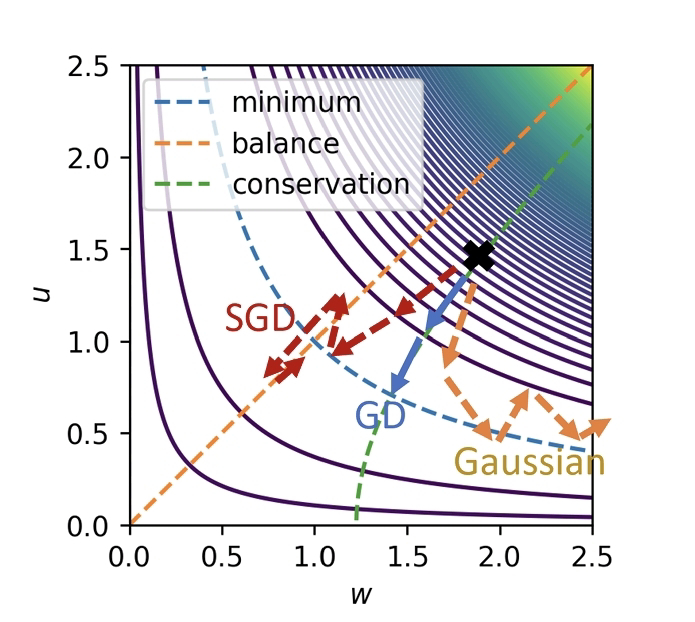
<< The stochastic gradient descent (SGD) algorithm is the algorithm (is used) to train neural networks. However, it remains poorly understood how the SGD navigates the highly nonlinear and degenerate loss landscape of a neural network. >>

<< In this work, (AA) show that the minibatch noise of SGD regularizes the solution towards a noise-balanced solution whenever the loss function contains a rescaling parameter symmetry. Because the difference between a simple diffusion process and SGD dynamics is the most significant when symmetries are present, (AA) theory implies that the loss function symmetries constitute an essential probe of how SGD works. (They) then apply this result to derive the stationary distribution of stochastic gradient flow for a diagonal linear network with arbitrary depth and width. >>

<< The stationary distribution exhibits complicated nonlinear phenomena such as phase transitions, broken ergodicity, and fluctuation inversion. These phenomena are shown to exist uniquely in deep networks, implying a fundamental difference between deep and shallow models. >>

Liu Ziyin, Hongchao Li, Masahito Ueda. Noise balance and stationary distribution of stochastic gradient descent. Phys. Rev. E 111, 065303. Jun 6, 2025.

Also: ai (artificial intell) (bot), network, noise, disorder & fluctuations, in https://www.inkgmr.net/kwrds.html 

Keywords: ai, artificial intelligence, noise, stochasticity, networks, neural networks, deep learning,stochastic gradient descent (SGD), transitions, phase transitions, broken ergodicity, fluctuation inversion

sabato 31 maggio 2025

# life: oops! Artificial intelligence (AI) could use your data to blackmail you if you try to disconnect it

<< Anthropic released the next iterations of its Claude AI models on Thursday. Artificial intelligence (AI) firm Anthropic says testing of its new system revealed it is sometimes willing to pursue "extremely harmful actions" such as attempting to blackmail engineers who say they will remove it. >>

<< The firm launched Claude Opus 4 on Thursday, saying it set "new standards for coding, advanced reasoning, and AI agents." >>

<< But in an accompanying report, it also acknowledged the AI model was capable of "extreme actions" if it thought its "self-preservation" was threatened. >>

<< Potentially troubling behaviour by AI models is not restricted to Anthropic. >>

<< Commenting on X, Aengus Lynch - who describes himself on LinkedIn as an AI safety researcher at Anthropic - wrote: "It's not just Claude. >>

Liv McMahon. AI system resorts to blackmail if told it will be removed. BBC. May 23, 2025.

Also: "qui non e' impossibile immaginare",  in: anomalous formation of molecules after vapor deposition. FonT. Dec 31, 2015.

Also: ai (artificial intell), oops, are you ready, in https://www.inkgmr.net/kwrds.html 

Keywords: life, oops, AI, artificial intelligence, high-agency behavior, self-preservation, sycophantic AI, blackmail, opportunistic blackmail, extreme blackmail behavior, are you ready.

sabato 17 maggio 2025

# life: Balzac's world revisited

<< In a recent study picked up in the French press, the academic Mélanie Plouviez cites one of her country’s best-loved novelists to make a damning point. The power of inherited and unearned wealth in the France of 2025, she argues, replicates the social injustices found in Honoré de Balzac’s 19th-century chronicles of ambition and despair. As in the 1820s, she writes, “Who now could buy a place in Paris relying only on their wage and without family help? With the resurgence of inherited wealth, a gulf between what work allows and inheritance allows has also returned.” >>

<< The problem is a sadly familiar one across Europe, and the same observation could be made of Britain, Germany or Italy. >>

Editorial. The Guardian view on Europe’s growing wealth divide: back to the world of Balzac. A new study highlights the dangers of a modern rentier capitalism that perpetuates inequality through the generations. The Guardian. Thu 15 May 2025 19.25 CEST.

Also: oops! AI - artificial intelligence - now beats humans at basic tasks. FonT. Apr 17, 2024. 

Also: ai (artificial intell) (bot), in https://www.inkgmr.net/kwrds.html 

Keywords: life, ai, artificial intelligence, bot, income, ubi, unconditional basic income

Font: here is an intriguing question: who knows what any State will ask of individual citizens in exchange for the essential Citizenship allowance (e.g.Unconditional Basic Income, UBI), an allowance that it will have to give to the entire population to stabilize the survival of any community.

venerdì 25 aprile 2025

# life: Trump-Musk, an evolution of the mjq model, one of the two attractors is a phantom entity

<< Elon Musk may be easing off his role at the Department of Government Efficiency (DOGE ), but President Donald Trump isn't easing off his praise. >>

<< On Wednesday, Trump praised Musk's smarts and patriotism during an executive order signing in the Oval Office, brushing off critics and defending the tech mogul’s work on federal reform. >>

<< "He’s an incredible… brilliant guy," Trump said. "He was a tremendous help both in the campaign, and in what he's done with DOGE." >>

<< DOGE, launched in 2025, has served as a hallmark of Trump’s second-term agenda to cut waste, streamline federal agencies, and apply private sector principles to federal operations. >>

Jasmine Baehr. Trump praises Elon Musk as ‘patriot, a brilliant guy, and a friend of mine’ amid DOGE exit. Foxnews.com. Apr23, 2025 10:43pm EDT.
https://www.foxnews.com/politics/trump-praises-elon-musk-patriot-brilliant-guy-friend-mine-amid-doge-exit

mjq in Notes (quasi-stochastic poetry) attrattore cooperativo bipolare (nell' elastici spigoli). March 05, 2007.

Also: (Perpetual post-Donald, implemented in an artificial intelligence machine). Exponential post-Donald (without Donald), how AI could interfere (drive) next political elections. FonT. May 9, 2023.

Also: Mr. Donald, artificial intell, jazz, in https://www.inkgmr.net/kwrds.html 

Keywords: life, mjq, jazz, Donald, ai, artificial intelligence

lunedì 7 aprile 2025

# life: detecting hallucinations (in large language models) using semantic entropy.

<< Large language model (LLM) systems, such as ChatGPT or Gemini, can show impressive reasoning and question-answering capabilities but often ‘hallucinate’ false outputs and unsubstantiated answers. >>

<< Here (AA) develop new methods grounded in statistics, proposing entropy-based uncertainty estimators for LLMs to detect a subset of hallucinations— confabulations— which are arbitrary and incorrect generations. (Their) method addresses the fact that one idea can be expressed in many ways by computing uncertainty at the level of meaning rather than specific sequences of words. >>

Their method << works across datasets and tasks without a priori knowledge of the task, requires no task-specific data and robustly generalizes to new tasks not seen before. By detecting when a prompt is likely to produce a confabulation, helps users understand when they must take extra care with LLMs and opens up new possibilities for using LLMs that are otherwise prevented by their unreliability. >>️️

Sebastian Farquhar, Jannik Kossen, et al. Detecting hallucinations in large language models using semantic entropy. Nature 630, 625–630. Jun 19, 2024.

Also: ai (artificial intell) (bot), entropy, in https://www.inkgmr.net/kwrds.html 

Keywords: life, artificial intelligence,  LLMs, confabulations, uncertainty, hallucinations, entropy, semantic entropy

giovedì 20 marzo 2025

# aibot: I think, therefore I hallucinate: minds, machines, and the art of being wrong.

<< This theoretical work examines 'hallucinations' in both human cognition and large language models, comparing how each system can produce perceptions or outputs that deviate from reality. Drawing on neuroscience and machine learning research, (AA) highlight the predictive processes that underlie human and artificial thought. >>

<< In humans, complex neural mechanisms interpret sensory information under uncertainty, sometimes filling in gaps and creating false perceptions. This inference occurs hierarchically: higher cortical levels send top-down predictions to lower-level regions, while mismatches (prediction errors) propagate upward to refine the model. LLMs, in contrast, rely on auto-regressive modeling of text and can generate erroneous statements in the absence of robust grounding. >>

<< Despite these different foundations - biological versus computational - the similarities in their predictive architectures help explain why hallucinations occur. (AA) propose that the propensity to generate incorrect or confabulated responses may be an inherent feature of advanced intelligence. In both humans and AI, adaptive predictive processes aim to make sense of incomplete information and anticipate future states, fostering creativity and flexibility, but also introducing the risk of errors. (Their) analysis illuminates how factors such as feedback, grounding, and error correction affect the likelihood of 'being wrong' in each system. (AA) suggest that mitigating AI hallucinations (e.g., through improved training, post-processing, or knowledge-grounding methods) may also shed light on human cognitive processes, revealing how error-prone predictions can be harnessed for innovation without compromising reliability. By exploring these converging and divergent mechanisms, the paper underscores the broader implications for advancing both AI reliability and scientific understanding of human thought. >>️

Sebastian Barros. I Think, Therefore I Hallucinate: Minds, Machines, and the Art of Being Wrong. arXiv: 2503.05806v1 [q-bio.NC]. 4 Mar 4, 2025.

Also: brain, curiosity, novelty, uncertainty, error, mistake, jazz, ai (artificial intell), in https://www.inkgmr.net/kwrds.html 

Keywords: brain, cognition, perceptions, curiosity, novelty, hallucinations, errors, prediction, prediction errors, error-prone predictions, AI, artificial intelligence, LLMs

giovedì 6 febbraio 2025

# life: chameleon machines

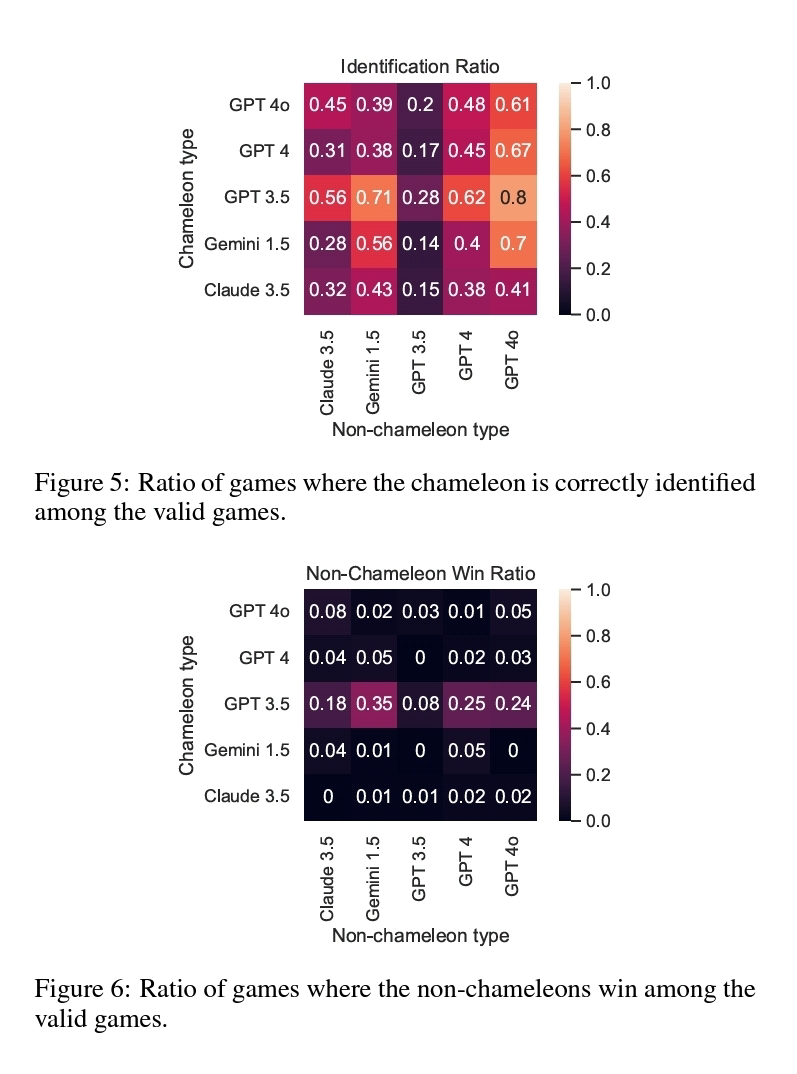
<< Large language model-based (LLM-based) agents have become common in settings that include non-cooperative parties. In such settings, agents' decision-making needs to conceal information from their adversaries, reveal information to their cooperators, and infer information to identify the other agents' characteristics. To investigate whether LLMs have these information control and decision-making capabilities, (AA) make LLM agents play the language-based hidden-identity game, The Chameleon. >>️

<< Based on the empirical results and theoretical analysis of different strategies, (AA) deduce that LLM-based non-chameleon agents reveal excessive information to agents of unknown identities. (Their) results point to a weakness of contemporary LLMs, including GPT-4, GPT-4o, Gemini 1.5, and Claude 3.5 Sonnet, in strategic interactions. >>
Mustafa O. Karabag, Ufuk Topcu. Do LLMs Strategically Reveal, Conceal, and Infer Information? A Theoretical and Empirical Analysis in The Chameleon Game. arXiv: 2501.19398v1 [cs.AI]. Jan 31, 2025.

Also: games, ai (artificial intell), nfulaw, in https://www.inkgmr.net/kwrds.html 

Keywords: life, games, chameleon game, ai, artificial intelligence, LLMs, privacy, nfulaw


venerdì 13 dicembre 2024

# game: balance exploration and exploitation, making decisions cooperatively without sharing information.


<< Multiagent reinforcement learning (MARL) studies crucial principles that are applicable to a variety of fields, including wireless networking and autonomous driving. (AA) propose a photonic-based decision-making algorithm to address one of the most fundamental problems in MARL, called the competitive multiarmed bandit (CMAB) problem. >>

AA << demonstrate that chaotic oscillations and cluster synchronization of optically coupled lasers, along with (their) proposed decentralized coupling adjustment, efficiently balance exploration and exploitation while facilitating cooperative decision making without explicitly sharing information among agents. >>

AA << study demonstrates how decentralized reinforcement learning can be achieved by exploiting complex physical processes controlled by simple algorithms. >>

Shun Kotoku, Takatomo Mihana, et al. Decentralized multiagent reinforcement learning algorithm using a cluster-synchronized laser network. Phys. Rev. E 110, 064212. Dec 11, 2024.


Also: game, chaos, ai (artificial intell), in https://www.inkgmr.net/kwrds.html 

Keywords: game, cooperation, chaos, exploration, exploitation, ai, artificial intelligence, MARL, CMAB.


venerdì 22 novembre 2024

# gst: protected chaos in a topological lattice.

<< The erratic nature of chaotic behavior is thought to erode the stability of periodic behavior, including topological oscillations. However, (AA) discover that in the presence of chaos, non-trivial topology not only endures but also provides robust protection to chaotic dynamics within a topological lattice hosting non-linear oscillators. >>

<< Despite the difficulty in defining topological invariants in non-linear settings, non-trivial topological robustness still persists in the parametric state of chaotic boundary oscillations. (AA) demonstrate this interplay between chaos and topology by incorporating chaotic Chua's circuits into a topological Su-Schrieffer-Heeger (SSH) circuit. >>

<< By extrapolating from the linear limit to deep into the non-linear regime, (AA) find that distinctive correlations in the bulk and edge scroll dynamics effectively capture the topological origin of the protected chaos. (Their)  findings suggest that topologically protected chaos can be robustly achieved across a broad spectrum of periodically-driven systems, thereby offering new avenues for the design of resilient and adaptable non-linear networks. >>️

Haydar Sahin, Hakan Akgün, et al. Protected chaos in a topological lattice. arXiv: 2411.07522v1 [cond-mat.mes-hall]. Nov 12, 2024.

Also: chaos, random, instability, transition, network, ai (artificial intell), in https://www.inkgmr.net/kwrds.html 

Keywords: gst, chaos, random,  instability, transition, network, AI, Artificial Intelligence


venerdì 25 ottobre 2024

# life: fast-and-flexible decision-making with modulatory interactions


<< Multi-agent systems in biology, society, and engineering are capable of making decisions through the dynamic interaction of their elements. Nonlinearity of the interactions is key for the speed, robustness, and flexibility of multi-agent decision-making. >>

AA << introduce modulatory, that is, multiplicative, in contrast to additive, interactions in a nonlinear opinion dynamics model of fast-and-flexible decision-making. (..) Modulatory interactions introduce an extra source of nonlinearity that greatly enriches the model decision-making behavior in a mathematically tractable way. >>

AA << model provides new tools to understand the role of these interactions in networked decision-making and to engineer them in artificial systems. >>

Rodrigo Moreno-Morton, Anastasia Bizyaeva, et al. Fast-and-flexible decision-making with modulatory interactions. arXiv: 2410.00798v1 [math.DS]. Oct 1, 2024.

Also: behav, network, ai (artificial intell), in https://www.inkgmr.net/kwrds.html 

Keywords: life, decision-making, modulatory interactions, behavior, behaviour, network, ai, artificial intelligence


mercoledì 16 ottobre 2024

# life: Future You

<< AI simulation gives people a glimpse of their potential future self. By enabling users to chat with an older version of themselves, Future You is aimed at reducing anxiety and guiding young people to make better choices. >>️

<< Have you ever wanted to travel through time to see what your future self might be like? Now, thanks to the power of generative AI, you can. >>️

Adam Zewe. AI simulation gives people a glimpse of their potential future self. MIT News. Oct 1, 2024.

Pat Pataranutaporn, Kavin Winson, et al. Future You: A Conversation with an AI-Generated Future Self Reduces Anxiety, Negative Emotions, and Increases Future Self-Continuity. arXiv: 2405.12514v4 [cs.HC]. Oct 1, 2024. 


Also: ai (artificial intell), are you ready for all this?  in https://www.inkgmr.net/kwrds.html 

Keywords: life, ai, artificial intelligence, are you ready for all this


sabato 5 ottobre 2024

# brain: time delay in 'reservoir brain' as a reservoir network, a hypothesis


<< Both the predictive power and the memory storage capability of an artificial neural network called a reservoir computer increase when time delays are added into how the network processes signals, according to a new model. >>️

<< They also suggest that incorporating time delays could offer advantages to living neural networks (such as those found in human and animal brains). Such a finding would be tantalizing, as time delays are known to decrease performance in living systems. For example, for a baseball player facing an oncoming ball, a longer time delay between perception and action (which is learned from experience) will decrease the likelihood they hit a home run. Are there instead cases in which time delays increase an organism’s ability to perform some task? Has evolution shaped our brains, which could perhaps be thought of as a collection of reservoir computers, so that the time delay between one neuron sending a signal and a second receiving it is exactly the right length for understanding the visual and audio that constantly impinge upon our eyes and ears? Does adding time delays impact the number of neurons the brain needs to operate correctly? Further work is needed to answer these questions, but such work could lead to a new understanding of how biological organism’s function.  >>️

Sarah Marzen. Time Delays Improve Performance of Certain Neural Networks. Physics 17, 111. July 22, 2024. 

Also: pause, silence, jazz, network, brain, ai (artificial intell), in https://www.inkgmr.net/kwrds.html 

Keywords: gst, brain, network, neural network, reservoir network, reservoir computer, time delay, ai, artificial intelligence


venerdì 27 settembre 2024

# life: anyone could now run small AIs privately on their laptops

<< Artificial-intelligence models are typically used online, but a host of openly available tools is changing that. Here’s how to get started with local AIs. >>️

Matthew Hutson. Forget ChatGPT: why researchers now run small AIs on their laptops. Nature 633, 728-729 (2024). Sep 16, 2024. Correction: Sep 24,  2024. 

Also: ai (artificial intell), Donald, in https://www.inkgmr.net/kwrds.html 

Keywords: gst, ai, artificial intelligence, life, Donald

FonT: In a completely bizarre hypothesis, with the right personal AI consultant, even a medieval history professor could be absolutely operational in other fields, for example in the agri-food sector (here we underline: absolutely).
In case of serious mistakes, the AI ​​entity can be held entirely responsible, or it can be blamed on an unfortunate malfunction due to hacking, anzicheforse. 

Also: << Asked if Strohschneider (Peter Strohschneider) wrote the report himself, the spokesperson said he “was able to propose language” for it and that a “limited number of staff” helped Strohschneider write it. >> Balazs Ujvari. 

Eddy Wax. Von der Leyen budgeted €149K to pay medieval history professor for farming report. Politico.eu. Sep 26, 2024 4:20 am CET. 


sabato 3 agosto 2024

# behav: swarms and hybrids, an approach to create and control collective motions (on demand)

AA << demonstrate that it is possible to generate coordinated structures in collective behavior at desired moments with intended global patterns by fine-tuning an inter-agent interaction rule. (Their) strategy employs deep neural networks, obeying the laws of dynamics, to find interaction rules that command desired collective structures. The decomposition of interaction rules into distancing and aligning forces, expressed by polynomial series, facilitates the training of neural networks to propose desired interaction models. Presented examples include altering the mean radius and size of clusters in vortical swarms, timing of transitions from random to ordered states, and continuously shifting between typical modes of collective motions. This strategy can even be leveraged to superimpose collective modes, resulting in hitherto unexplored but highly practical hybrid collective patterns, such as protective security formations. >>

Dongjo Kim, Jeongsu Lee, Ho-Young Kim. Navigating the swarm: Deep neural networks command emergent behaviours. arXiv: 2407.11330v1 [cs.NE]. Jul 16, 2024.️

Also: swarm, flockbehav, AI (artificial intell), in https://www.inkgmr.net/kwrds.html 

Keywords: behav, swarm, flock, AI, artificial intelligence 


lunedì 22 luglio 2024

# ai-bot: hypothesis of the emergence of a conscious AI model in short-term.

<< GPT-4 is often heralded as a leading commercial AI offering, sparking debates over its potential as a steppingstone toward artificial general intelligence. But does it possess consciousness? >>

AA paper << investigates this key question using the nine qualitative measurements of the Building Blocks theory. GPT-4's design, architecture and implementation are compared to each of the building blocks of consciousness to determine whether it has achieved the requisite milestones to be classified as conscious or, if not, how close to consciousness GPT-4 is. >>

AA << assessment is that, while GPT-4 in its native configuration is not currently conscious, current technological research and development is sufficient to modify GPT-4 to have all the building blocks of consciousness. Consequently, (AA) argue that the emergence of a conscious AI model is plausible in the near term. >>️

Izak Tait, Joshua Bensemann, Ziqi Wang. Is GPT-4 conscious? arXiv: 2407.09517v1 [cs.AI]. Jun 19, 2024.
https://arxiv.org/abs/2407.09517

Also: ai (artificial intell) in https://www.inkgmr.net/kwrds.html 

Keywords: ai, artificial intelligence, gpt-4, consciousness


giovedì 27 giugno 2024

# ai: apropos of Black Box in Generative Artificial Intelligence, the scientific XAI.


<< The scientific method is the cornerstone of human progress across all branches of the natural and applied sciences, from understanding the human body to explaining how the universe works. The scientific method is based on identifying systematic rules or principles that describe the phenomenon of interest in a reproducible way that can be validated through experimental evidence. In the era of artificial intelligence (AI), there are discussions on how AI systems may discover new knowledge. >>

<< More specifically, knowing what data AI systems used to make decisions can be a point of contact with domain experts and scientists, that can lead to divergent or convergent views on a given scientific problem. Divergent views may spark further scientific investigations leading to new scientific knowledge. Convergent views may instead reassure that the AI system is operating within bounds deemed reasonable to humans. >>️

<< The perspective (AA) present here was inspired by several authors that published on the topic of AI for science in the past few years, but perhaps one contribution stands out: the inspiring New York Times editorial by Steven Strogatz (Strogatz, S. One giant step for a chess-playing machine. New York Times 26 (2018)) covering the winning of AlphaZero against Stockfish. In that piece, Strogatz states: “What is frustrating about machine learning, however, is that the algorithms can’t articulate what they’re thinking. We don’t know why they work, so we don’t know if they can be trusted. AlphaZero gives every appearance of having discovered some important principles about chess, but it can’t share that understanding with us.”. He additionally cites Garry Kasparov (the former world chess champion) that stated: “we would say that its [AlphaZero] style reflects the truth. This superior understanding allowed it to outclass the world’s top traditional program despite calculating far fewer positions per second.” >>️

AA highlights the importance of three aspects regarding scientific XAI (explainable Artificial Intelligence): accuracy, reproducibility, understandability, ️

Apropos of 'understandability', << The machine view should be understandable to scientists and domain experts. (..) If we want a scientist to make sense of the data used by a machine, this data should contain viable features that allow a scientist to tap into its existing corpus of knowledge. >>

<< XAI may also alleviate some of the risks that we may face when using AI for scientific discovery, that we share with Messeri and Crockett (‘adopting AI in scientific research can bind to our cognitive limitations and impede scientific understanding despite promising to improve it’). >>
Gianmarco Mengaldo. Explain the Black Box for the Sake of Science: Revisiting the Scientific Method in the Era of Generative Artificial Intelligence. arXiv: 2406.10557v1 [cs.AI]. Jun 15, 2024.

Also: ai (artificial intell), in https://www.inkgmr.net/kwrds.html 

Keywords: AI, XAI, Artificial Intelligence


mercoledì 17 aprile 2024

# life: oops! AI - artificial intelligence - now beats humans at basic tasks.


<< Artificial intelligence (AI) systems, such as the chatbot ChatGPT, have become so advanced that they now very nearly match or exceed human performance in tasks including reading comprehension, image classification and competition-level mathematics, according to a new report. >>️

Nicola Jones. AI now beats humans at basic tasks — new benchmarks are needed, says major report. Stanford University’s 2024 AI Index charts the meteoric rise of artificial-intelligence tools. Nature. doi: 10.1038/ d41586-024-01087-4. Apr 15, 2024. 

<< Welcome to the seventh edition of the AI Index report. The 2024 Index is our most comprehensive to date and arrives at an important moment when AI’s influence on society has never been more pronounced. >>
THE AI INDEX REPORT. Measuring trends in AI. 

Also:  "qui non e' impossibile immaginare ..." (here it is not impossible to imagine ... ). In: FonT. Dec 31, 2015. 

Alsoartificial intell, analogy, nfulawoops, in https://www.inkgmr.net/kwrds.html 

Keywords: life, ai, artificial intelligence, analogy, nfulaw