Translate

Visualizzazione dei post in ordine di pertinenza per la query stochastic resetting. Ordina per data Mostra tutti i post

martedì 23 aprile 2024

# gst: Lévy flights and Lévy walks under stochastic resetting.

<< Stochastic resetting is a protocol of starting anew, which can be used to facilitate the escape kinetics. (AA)  demonstrate that restarting can accelerate the escape kinetics from a finite interval restricted by two absorbing boundaries also in the presence of heavy-tailed, Lévy-type, α
-stable noise. However, the width of the domain where resetting is beneficial depends on the value of the stability index α determining the power-law decay of the jump length distribution. For heavier (smaller α) distributions, the domain becomes narrower in comparison to lighter tails. >>

<< Additionally, (AA) explore connections between Lévy flights (LFs) and Lévy walks (LWs) in the presence of stochastic resetting. First of all, (They) show that for Lévy walks, the stochastic resetting can also be beneficial in the domain where the coefficient of variation is smaller than 1. Moreover, (They) demonstrate that in the domain where LWs are characterized by a finite mean jump duration (length), with the increasing width of the interval, the LWs start to share similarities with LFs under stochastic resetting. >>️

Bartosz Żbik, Bartłomiej Dybiec. Lévy flights and Lévy walks under stochastic resetting. Phys. Rev. E 109, 044147. April 22, 2024.

Also: keyword Lévy in FonT

Also: escape, noise, in https://www.inkgmr.net/kwrds.html 

Keywords: gst, escape, noise, stochastic resetting, Lévy


sabato 27 settembre 2025

# gst: universal criterion for selective outcomes under stochastic resetting


<< ️Resetting plays a pivotal role in optimizing the completion time of complex first-passage processes with single or multiple outcomes and exit possibilities. While it is well established that the coefficient of variation—a statistical dispersion defined as a ratio of the fluctuations over the mean of the first-passage time—must be larger than unity for resetting to be beneficial for any outcome averaged over all the possibilities, the same cannot be said while conditioned on a particular outcome.  >>

<< ️The purpose of (AA) article is to derive a universal condition that reveals that two statistical metrics—the mean and coefficient of variation of the conditional times—come together to determine when resetting can expedite the completion of a selective outcome, and furthermore can govern the biasing between preferential and nonpreferential outcomes. The universality of this result is demonstrated for a one-dimensional diffusion process subjected to resetting with two absorbing boundaries. >>

<< ️Processes with multiple outcomes are abundant in nature starting from gated chemical reactions, enzymatic reactions, channel facilitated transport, directed intermittent search in cellular biology such as cytoneme based morphogenesis, motor driven intracellular transport and in artificial systems such as queues, algorithms and games. Many such systems have resetting integrated to their dynamics either intrinsically or externally (..).  >>

Suvam Pal, Leonardo Dagdug, et al. Universal criterion for selective outcomes under stochastic resetting. Phys. Rev. E 112, 034116. Sep 5, 2025.

arXiv: 2502.09127v1 [cond-mat.stat-mech]. Feb 13, 2025.


Also: walk, walking, random, in https://www.inkgmr.net/kwrds.html

Keywords: gst, walk, walking, random, resetting strategy,  stochastic resetting.

venerdì 17 ottobre 2025

# gst: apropos of stochastic resetting, abrupt transitions in the optimization of diffusion with distributed resetting.

<< ️Brownian diffusion subject to stochastic resetting to a fixed position has been widely studied for applications to random search processes. In an unbounded domain, the mean first-passage time at a target site can be minimized for a convenient choice of the resetting rate. >>

<< ️Here (AA) study this optimization problem in one dimension when resetting occurs to random positions, chosen from a probability density function with compact support that does not include the target. Depending on the shape of this distribution, the optimal resetting rate either varies smoothly with the mean distance to the target, as in single-site resetting, or exhibits a discontinuity caused by the presence of a second local minimum in the mean first-passage time. These two regimes are separated by a critical line containing a singular point that (They) characterize through a Ginzburg-Landau theory. >>

<< ️To quantify how useful is a given resetting point for the search, (AA) calculate the probability density function of the last resetting position before absorption. The discontinuous transition separates two markedly different optimal strategies: one with a small resetting rate where the last path before absorption starts from a rather distant but likely position, while the other strategy has a large resetting rate, favoring last paths starting from not-so-likely points but which are closer to the target. >>

Pedro Julián-Salgado, Leonardo Dagdug, Denis Boyer. Abrupt transitions in the optimization of diffusion with distributed resetting. Phys. Rev. E 112, 044110. Oct 6, 2025.

arXiv: 2507.14483v2 [cond-mat.stat-mech]. Oct 7, 2025.

Also: random, transition, in https://www.inkgmr.net/kwrds.html 

Keywords: gst, randomness, transitions, stochastic resetting, small-- large resetting rate.

martedì 20 maggio 2025

# gst: biased random walks on networks with stochastic resetting.

<< This study explores biased random walk dynamics with stochastic resetting on general networks. (AA) show that the combination of biased random walks and stochastic resetting makes significant contributions by analyzing the search efficiency. (They) derive two analytical expressions for the stationary distribution and the mean first passage time, which are related to the spectral representation of the probability transition matrix of a biased random walk without resetting. These expressions can be used to determine the capacity of a random walker to reach the specific target and probe a finite network. >>

AA << apply the analytical results to two types of networks, pseudofractal scale-free webs and T-fractals, which are constructed through an iterative process. (They) also extend a strategy to explore other complex structure networks or larger networks by leveraging the spectral properties. >>

Anlin Li, Xiaohan Sun. Biased random walks on networks with stochastic resetting. Phys. Rev. E 111, 054309. May 16, 2025.

Also: walk, random, network, in https://www.inkgmr.net/kwrds.html 

Keywords: gst, networks, randomness, random walk, stochasticity, stochastic resetting.

sabato 16 marzo 2024

# gst: apropos of random walks, intermittent random walks under stochastic resetting

AA << analyze a one-dimensional intermittent random walk on an unbounded domain in the presence of stochastic resetting. In this process, the walker alternates between local intensive search, diffusion, and rapid ballistic relocations in which it does not react to the target. >>

AA << demonstrate that Poissonian resetting leads to the existence of a non-equilibrium steady state. (They) calculate the distribution of the first arrival time to a target along with its mean and show the existence of an optimal reset rate. In particular, (..) the initial condition of the walker, i.e., either starting diffusely or relocating, can significantly affect the long-time properties of the search process. >>

<< the presence of distinct parameter regimes for the global optimization of the mean first arrival time when ballistic and diffusive movements are in direct competition. >>️

Rosa Flaquer-Galmes, Daniel Campos,  Vicenc Mendez. Intermittent random walks under stochastic resetting. Phys. Rev. E 109, 034103. March 4, 2024. 

Also: walk, walking, random, in https://www.inkgmr.net/kwrds.html

Keywords: gst, walk, intermittent random walk, stochasticity, stochastic resetting


giovedì 21 agosto 2025

# gst: stationary-state dynamics of interacting phase oscillators in presence of noise and stochastic resetting


<< ️(AA) explore the impact of global resetting on Kuramoto-type models of coupled limit-cycle oscillators with distributed frequencies both in absence and presence of noise. The dynamics comprises repeated interruption of the bare dynamics at random times with simultaneous resetting of phases of all the oscillators to a predefined state. >>

<< ️A key finding is the pivotal role of correlations in shaping the ordering dynamics under resettling. >>

<< ️It would be interesting to consider suitable refinement to the mean-field approximation  invoked in this work in order to have a better match of analytical with simulation results. An immediate extension is to consider resetting only a subset of the degrees of freedom at random times. >>

Anish Acharya, Mrinal Sarkar, Shamik Gupta. Stationary-state dynamics of interacting phase oscillators in presence of noise and stochastic resetting. arXiv: 2504.08510v2 [cond-mat.stat-mech].  https://arxiv.org/abs/2504.08510v2

Also: random, disorder, noise, in https://www.inkgmr.net/kwrds.html 

Keywords: gst, coupled limit-cycle oscillators, stationary-state behavior, global resetting, quenched disorder, annealed disorder, random times, noise.

sabato 22 marzo 2025

# gst: First-passage-time statistics of active Brownian particles: a perturbative approach.


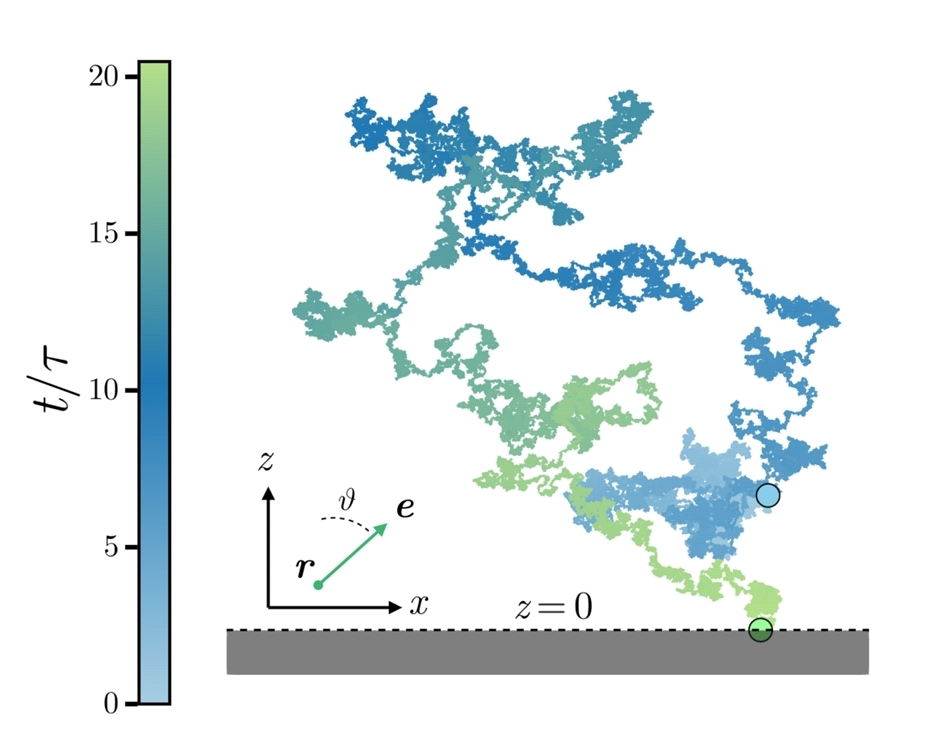
AA << study the first-passage-time (FPT) properties of active Brownian particles to reach an absorbing wall in two dimensions. Employing a perturbation approach (They) obtain exact analytical predictions for the survival and FPT distributions for small Péclet numbers, measuring the importance of self-propulsion relative to diffusion. >>

<< While randomly oriented active agents reach the wall faster than their passive counterpart, their initial orientation plays a crucial role in the FPT statistics. Using the median as a metric, (AA) quantify this anisotropy and find that it becomes more pronounced at distances where persistent active motion starts to dominate diffusion. >>️

Yanis Baouche, Magali Le Goff, et al. First-passage-time statistics of active Brownian particles: a perturbative approach. arXiv: 2503.05401v1 [cond-mat.soft]. Mar 7, 2025.

Also: particle, random, in https://www.inkgmr.net/kwrds.html 

Keywords: gst, particles, active particles, perturbation approach, randomness, stochasticity, stochastic resetting, rotational diffusion, anisotropy