Translate

Visualizzazione post con etichetta particle. Mostra tutti i post

mercoledì 29 ottobre 2025

# gst: coupling an elastic string to an active bath: the emergence of inverse damping.

<< ️The interaction between continuous media and particles is a central topic in much of modern physics, and this (AA) paper specifically addresses the transfer of persistence and activity between particles and waves. Indeed, setting up a nonequilibrium dynamics of continuous (field) degrees of freedom requires understanding how that arises from coupling with active matter degrees of freedom. >>

<< ️Within that program, (AA) have studied a system of fast-moving, overdamped, run-and-tumble particles moving on and interacting with a slower string modeled as a scalar Klein-Gordon field. Using time scale separation and weak coupling, (They) have derived an effective fluctuation dynamics for the field after integrating out the active bath. Akin to Landau (inverse) damping, the particles induce friction on the scalar field given by an explicit time correlation for bath observables. >>

<< ️Depending on the level of activity and persistence of the active particles (and their velocity distribution), this friction can be negative, leading to instability. This emergence of negative (linear) friction for an elastic string extends previous results where the probe is a slow inertial particle in an active medium, (..), except that the acceleration (creating transverse waves) is orthogonal to the active motion. >>

Aaron Beyen, Christian Maes, Ji-Hui Pei. Coupling an elastic string to an active bath: The emergence of inverse damping. arXiv: 2505.18665v2 [cond-mat.stat-mech]. Sep 1, 2025.

Phys. Rev. E 112, L042103. Oct 17, 2025.

Also: particle, waves, elastic, in https://www.inkgmr.net/kwrds.html 

Keywords: gst, particles, run-and-tumble particles, waves, elasticity, elastic strings, wave-particle interactions.

martedì 23 settembre 2025

# gst: extreme vertical drafts as drivers of Lagrangian dispersion in stably stratified turbulent flows.

<< ️The dispersion of Lagrangian particle pairs is a fundamental process in turbulence, with implications for mixing, transport, and the statistical properties of particles in geophysical and environmental flows. While classical theories describe pair dispersion through scaling laws related to energy cascades, extreme events in turbulent flows can significantly alter these dynamics. This is especially important in stratified flows, where intermittency manifests itself also as strong updrafts and downdrafts. >>

<< ️In this study, (AA) investigate the influence of extreme events on the relative dispersion of particle pairs in stably stratified turbulence. Using numerical simulations (They) analyze the statistical properties of pair separation across different regimes, and quantify deviations from classical Richardson scaling. (Their) results highlight the role of extreme drafts in accelerating dispersion. >>

Christian Reartes, Pablo D. Mininni, Raffaele Marino. Extreme vertical drafts as drivers of Lagrangian dispersion in stably stratified turbulent flows. arXiv: 2509.12962v1 [physics.flu-dyn]. Sep 16, 2025.

Also: turbulence, intermittency, chaos, transition, particle, in https://www.inkgmr.net/kwrds.html 

Keywords: gst, turbulence, stratified turbulence,  intermittency, chaos, transitions, particles, extreme events, stratified flows, accelerating dispersion.

sabato 13 settembre 2025

# gst: intensity landscapes in elliptic and oval billiards with a circular absorbing region.


<< ️Billiard models of single particles moving freely in two-dimensional regions enclosed by hard walls have long provided ideal toy models for the investigation of dynamical systems and chaos. Recently, billiards with (semi)permeable walls and internal holes have been used to study open systems. >>

<< ️Here (AA) introduce a billiard model containing an internal region with partial absorption. The absorption does not change the trajectories but instead reduces an intensity variable associated with each trajectory. The value of the intensity can be tracked as a function of the initial configuration and the number of reflections from the wall and depicted in intensity landscapes over the Poincaré phase space. >>

<< ️This is similar in spirit to escape time diagrams that are often considered in dynamical systems with holes.  >>

<< ️(AA) analyze the resulting intensity landscapes for three different geometries: a circular, elliptic, and oval billiard, respectively, all with a centrally placed circular absorbing region. The intensity landscapes feature increasingly more complex structures, organized around the sets of points in phase space that intersect the absorbing region in a given iteration, which (They) study in some detail. On top of these, the intensity landscapes are enriched by effects arising from multiple absorption events for a given trajectory. >>

Katherine Holmes, Joseph Hall, Eva-Maria Graefe. Intensity landscapes in elliptic and oval billiards with a circular absorbing region. Phys. Rev. E 112, 034202. Sep 2, 2025.

Also: billiard, particle, escape, in https://www.inkgmr.net/kwrds.html 

Keywords: gst, billiard, particle, escape.

venerdì 12 settembre 2025

# gst: shock waves in classical dust collapse.

<< ️During gravitational collapse of dust in spherical symmetry, matter particles may collide forming shell crossing singularities (SCSs) at which the Einstein equations become indeterminate. >>

<< ️(AA) show that in the case of marginally bound dust collapse, there is a unique evolution beyond SCSs such that a propagating shock wave forms, the metric remains continuous, and the stress-energy tensor dynamically becomes that of a thin shell. (They) give numerical simulations that exhibit this result. >>

Viqar Husain, Hassan Mehmood. Shock waves in classical dust collapse. Phys. Rev. Research 7, 033215. Sep 3, 2025.

arXiv: 2504.14883v1 [gr-qc]. Apr 21, 2025.

Also: particle, singularity, collapse, waves, in https://www.inkgmr.net/kwrds.html 

Keywords: gst, particles, singularity, shell crossing singularities, waves, shock waves, gravitational waves, collapse, dust collapse, gravitational collapse. 

martedì 29 luglio 2025

# gst: apropos of monopoles with internal degrees of freedom

AA << ️consider a class of spontaneously broken SU(2) gauge theories with adjoint scalar and look for exact magnetic monopole solutions in the Bogomol'nyi--Prasad--Sommerfield (BPS) limit. (They) find that some of the resulting solutions exhibit a new internal degree of freedom (a moduli space parameter) that controls the energy density profile of the monopole while keeping the total energy (mass) constant. >>
Petr Beneš, Filip Blaschke. Magnetic monopoles with an internal degree of freedom. arXiv: 2507.13879v1 [hep-th]. Jul 18, 2025.

Also: particle, fracture, crack, in https://www.inkgmr.net/kwrds.html 

Keywords: gst, particles, magnetic particles, monopoles, degrees of freedom, spontaneous break, fracture, crack

giovedì 24 luglio 2025

# gst: apropos of drift surfaces, e.g., banana orbits, perturbed toroidal vortices display internal simply connected topology.


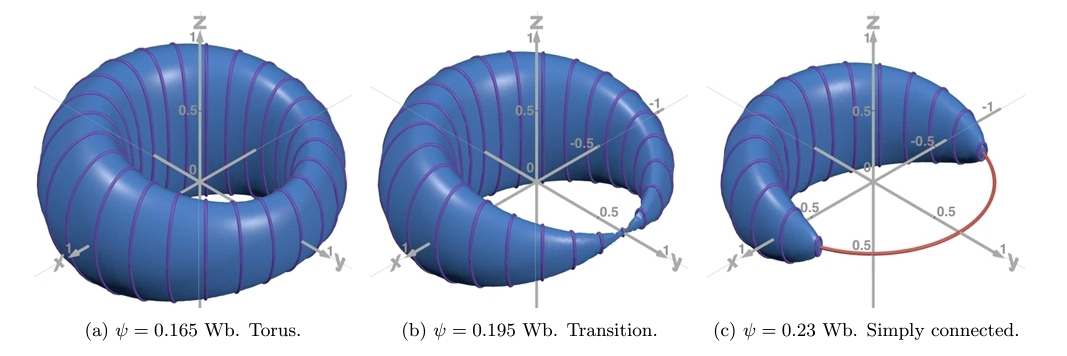
<< ️This (AA) work shows that the interiors of perturbed zero-helicity vortices display simply connected topology with a crescent-shaped boundary. Flux surfaces in fluid and magnetic vortices were explored analytically, while particle trajectories in the context of plasma confinement were examined numerically, demonstrating the existence of both toroidal and simply connected topologies. >>

<< ️Numerical simulations of particle trajectories were conducted in the context of fusion confinement to calculate particle trajectories in a perturbed Soloviev equilibrium where simply connected flux surfaces were observed. The orbits often displayed crescent shapes, yet showed several marked differences from the flux surfaces, e.g., gyro-radii of size comparable to the crescent diameter, asymmetric crescents, connections between well-separated crescent tips, and possibly toroidal shapes, with an inversion of the roles played by the major and minor axes. >>

<< ️This new topology appears for perturbations in a broad class, with amplitudes and spatial variance allowed to be arbitrarily small. A corollary of this work proves the closedness of field lines under odd-parity perturbations of zero-helicity vortices. >>

Taosif Ahsan, Samuel A. Cohen, Alan H. Glasser. Perturbed Toroidal Vortices Display Internal Simply Connected Topology. arXiv: 2507.04596v1 [math-ph]. Jul 7, 2025. 

Also: vortex, particle, transition, in https://www.inkgmr.net/kwrds.html 

Keywords: gst, vortex, particle, transition, foliated torus, toroidal vortices, banana orbits. 

martedì 29 aprile 2025

# gst: homology for structural characterization in disordered systems

<< Local and global structural characterizations emphasize different aspects of materials, with the former focusing on microscopic features like coordination environment, short-range order, bond angles and lengths, and the latter on macroscopic features like long-range order, phase structure, lattice constants, and overall symmetry. In conclusion, local characterization focuses on the environment and structure of individual particles or regions, while global characterization refers to the overall topology or geometry of the material. >>

AA << propose a unified framework based on persistent homology to characterize both local and global structures in disordered systems. It can simultaneously generate local and global descriptors using the same algorithm and data structure, and has been shown to be highly effective and interpretable in predicting particle rearrangements and classifying global phases. >>

AA also << define a nonparametric metric, the separation index, (that) establishes a connection between particle environments and the global phase structure. >>

An Wang, Li Zou. Persistent homology for structural characterization in disordered systems. Phys. Rev. E 111, 045306. Apr 17, 2025.

Also: particle, disorder, in https://www.inkgmr.net/kwrds.html 

Keywords: gst, particle, disorder, homology


giovedì 10 aprile 2025

# gst: multiparticle dispersion in rotating-stratified turbulent flows (when stratification increases turbulent fluctuations may not be weaker)

AA << study the relative movement of groups of two (pairs) and four (tetrahedra) Lagrangian particles using direct numerical simulations of the stably stratified Boussinsesq equations, with Brunt-Väisälä frequency 𝑁 and Coriolis parameter 𝑓. >>

<< In all cases considered, (AA) demonstrate that the relative particle motion differs depending on whether dispersion is considered forward or backward in time, although the asymmetry becomes less pronounced when stratification and rotation increase. On the other hand, the strong fluctuations in the dispersion between two particles become more extreme when 𝑁 and 𝑓  increase. (They) also find evidence for the formation of shear layers, which become more pronounced as 𝑁 and 𝑓  become larger. Finally, (They) show that the irreversibility on the dispersion of a set of particles initially forming a regular tetrahedron becomes weaker when the influence of stratification and rotation increases, a property that (They) relate to that of the perceived rate-of-strain tensor. >>️

<< Unexpectedly, (AA) observe that the higher moments of particle separation, in particular the normalized fourth-order central moment of the separation (the kurtosis Kr) is an increasing function of stratification and rotation. This is surprising, as when stratification increases the turbulent fluctuations are expected to be weaker, (..) >>️

Sebastian Gallon, Fabio Feraco, et al. Multiparticle dispersion in rotating-stratified turbulent flows. Phys. Rev. Fluids 10, 034605. Mar 17, 2025. 

Also: particle, turbulence, disorder & fluctuations, in https://www.inkgmr.net/kwrds.html 

Keywords: gst, particle, turbulence, disorder, fluctuations

mercoledì 19 febbraio 2025

# gst: alignment-induced self-organization of autonomously steering microswimmers: turbulence, clusters, vortices, and jets.


<< Microorganisms can sense their environment and adapt their movement accordingly, which gives rise to a multitude of collective phenomena, including active turbulence and bioconvection. In fluid environments, collective self-organization is governed by hydrodynamic interactions. >>

<< By large-scale mesoscale hydrodynamics simulations, (AA) study the collective motion of polar microswimmers, which align their propulsion direction by hydrodynamic steering with that of their neighbors. The simulations of the employed squirmer model reveal a distinct dependence on the type of microswimmer—puller or pusher—flow field. No global polar alignment emerges in both cases. Instead, the collective motion of pushers is characterized by active turbulence, with nearly homogeneous density and a Gaussian velocity distribution; strong self-steering enhances the local coherent movement of microswimmers and leads to local fluid-flow speeds much larger than the individual swim speed. >>

<< Pullers exhibit a strong tendency for clustering and display velocity and vorticity distributions with fat exponential tails; their dynamics is chaotic, with a temporal appearance of vortex rings and fluid jets. >>

AA << results show that the collective behavior of autonomously steering microswimmers displays a rich variety of dynamic self-organized structures. >>

Segun Goh, Elmar Westphal, et al. Alignment-induced self-organization of autonomously steering microswimmers: Turbulence, clusters, vortices, and jets. Phys. Rev. Research 7, 013142. Feb 7, 2025. 

Also: swim, microswimmer, particle, turbulencechaos, noise, in https://www.inkgmr.net/kwrds.html 

Keywords: gst, swim, swimmer, microswimmers, particle, turbulence, chaos, noise


venerdì 24 gennaio 2025

# gst: scattered waves fuel emergent activity.


<< Active matter taps into external energy sources to power its own processes. Systems of passive particles ordinarily lack this capacity, but can become active if the constituent particles interact with each other nonreciprocally. By reformulating the theory of classical wave-matter interactions, (AA) demonstrate that interactions mediated by scattered waves generally are not constrained by Newton's third law. The resulting center-of-mass forces propel clusters of scatterers, enabling them to extract energy from the wave and rendering them active. This form of activity is an emergent property of the scatterers' state of organization and can arise in any system where mobile objects scatter waves. Emergent activity flips the script on conventional active matter whose nonreciprocity emerges from its activity, and not the other way around. >>

AA << combine theory, experiment, and simulation to illustrate how emergent activity arises in wave-matter composite systems and to explore the phenomenology of emergent activity in experimentally accessible models. These preliminary studies suggest that heterogeneity is a singular perturbation to the dynamics of wave-matter composite systems, and induces emergent activity under all but the most limited circumstances. >>️

Ella M. King, Mia C. Morrell, et al. Scattered waves fuel emergent activity. Phys. Rev. Research 7, 013055. Jan 15, 2025

Also: waves, particle, self-assembly, in https://www.inkgmr.net/kwrds.html 

Keywords: gst, waves, particle, self-assembly


sabato 18 gennaio 2025

# gst: traveling strings of active dipolar colloids.

AA << study an intriguing new type of self-assembled active colloidal polymer system in 3D. It is obtained from a suspension of Janus particles in an electric field that induces parallel dipoles in the particles as well as self-propulsion in the plane perpendicular to the field. >>

<< At low volume fractions, in experiment, the particles self-assemble into 3D columns that are self-propelled in 2D. Explicit numerical simulations combining dipolar interactions and active self-propulsion find an activity dependent transition to a string phase by increasing dipole strength. >>

AA << classify the collective dynamics of strings as a function of rotational and translational diffusion. (..) (They) also discover long range correlations of the fluctuations along the string contour that grow with the active persistence time, a purely active effect that disappears in the thermal limit. >>

Xichen Chao, Katherine Skipper, et al. Traveling Strings of Active Dipolar Colloids. Phys. Rev. Lett. 134, 018302. Jan 6, 2025. 

Also: particle, colloids, self-assembly, transition, in https://www.inkgmr.net/kwrds.html 

Keywords: gst, particle, colloids, self-assembly, Janus, polymers, strings, transition


lunedì 2 dicembre 2024

# gst: apropos of diffusive anomalies, anomalous diffusion of active Brownian particles in responsive elastic gels.

Here, AA << examine via extensive computer simulations the dynamics of SPPs (self-propelled particles) in deformable gellike structures responsive to thermal fluctuations. (AA) treat tracer particles comparable to and larger than the mesh size of the gel. (They) observe distinct trapping events of active tracers at relatively short times, leading to subdiffusion; it is followed by an escape from meshwork-induced traps due to the flexibility of the network, resulting in superdiffusion. >>

AA << thus find crossovers between different transport regimes. (They) also find pronounced nonergodicity in the dynamics of SPPs and non-Gaussianity at intermediate times. The distributions of trapping times of the tracers escaping from “cages” in (..)  quasiperiodic gel often reveal the existence of two distinct timescales in the dynamics. At high activity of the tracers these timescales become comparable. >>

<< Furthermore, (AA) find that the mean waiting time exhibits a power-law dependence on the activity of SPPs (in terms of their Péclet number). (Their) results additionally showcase both exponential and nonexponential trapping events at high activities. Extensions of this setup are possible, with the factors such as anisotropy of the particles, different topologies of the gel network, and various interactions between the particles (also of a nonlocal nature) to be considered. >>

Koushik Goswami, Andrey G. Cherstvy, et al. Anomalous diffusion of active Brownian particles in responsive elastic gels: Nonergodicity, non-Gaussianity, and distributions of trapping times. Phys. Rev. E 110, 044609. Oct 29, 2024.

Also: particle, random, escape, network, in https://www.inkgmr.net/kwrds.html 

Keywords: gst, particle, random, random walks, escape, network


sabato 19 ottobre 2024

# gst: underdamped and overdamped scenarios of a one-dimensional inertial run-and-tumble particle


AA << study the nonequilibrium stationary state of a one-dimensional inertial run-and-tumble particle  trapped in a harmonic potential. (AA) find that the presence of inertia leads to two distinct dynamical scenarios, namely, overdamped and underdamped, characterized by the relative strength of the viscous and the trap timescales. >>
<< in the underdamped regime, both the position and velocity undergo transitions from a novel multipeaked structure in the strongly active limit to a single-peaked Gaussian-like distribution in the passive limit. On the other hand, in the overdamped scenario, the position distribution shows a transition from a U shape to a dome shape, as activity is decreased. Interestingly, the velocity distribution in the overdamped scenario shows two transitions—from a single-peaked shape with an algebraic divergence at the origin in the strongly active regime to a double-peaked one in the moderately active regime to a dome-shaped one in the passive regime. >>️

Debraj Dutta, Anupam Kundu, et al. Harmonically trapped inertial run-and-tumble particle in one dimension. Phys. Rev. E 110, 044107. Oct 4, 2024. 

Also: particle, transition, in https://www.inkgmr.net/kwrds.html 

Keywords: gst, particle, transition 


giovedì 10 ottobre 2024

# gst: apropos of breaking mechanisms, crack of a floating particle raft caused by waves.

<< When particles of a few tens of microns are spread on the surface of water, they aggregate under the action of capillary forces and form a thin floating membrane, a particle raft. >>

<< For a sufficiently strong wave amplitude, the raft breaks up progressively by developing cracks and producing fragments whose sizes decrease on a timescale long compared to the period of the wave. (AA)  characterize the breaking mechanisms.  >>️️

<< The visual appearance of the fragments distributed in size and surrounded by open water bears a notable resemblance to the floes produced by the fracturing of sea ice by waves in the polar oceans. Fragmentation concepts and morphological tools built for sea ice floes can be applied to (AA) macroscopic analog, on which the entire dynamic evolution is accessible. However, the mechanics of the two systems differ, as (AA) particle raft breaks due to the viscous stresses, whereas the sea ice fractures due to its bending by the waves. >>️

Louis Saddier, Ambre Palotai, et al. Breaking of a floating particle raft by water waves. Phys. Rev. Fluids 9, 094302. Sep 27, 2024.

Also: 'crack', 'particle', in  https://www.inkgmr.net/kwrds.html 


Also: 'zattera' (quasi-stochastic poetry) in  https://inkpi.blogspot.com/search?q=zattera  'randa' (quasi-stochastic poetry) in https://inkpi.blogspot.com/search?q=randa

Keywords: gst, crack, break, particle, raft, particle raft


martedì 8 ottobre 2024

# gst: apropos of inertial particles, they dispersion in turbulent canopy flows with buoyant and nonbuoyant plumes.

<< In an idealized “wind-driven” model system, (AA) consider the impact of plume buoyancy, plume momentum, and canopy turbulence on the downstream transport of particles in the wake of a canopy, and in particular the mean and standard deviation of the distribution of landing sites. >>

<< In a first set of experiments, particles were released with a fixed starting elevation above the plumes' upper boundaries, such that the particles were not lofted by the plume. In these cases, observations suggest that plumes have a role in extending particles' streamwise transport by delaying their downward transport. The plumes also have a strong role in increasing absolute dispersion of the particles, although less so when dispersion is normalized by distance traveled. While canopy turbulence alone significantly increases particle dispersion, in the presence of the plume its impact is more limited. Canopy turbulence was also found to cause shorter mean landing positions. >>

<< In a second set of experiments, particles were released at the plume source/outlet such that their initial vertical momentum was provided by the plume's momentum and buoyancy. In these cases, the impact of canopy turbulence on particle transport is observed more distinctly. The canopy coherent structures introduce a mechanical instability to the plume, which manifests as vertical oscillatory motions that lead to variability in the particles' initial conditions and, therefore, trajectories. This leads to particles settling at both shorter and longer downstream distances. >>

Hayoon Chung, Laura K. C. Sunberg, et al. Dispersion of inertial particles in turbulent canopy flows with buoyant and nonbuoyant plumes. Phys. Rev. Fluids 9, 093801. Sept 25, 2024.

Also: particle, turbulence, in https://www.inkgmr.net/kwrds.html 

Keywords: gst, particle, turbulence


martedì 14 maggio 2024

# gst: quantum jamming on the macroscopic scale


 << In the presence of kinetic constraints, quasiparticles describing the behavior of an ordered arrangement of quantum spins can get “stuck” as their density increases. Because of its similarity to the formation of amorphous solids, this situation can be interpreted as the quantum analog of jamming. Jammed states are intrinsically unstable and small perturbations produce unusual nonequilibrium dynamics. >> 

 AA << show that quantum jamming is a mechanism to make microscopic phenomena visible at a macroscopic scale: A single impurity produces a permanent change in the state, and a few impurities leave an imprint of their scattering properties and bound states. >> 

Maurizio Fagotti. Quantum Jamming Brings Quantum Mechanics to Macroscopic Scales. Phys. Rev. X 14, 021015. Apr 23, 2024.

Also: particle, jamming, in https://www.inkgmr.net/kwrds.html 

Keywords: gst, particle, jamming


martedì 16 aprile 2024

# gst: apropos of collective behaviors, a visual model to reproduces swarming, schooling, and milling.


<< Animal collective behavior is often modeled with self-propelled particles, assuming each individual has “omniscient” knowledge of its neighbors. Yet, neighbors may be hidden from view and we do not know the effect of this information loss. To address this question, (AA) propose a visual model of collective behavior where each particle moves according to bioplausible visual cues, in particular the optic flow. This visual model successfully reproduces three classical collective behaviors: swarming (no orientational order), schooling (high orientational order), and milling (the group coordinately swirls in a circular pattern). >>️

Diego Castro, Franck Ruffier, Christophe Eloy. Modeling collective behaviors from optic flow and retinal cues. Phys. Rev. Research 6, 023016. Apr 4, 2024. 

Also: swarm, flockbehav, particle, in https://www.inkgmr.net/kwrds.html 

Keywords: gst, swarming, flocking, behavior, particle, self-propelled particles


lunedì 8 aprile 2024

# gst: apropos of evaporation, puncturing of active drops

<< By virtue of self-propulsion, active particles impart intricate stresses to the background fluids. (..) this active stress can be utilized to greatly control evaporation dynamics of active drops. >>

AA << discover a new phenomenon of puncturing of the active drops, where the air-liquid interface of the drop undergoes spontaneous tearing and there occurs a formation of a new three-phase contact line due to the liquid-air interface hitting the liquid-solid interface through evaporation-driven mass loss. Post puncturing, (AA) see an inside-out evaporation of the drop, where the new contact line sweeps towards the pinned outer contact line of the drops, contrasting regular drops that straightaway shrink to zero volume with self-similar shape. >>

<< Furthermore, (..) the activity inside the drops can manipulate the three-phase contact-line dynamics, which for contractile drops can result in an up to 50% enhanced lifetime of the drop and 33% quicker evaporation for extensile drops. By analyzing the flux distribution inside the drop, (AA) gain insights on nonintuitive deposition patterns (e.g., ring galaxy type deposits that demonstrate controllable spatial gradients in the concentrations of the deposited particles) of active particles, which are oftentimes biological substances or bimetallic nanoparticles of interest. >>

Ghansham Rajendrasingh Chandel, Vishal Sankar Sivasankar, Siddhartha Das. Evaporation of active drops: Puncturing drops and particle deposits of ring galaxy patterns. Phys. Rev. Fluids 9, 033603. Mar 27, 2024. 

Also: drop, particle, evaporation, transition, in https://www.inkgmr.net/kwrds.html 

Keywords: gst, drop, particle, evaporation, transition, drop interactions, droplet, droploid


venerdì 23 febbraio 2024

# gst: soft and stiff modes in colloidal particle networks

<< Floppy microscale spring networks are widely studied in theory and simulations, but no well-controlled experimental system currently exists. >> 

AA << show that square lattices consisting of colloid-supported lipid bilayers functionalized with DNA linkers act as microscale floppy spring networks. (AA) extract their normal modes by inverting the particle displacement correlation matrix, showing the emergence of a spectrum of soft modes with low effective stiffness in addition to stiff modes that derive from linker interactions. >>

<< Evaluation of the softest mode, a uniform shear mode, reveals that shear stiffness decreases with lattice size. >>

 AA << results reveal the importance of entropic steric effects. >>
Julio Melio, Silke E. Henkes, Daniela J. Kraft. Soft and Stiff Normal Modes in Floppy Colloidal Square Lattices. Phys. Rev. Lett. 132, 078202. Feb 14, 2024. 

Also: particle, nano, colloids, network, in https://www.inkgmr.net/kwrds.html

Keywords: gst, particle, nano, colloids, network, colloidal network


sabato 3 febbraio 2024

# gst: transitions in disordered medium.

AA << study computationally the dynamics of forced, Brownian particles through a disordered system. As the concentration of mobile particles and/or fixed obstacles increase, (AA) characterize the different regimes of flow and address how clogging develops. >>️

AA << show that clogging is preceded by a wide region of anomalous transport, characterized by a power law decay of intermittent bursts. (..) this abnormal flow region is characterized by a coexistence between mobile and arrested particles, and their relative populations change smoothly as clogging is approached. >>
Sergi G. Leyva, Ignacio Pagonabarraga. Clogging transition and anomalous transport in driven suspensions in a disordered medium. Phys. Rev. E 109, 014618. Jan 31, 2024.


Also: transition, particledisorder, in https://www.inkgmr.net/kwrds.html

Keywords: gst, transition, particle, disorder