Translate

Visualizzazione dei post in ordine di data per la query billiard. Ordina per pertinenza Mostra tutti i post

domenica 26 ottobre 2025

# gst: transition to chaos with conical billiards.


<< ️In this paper, (AA) introduced and extensively investigated dynamical billiards on the surface of a cone with a tilted base. Upon varying the cone angle β, corresponding to a deficit angle 
2πχ = 2π(1 − sin(β)), and tilt angle γ, (They) identified three distinct types of trajectories with associated Poincaré map for conical billiards: rim, hourglass, and mixed. >>

<< ️Region I, where Poincaré space consists of rim, hourglass, and mixed trajectories; Region IIB, where Poincaré space consists of only hourglass and mixed trajectories; and Region IIA, in which (They) find choices of γ and χ for which almost all trajectories are strongly mixing. (..) (AA) also developed a scheme for identifying strongly mixing trajectories. >>

<< ️Furthermore, (They) were able to show that a dynamical billiard on a surface with exclusively convex and positive Gaussian curvature in three dimensions can still exhibit ergodic behavior in certain parameter regimes. >>

<< ️A particularly intriguing feature of this system is that by tuning χ and γ, nearly all points in (θ,ϕ) Poincaré space describing conical line segments in between bounces can be placed at the edge between chaotic and integrable dynamics. Thus this work highlights the potential of conical billiards as a model system for exploring intriguing problems inspired by neural networks at the “edge of chaos”. >>

Lara Braverman, David R. Nelson. Transition to chaos with conical billiards. arXiv: 2508.02786v1 [nlin.CD]. Aug 4, 2025. 
Phys. Rev. E 112, 044221. Oct 21, 2025.

Also: billiard, chaos, transition, in https://www.inkgmr.net/kwrds.html 

Keywords: gst, billiards, conical billiard, chaos, transitions, neural networks

sabato 18 ottobre 2025

# gst: apropos of waves that escape trapping; on internal wave whispering gallery modes in channels and critical-slope wave attractors.

<< ️Internal waves are an important feature of stratified fluids, both in oceanic and lake basins and in other settings. Many works have been published on the generic feature of internal wave trapping onto planar wave attractors and super-attractors in 2D & 3D and the exceptional class of standing global internal wave modes. >>

<< ️However, most of these works did not deal with waves that escape trapping. By using continuous symmetries (AA) analytically prove the existence of internal wave Whispering Gallery Modes (WGMs), internal waves that propagate continuously without getting trapped by attractors. WGMs neutral stability with respect to different perturbations enable whispering gallery beams, a continuum of rays propagating together coherently. The systems' continuous symmetries also enable projection onto 2D planes that yield effective 2D billiards preserving the original dynamics. >>

<< ️By examining rays deviating from these WGMs in parabolic channels (They) discover a new type of wave attractor which is located along the channel instead of across it as in previous works. This new wave attractor leads to a re-understanding of WGMs as sitting at the border between the two basins of attraction. >>

<< ️Finally, both critical-slope wave attractors and whispering gallery beams are used to propose explanations for along-channel energy fluxes in submarine canyons and tidal energy intensification near critical slopes. >>

Nimrod Bratspiess, Eyal Heifetz, Leo R. M. Maas. On internal wave whispering gallery modes in channels and critical-slope wave attractors. arXiv: 2510.07218v1 [physics.flu-dyn]. Oct 8, 2025.

Also: waves, billiard, in https://www.inkgmr.net/kwrds.html 

Keywords: gst, waves, internal waves, internal wave whispering gallery modes (WGMs), wave attractors, basins of attraction, billiards.

sabato 13 settembre 2025

# gst: intensity landscapes in elliptic and oval billiards with a circular absorbing region.


<< ️Billiard models of single particles moving freely in two-dimensional regions enclosed by hard walls have long provided ideal toy models for the investigation of dynamical systems and chaos. Recently, billiards with (semi)permeable walls and internal holes have been used to study open systems. >>

<< ️Here (AA) introduce a billiard model containing an internal region with partial absorption. The absorption does not change the trajectories but instead reduces an intensity variable associated with each trajectory. The value of the intensity can be tracked as a function of the initial configuration and the number of reflections from the wall and depicted in intensity landscapes over the Poincaré phase space. >>

<< ️This is similar in spirit to escape time diagrams that are often considered in dynamical systems with holes.  >>

<< ️(AA) analyze the resulting intensity landscapes for three different geometries: a circular, elliptic, and oval billiard, respectively, all with a centrally placed circular absorbing region. The intensity landscapes feature increasingly more complex structures, organized around the sets of points in phase space that intersect the absorbing region in a given iteration, which (They) study in some detail. On top of these, the intensity landscapes are enriched by effects arising from multiple absorption events for a given trajectory. >>

Katherine Holmes, Joseph Hall, Eva-Maria Graefe. Intensity landscapes in elliptic and oval billiards with a circular absorbing region. Phys. Rev. E 112, 034202. Sep 2, 2025.

Also: billiard, particle, escape, in https://www.inkgmr.net/kwrds.html 

Keywords: gst, billiard, particle, escape.

lunedì 8 settembre 2025

# gst: a journey into billiard systems

<< ️Have you ever played or watched a game of pool? If so, you have already seen a billiard system in action. In mathematics and physics, a billiard system describes a ball that moves in straight lines and bounces off walls. Despite these simple rules, billiard systems can produce remarkably rich behaviors: some table shapes generate regular, periodic patterns, while others give rise to complete chaos. >>

<< Scientists also study what happens when (They) shrink the ball down to the size of an electron to a world where quantum effects take over and the familiar reflection rules no longer apply. >>

<< ️In this article, (AA) discuss billiard systems in their many forms and show how such a simple setup can reveal fundamental insights into the behavior of nature at both classical and quantum scales. >>

Weiqi Chu, Matthew Dobson. What Do Bouncing Balls Tell Us About the Universe? A Journey into Billiard Systems. arXiv: 2508.18519v1 [math.DS]. Aug 25, 2025.

Also: billiard, transition, chaos, in https://www.inkgmr.net/kwrds.html 

Keywords: gst, billiard, transition, chaos.

martedì 19 agosto 2025

# gst: hidden qu-classical correspondence in chaotic billiards revealed by mutual information.


<< ️Avoided level crossings, commonly associated with quantum chaos, are typically interpreted as signatures of eigenstate hybridization and spatial delocalization, often viewed as ergodic spreading. >>

<< ️(AA) show that, contrary to this expectation, increasing chaos in quantum billiards enhances mutual information between conjugate phase space variables, revealing nontrivial correlations. Using an information-theoretic decomposition of eigenstate entropy, (They) demonstrate that spatial delocalization may coincide with increased mutual information between position and momentum. >>

<< These correlations track classical invariant structures in phase space and persist beyond the semiclassical regime, suggesting a robust information-theoretic manifestation of quantum-classical correspondence. >>

Kyu-Won Park, Soojoon Lee, Kabgyun Jeong. Hidden quantum-classical correspondence in chaotic billiards revealed by mutual information. Phys. Rev. E 112, 024209. Aug 13, 2025.

arXiv:2505.08205v1 [nlin.CD]. May 13, 2025.

Also: billiard, chaos, waves, transition, in https://www.inkgmr.net/kwrds.html 

Keywords: gst, billiard, chaos, qu-chaos, waves, quantum-to-classical transition

martedì 12 agosto 2025

# gst: transition to chaos with conical billiards.


<< ️(AA) adapt ideas from geometrical optics and classical billiard dynamics to consider particle trajectories with constant velocity on a cone with specular reflections off an elliptical boundary formed by the intersection with a tilted plane, with tilt angle γ. >>

<< ️(They) explore the dynamics as a function of γ and the cone deficit angle χ that controls the sharpness of the apex, where a point source of positive Gaussian curvature is concentrated. >>

<<(AA) find regions of the (γ,χ) plane where, depending on the initial conditions, either (A) the trajectories sample the entire cone base and avoid the apex region; (B) sample only a portion of the base region while again avoiding the apex; or (C) sample the entire cone surface much more uniformly, suggestive of ergodicity. >>

<< ️The special case of an untilted cone displays only type A trajectories which form a ring caustic at the distance of closest approach to the apex. However, (They) observe an intricate transition to chaotic dynamics dominated by Type (C) trajectories for sufficiently large χ and γ. A Poincaré map that summarizes trajectories decomposed into the geodesic segments interrupted by specular reflections provides a powerful method for visualizing the transition to chaos. (AA) then analyze the similarities and differences of the path to chaos for conical billiards with other area-preserving conservative maps. >>

Lara Braverman, David R. Nelson. Transition to chaos with conical billiards. arXiv: 2508.02786v1 [nlin.CD]. Aug 4, 2025.

Also: billiard, particle, transition, chaos,  in https://www.inkgmr.net/kwrds.html 

Keywords: gst, billiard, particles, transitions, chaos. 

sabato 21 giugno 2025

# gst: a note on spinning billiards and chaos


AA << investigate the impact of internal degrees of freedom - specifically spin - on the classical dynamics of billiard systems. While traditional studies model billiards as point particles undergoing specular reflection, (AA) extend the paradigm by incorporating finite-size effects and angular momentum, introducing a dimensionless spin parameter that characterizes the moment of inertia. Using numerical simulations across circular, rectangular, stadium, and Sinai geometries, (AA) analyze the resulting trajectories and quantify chaos via the leading Lyapunov exponent. >>

<< Strikingly, (They) find that spin regularizes the dynamics even in geometries that are classically chaotic: for a wide range of α, the Lyapunov exponent vanishes at late times in the stadium and Sinai tables, signaling suppression of chaos. This effect is corroborated by phase space analysis showing non-exponential divergence of nearby trajectories. >>

AA << results suggest that internal structure can qualitatively alter the dynamical landscape of a system, potentially serving as a mechanism for chaos suppression in broader contexts. >>

Jacob S. Lund, Jeff Murugan, Jonathan P. Shock. A Note on Spinning Billiards and Chaos. arXiv: 2505.15335v1 [nlin.CD]. May 21, 2025.

Also: billiard, chaos, in https://www.inkgmr.net/kwrds.html 

Keywords: gst, billiard, spinning billiards, chaos.

venerdì 6 giugno 2025

# gst: symmetry breaking in time-dependent billiards.

AA << investigate symmetry breaking in a time-dependent billiard that undergoes a continuous phase transition when dissipation is introduced. The system presents unlimited velocity, and thus energy growth for the conservative dynamics. When inelastic collisions are introduced between the particle and the boundary, the velocity reaches a plateau after the crossover iteration. The system presents the expected behavior for this type of transition, including scale invariance, critical exponents related by scaling laws, and an order parameter approaching zero in the crossover iteration. >>

AA << analyze the velocity spectrum and its averages for dissipative and conservative dynamics. The transition point in velocity behavior caused by the physical limit of the boundary velocity and by the introduced dissipation coincides with the crossover interaction obtained from the Vrms (root mean sq V) curves. Additionally, (they) examine the velocity distributions, which lose their symmetry once the particle's velocity approaches the lower limit imposed by the boundary's motion and the system's control parameters. This distribution is also characterized analytically by an expression P(V,n), which attains a stationary state, with a well-defined upper bound, only in the dissipative case. >>

Anne Kétri Pasquinelli da Fonseca, Edson Denis Leonel. Symmetry breaking in time-dependent billiards. arXiv: 2505.20488v1 [nlin.CD]. May 26, 2025.

Also: billiard, transition, dissipation,  in https://www.inkgmr.net/kwrds.html 

Keywords: gst, billiard, particles, transitions, dissipation, symmetry breaking, inelastic collisions.

lunedì 12 maggio 2025

# gst: overcoming overly simplistic representations, chaos and regularity in an anisotropic soft squircle billiard.


<< A hard-wall billiard is a mathematical model describing the confinement of a free particle that collides specularly and instantaneously with boundaries and discontinuities. >>

<< Soft billiards are a generalization that includes a smooth boundary whose dynamics are governed by Hamiltonian equations and overcome overly simplistic representations. >>

AA << study the dynamical features of an anisotropic soft-wall squircle billiard. This curve is a geometric figure that seamlessly blends the angularity of a square with the smooth curves of a circle. (AA) characterize the billiard's emerging trajectories, exhibiting the onset of chaos and its alternation with regularity in the parameter space. (They) characterize the transition to chaos and the stabilization of the dynamics by revealing the nonlinearity of the parameters (squarness, ellipticity, and hardness) via the computation of Poincaré surfaces of section and the Lyapunov exponent across the parameter space. >>

AA << expect (Their) work to introduce a valuable tool to increase understanding of the onset of chaos in soft billiards. >>

A. González-Andrade, H. N. Núñez-Yépez, M. A. Bastarrachea-Magnani. Chaos and Regularity in an Anisotropic Soft Squircle Billiard. arXiv: 2504.20270v1 [nlin.CD]. Apr 28, 2025.

Also: billiard, chaos, particle, transition, in https://www.inkgmr.net/kwrds.html 

Keywords: gst, billiard, soft billiard, soft-wall squircle billiard, particles, smooth boundary,  specular collisions, transitions, chaos

sabato 5 aprile 2025

# gst: asymptotic scaling in a one-dimensional billiard

<< The emergence of power laws that govern the large-time dynamics of a one-dimensional billiard of N point particles is analysed. In the initial state, the resting particles are placed in the positive half-line x≥0 at equal distances. Their masses alternate between two distinct values. The dynamics is initialized by giving the leftmost particle a positive velocity. >>

<< Due to elastic inter-particle collisions the whole system gradually comes into motion, filling both right and left half-lines. As shown by S. Chakraborti, et al. (2022), an inherent feature of such a billiard is the emergence of two different modes: the shock wave that propagates in x≥0 and the splash region in x<0. >>

<< Moreover, the behaviour of the relevant observables is characterized by universal asymptotic power-law dependencies. In view of the finite size of the system and of finite observation times, these dependencies only start to acquire a universal character. To analyse them, (AA) set up molecular dynamics simulations using the concept of effective scaling exponents, familiar in the theory of continuous phase transitions. (They) present results for the effective exponents that govern the large-time behaviour of the shock-wave front, the number of collisions, the energies and momentum of different modes and analyse their tendency to approach corresponding universal values. >>️

<< A characteristic feature of the billiard problem (AA) have considered (..) is the lack of a priori randomness, neither in the distribution of masses nor in the inter-particle distances. Therefore, the emergence of the hydrodynamic power-law asymptotics– pointing to the stochastic background of the underlying process– may be interpreted as a kind of self-averaging in the system.  >>️

Taras Holovatch, Yuri Kozitsky, et al. Effective and asymptotic scaling in a one-dimensional billiard problem. arXiv: 2503.20476v1 [cond-mat.stat-mech]. Mar 26, 2025.

Also: billiard, random, in https://www.inkgmr.net/kwrds.html 

Keywords: gst, billiard, randomness 

mercoledì 12 febbraio 2025

# gst: chaotic billiards inside mixed curvatures


<< The boundary of a billiard system dictates its dynamics, which can be integrable, mixed, or fully chaotic. >>️

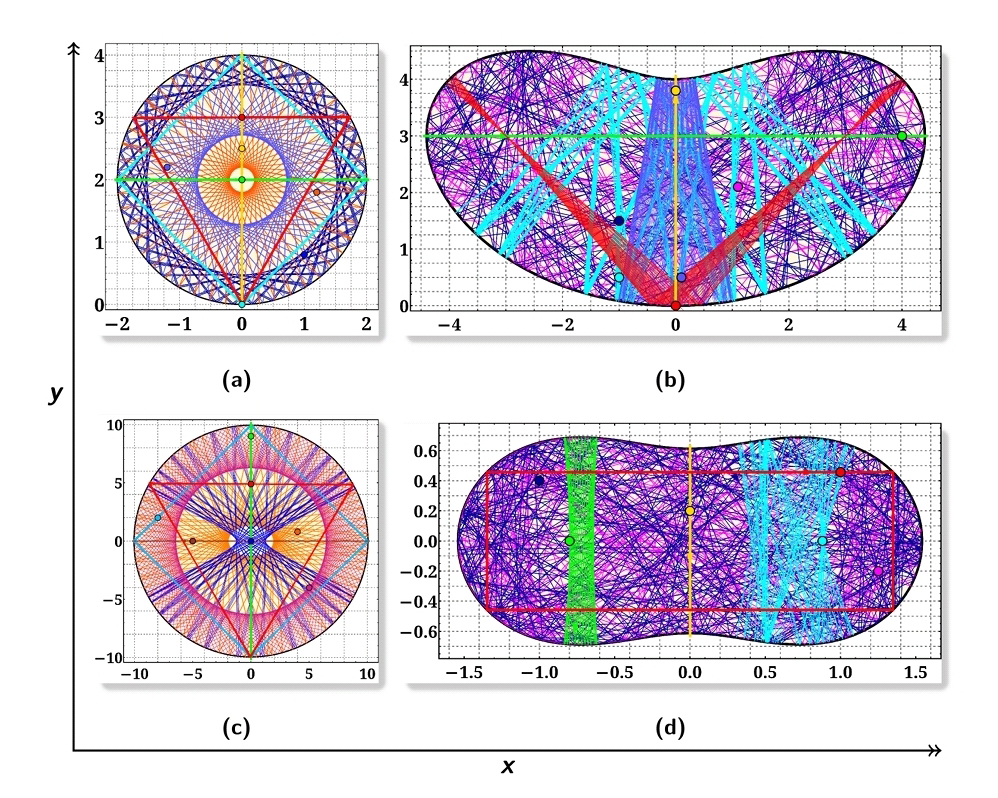
This AA study << introduces two such billiards: a bean-shaped billiard and a peanut-shaped billiard, the latter being a variant of Cassini ovals. Unlike traditional chaotic billiards, these systems incorporate both focusing and defocusing regions along their boundaries, with no neutral segments. >>

AA << examine both classical and quantum dynamics of these billiards and observe a strong alignment between the two perspectives. For classical analysis, the billiard flow diagram and billiard map reveal sensitivity to initial conditions, a hallmark of classical chaos. In the quantum domain, (AA) use nearest-neighbour spacing distribution and spectral complexity as statistical measures to characterise chaotic behaviour. >>

<< Both classical and quantum mechanical analysis are in firm agreement with each other. One of the most striking quantum phenomena (They) observe is the eigenfunction scarring (both scars and super-scars). Scarring phenomena serve as a rich visual manifestation of quantum and classical correspondence, and highlight quantum suppression chaos at a local level. >>

Pranaya Pratik Das, Tanmayee Patra, Biplab Ganguli. Manifestations of chaos in billiards: the role of mixed curvature. arXiv: 2501.08839v1 [nlin.CD]. Jan 15, 2025.

Also: billiard, chaos, in https://www.inkgmr.net/kwrds.html 

Keywords: gst, billiard, chaos


domenica 13 ottobre 2024

# gst: pensive billiards


AA << define a new class of plane billiards - the `pensive billiard' - in which the billiard ball travels along the boundary for some distance depending on the incidence angle before reflecting, while preserving the billiard rule of equality of the angles of incidence and reflection. This generalizes so called `puck billiards' (..), as well as a `vortex billiard', i.e. the motion of a point vortex dipole in 2D hydrodynamics on domains with boundary. (AA) prove the variational origin and invariance of a symplectic structure for pensive billiards, as well as study their properties including conditions for a twist map, the existence of periodic orbits, etc. (AA) also demonstrate the appearance of both the golden and silver ratios in the corresponding hydrodynamical vortex setting. Finally, (AA) introduce and describe basic properties of pensive outer billiards. >>

Theodore D. Drivas, Daniil Glukhovskiy, Boris Khesin. Pensive billiards, point vortices, and pucks. arXiv: 2408.03279v1 [math.DS]. Aug 6, 2024.


FonT: 'pensive billiard' evokes images in me that could inspire a series of quasi-stochastic short poems ( https://inkpi.blogspot.com ), but (for now) I will abstain.

Keywords: gst, billiards, pensive billiard, puck billiard, vortex billiard


martedì 21 giugno 2022

# gst: even tight-binding billiards could exhibit chaotic behaviors


<< Recent works have established universal entanglement properties and demonstrated validity of single-particle eigenstate thermalization in quantum-chaotic quadratic Hamiltonians. However, a common property of all quantum-chaotic quadratic Hamiltonians studied in this context so far is the presence of random terms that act as a source of disorder. >>

AA << introduce tight-binding billiards in two dimensions, which are described by non-interacting spinless fermions on a disorder-free square lattice subject to curved open boundaries. >>

They <<  show that many properties of tight-binding billiards match those of quantum-chaotic quadratic Hamiltonians (..) these properties indeed appear to be consistent with the emergence of quantum chaos in tight-binding billiards. This statement nevertheless needs to be taken with some care since there exist a sub-extensive (in lattice volume) set of single-particle eigenstates that are degenerate in the middle of the spectrum at zero energy (i.e., zero modes), for which the agreement with RMT (random matrix theory) predictions may not be established. >>

Iris Ulcakar, Lev Vidmar. Tight-binding billiards. arXiv:2206.07078v1 [cond-mat.stat-mech]. Jun 14, 2022. 


Also

keyword 'billiard' in FonT


keyword 'chaos' | 'chaotic' in Font


keyword 'caos' | 'caotico' in Notes (quasi-stochastic poetry)


keywords: gst, billiard, chaos, chaotic behavior


mercoledì 30 marzo 2022

# gst: solitary wave billiards

<<  In the present work (AA) introduce the concept of solitary wave billiards. I.e., instead of a point particle, (they) consider a solitary wave in an enclosed region and explore its collision with the boundaries and the resulting trajectories in cases which for particle billiards are known to be integrable and for cases that are known to be chaotic. A principal conclusion is that solitary wave billiards are generically found to be chaotic even in cases where the classical particle billiards are integrable. However, the degree of resulting chaoticity depends on the particle speed and on the properties of the potential. >>

J. Cuevas-Maraver, P.G. Kevrekidis, H. Zhang. Solitary wave billiards. arXiv: 2203.09489v1 [nlin.PS]. Mar 17, 2022. 


Also 

keyword 'chaos' | 'chaotic' in Font


keyword 'caos' | 'caotico' in Notes (quasi-stochastic poetry)


keyword | 'soliton' in FonT


keywords: gst, waves, solitons, billiard, chaos 


giovedì 8 luglio 2021

# gst: apropos of 'disordered interactions', localization and dissociation of bound states and mapping to chaotic billiards concerning two particles on a chain

AA << consider two particles hopping on a chain with a contact interaction between them. At strong interaction, there is a molecular bound state separated by a direct gap from a continuous band of atomic states. Introducing weak disorder in the interaction, the molecular state becomes Anderson localized (exponential localization of all energy eigenstates,). At stronger disorder, part of the molecular band delocalizes and dissociates due to its hybridization to the atomic band. (AA) characterize these different regimes by computing the density of states, the inverse participation ratio, the level-spacing statistics and the survival probability of an initially localized state.  >>️

<< The atomic band is best described as that of a rough billiard for a single particle on a square lattice that shows signatures of quantum chaos. In addition to typical ``chaotic states'', (AA) find states that are localized along only one direction. These ``separatrix states'' are more localized than chaotic states, and similar in this respect to scarred states, but their existence is due to the separatrix iso-energy line in the interaction-free dispersion relation, rather than to unstable periodic orbits. >> 

Hugo Perrin, Janos K. Asboth, et al.  Two particles on a chain with disordered interaction: Localization and dissociation of bound states and mapping to chaotic billiards. arXiv: 2106.09603v1. Jun 17, 2021. 


mercoledì 24 febbraio 2016

# s-gst: tracing nonlocal surreal behaviors ...

<< (..) particles at the quantum level can in fact be seen as behaving something like billiard balls rolling along a table, and not merely as the probabilistic smears that the standard interpretation of quantum mechanics suggests. But there’s a catch – the tracks the particles follow do not always behave as one would expect from “realistic” trajectories, but often in a fashion that has been termed “surrealistic” >>

http://www.cifar.ca/assets/researchers-demonstrate-quantum-surrealism/

Dylan H. Mahler, Lee Rozema, et al. Experimental nonlocal and surreal Bohmian trajectories. Science Advances  19 Feb 2016:
Vol. 2, no. 2, e1501466. DOI: 10.1126/science.1501466

http://dx.doi.org/10.1126/science.1501466

http://advances.sciencemag.org/content/2/2/e1501466.full-text.pdf+html