Translate

mercoledì 28 maggio 2025

# gst: defect-free and defective adaptations of crystalline sheets to stretching deformation.

<< The elastic response of the crystalline sheet to the stretching deformation in the form of wrinkles has been extensively investigated. In this work, (AA) extend this fundamental scientific question to the plastic regime by exploring the adaptations of crystalline sheets to the large uniaxial mechanical stretching. >>

AA << reveal the intermittent plastic shear deformations leading to the complete fracture of the sheets wrapping the cylinder. Specifically, systematic investigations of crystalline sheets of varying geometry show that the fracture processes can be classified into defect-free and defective categories depending on the emergence of topological defects. >>

AA << highlight the characteristic mechanical and geometric patterns in response to the large stretching deformation, including the shear-driven intermittent lattice tilting, the vortex structure in the displacement field, and the emergence of mobile and anchored dislocations as plastic excitations. >>

<< The effects of noise and initial lattice orientation on the plastic deformation of the stretched crystalline sheet are also discussed. These results advance our understanding of the atomic level on the irreversible plastic instabilities of two-dimensional crystals under large uniaxial stretching and may have potential practical implications in the precise engineering of structural instabilities in packings of covalently bonded particulate systems. >>

Ranzhi Sun, Zhenwei Yao. Defect-free and defective adaptations of crystalline sheets to stretching deformation. Phys. Rev. E 111, 055504. May 21, 2025.

Also: elastic, intermittency, noise, instability, vortex, defect, fracture, crack, in https://www.inkgmr.net/kwrds.html 

Keywords: gst, elastic, noise, intermittency, instability, vortex, defect, fracture, crack, stretch, deformation, wrinkles, tilting, plastic instabilities,  plastic excitations.

martedì 27 maggio 2025

# gst: dynamic expulsion of magnetic flux by vortices.

AA << study numerically the dynamical evolution of two different vorticity arrays with an initially uniform magnetic field in two-dimensional incompressible magnetohydrodynamics. (They)  concentrate particularly on the role of the strength of the background magnetic field, which is always assumed weak in the sense that its energy is much less than the kinetic energy of the vortical flows. >>

<< Within the context of a weak background field, (AA) are able to identify four distinct regimes. When the field is so weak that the back-reaction of the Lorentz force can be ignored (the kinematic regime), classical flux expulsion occurs. As the field strength is increased, the first signs of the dynamical influence of the small-scale field generated is in the disruption of vortex filaments, with flux expulsion still occurring in the vortex cores. A further increase in field strength leads to the regime of vortex disruption, in which the magnetic field is expelled, but is then of sufficient strength to disrupt or destroy the vortices. For yet stronger fields, even the large-scale field can be sufficiently strong to be dynamically active; flux expulsion is then prevented, and the field is dynamically active throughout the evolution. >>

<< Furthermore, in the case of a row of vortices, (AA) show that the orientation of the background field significantly influences the evolution, especially at higher field strengths. >>

Jonathan Tessier, Francis J. Poulin, David W. Hughes. Dynamic expulsion of magnetic flux by vortices. Phys. Rev. Fluids 10, 053702. May 19, 2025.

Also: vortex, transition, in https://www.inkgmr.net/kwrds.html 

Keywords: gst, vortex, transitions, flux expulsion, vortex disruption.

lunedì 26 maggio 2025

# gst: apropos of attractive-- repulsive potentials in free boundary movements, stochastic and deterministic dynamics of free boundaries atop turbulent convection

AA << present a low-dimensional model that explains the coupled dynamics of floating boundaries that interact with turbulent flows in thermal convection. >>

<< The model consists of Langevin-type, stochastic differential equations, which captures the deterministic and stochastic movements of boundaries shown in an earlier experiment J.-Q. Zhong et al. [Phys. Rev. E 75, 055301(R) (2007)]. From the displacement, speed, and acceleration of the boundaries, (They) construct the force potentials that underlie two distinct boundary-size-dependent behaviors. >>

<< Namely, (AA) find a repulsive potential (when the boundary is small) that leads to an oscillatory state and an attractive potential (when the boundary is large) that leads to a trapped state. >>

<< The boundary movements, which are subject to thermal convection underneath, also inform us of the mean speed and turbulent fluctuations of the flows. >>

Wen-Tao Wu, Jun Zhang, Jin-Qiang Zhong. Stochastic and deterministic dynamics of free boundaries atop turbulent convection. Phys. Rev. Fluids 10, 053504. May 9, 2025.

Also: disorder & fluctuations, turbulence, in https://www.inkgmr.net/kwrds.html 

Keywords: gst, convection, floating 
boundaries, turbulence, turbulent flows, turbulent fluctuations, disorder & fluctuations, trapped states

sabato 24 maggio 2025

# gst: apropos of absorbing targets, persistence exponents of self-interacting random walks


<< The persistence exponent, which characterizes the long-time decay of the survival probability of stochastic processes in the presence of an absorbing target, plays a key role in quantifying the dynamics of fluctuating systems. Determining this exponent for non-Markovian processes is known to be a difficult task, and exact results remain scarce despite sustained efforts. >> 

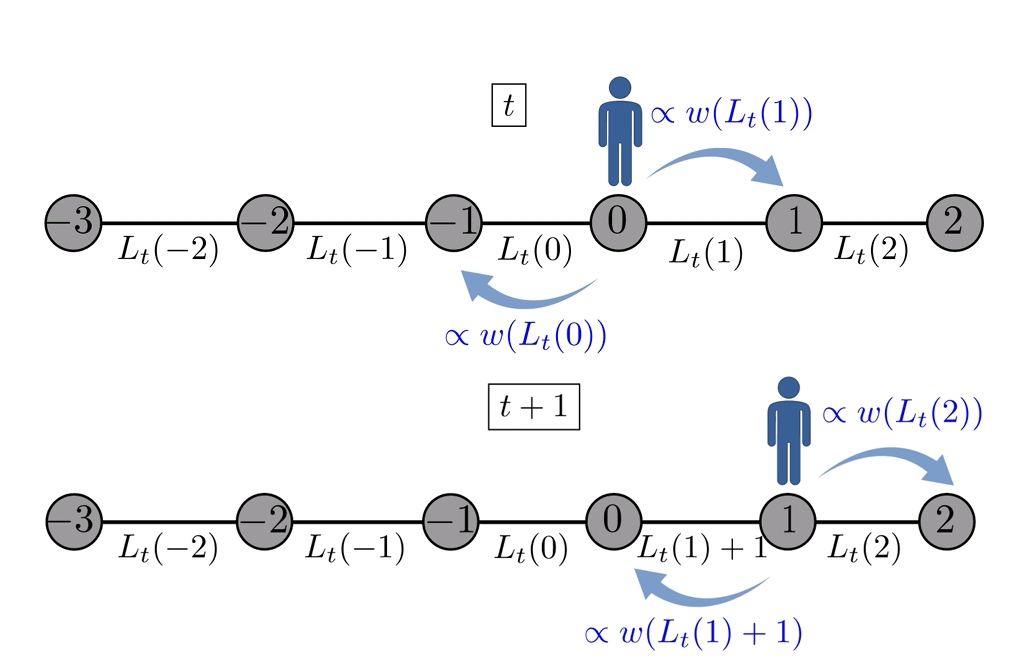
In their Letter, AA << consider the fundamental class of self-interacting random walks (SIRWs), which display long-range memory effects that result from the interaction of the random walker at time 𝑡 with the territory already visited at earlier times 𝑡′ <𝑡. (AA)  compute exactly the persistence exponent for all physically relevant SIRWs. As a byproduct, (They) also determine the splitting probability of these processes. >>

<< Besides their intrinsic theoretical interest, these results provide a quantitative characterization of the exploration process of SIRWs, which are involved in fields as diverse as foraging theory, cell biology, and nonreversible Monte Carlo methods. >>

J. Brémont, L. Régnier, et al. Persistence Exponents of Self-Interacting Random Walks. Phys. Rev. Lett. 134, 197103. May 16, 2025.

arXiv:2410.18699v1 [cond-mat.stat-mech]. 

Also: walk, walking, in https://www.inkgmr.net/kwrds.html 

Keywords: gst, walk, walking, self-interacting random walk, walker self-repulsion, walker self-attraction, stochasticity, absorbing targets.

venerdì 23 maggio 2025

# gst: toy model of turbulent shear flow using vortons.

AA << introduce a toy model for shear flows, exploiting the spatial intermittency and the scale separation between large-scale flows and small-scale structures. The model is highly sparse, focusing exclusively on the most intense structures, which are represented by vortons—dynamically regularized quasisingularities that experience rapid distortion from the large-scale shear. The vortons, in turn, influence the large-scale flow through the subgrid stress tensor. >>

<< Despite its simplicity, the model displays an interesting transition between two distinct regimes: (i) a laminar regime, where dissipation is entirely attributed to the large-scale flow and the vortons dynamics is essentially diffusive, and (ii) a turbulent regime, in which most of the dissipation arises from the vortons. These regimes correspond to different scalings of dissipation and the Grashof number as functions of the Reynolds number, with power-law relationships that resemble those observed in classical turbulence. >>

Wandrille Ruffenach, Lucas Fery, Bérengère Dubrulle. Toy model of turbulent shear flow using vortons. Phys. Rev. Fluids 10, 054601. May 1, 2025.

arXiv:2501.05779v2 [physics.flu-dyn]. 

Also: turbulence, intermittency, transition, in https://www.inkgmr.net/kwrds.html 

Keywords: gst, turbulence, intermittency, transitions, vortons

giovedì 22 maggio 2025

# life: to protect freedoms, not just funding.

<< At Harvard University in Cambridge, Massachusetts, and Columbia University in New York City, cuts to previously granted federal research funds have been accompanied by demands from the government. If enacted, the changes to departmental oversight, disciplinary procedures, campus police and governance structures would allow the government to dictate hiring, student admissions and disciplinary decisions. >>

<< So far, the US science community has been outspoken about the threats that funding cuts pose to health, innovation and the economy. Yet, few researchers have decried the devastation wreaked on science by attacks on civil liberties and the rule of law. >>

Andrew M. Leifer, Andrea J. Liu, Sidney R. Nagel. US researchers must stand up to protect freedoms, not just funding. Nature 641, 592-593. May 13, 2025.

Also: people who turn career into a game playing ... FonT. May 31, 2017.

Also: minimal risk, in FonT 

Also: acad, in Font https://flashontrack.blogspot.com/search?q=acad.  acad, in Notes (quasi-stochastic poetry) https://inkpi.blogspot.com/search?q=acad

Alsodance, game, transition, sars* covid* (aka 1or2achoos), forms of power, Mr. Donald, are you ready, in https://www.inkgmr.net/kwrds.html 

Also: nefst (e.g. not embedded, freestyle thinker) 

Keywords: life, acad, game, dance, transitions, nefst, 1or2achoos, minimal risk, turn career, forms of power, Mr. Donald, are you ready.

mercoledì 21 maggio 2025

# gst: accelerated first detection in discrete-time quantum walks using sharp restarts.

<< Restart is a common strategy observed in nature that accelerates first-passage processes, and has been extensively studied using classical random walks. In the quantum regime, restart in continuous-time quantum walks (CTQWs) has been shown to expedite the quantum hitting times [Phys. Rev. Lett. 130, 050802 (2023)]. >>

 Here, AA << study how restarting monitored discrete-time quantum walks (DTQWs) affects the quantum hitting times. (They) show that the restarted DTQWs outperform classical random walks in target searches, benefiting from quantum ballistic propagation, a feature shared with their continuous-time counterparts. >>

Kunal Shukla, Riddhi Chatterjee, C. M. Chandrashekar. Accelerated first detection in discrete-time quantum walks using sharp restarts. Phys. Rev. Research 7, 023069. Apr 21, 2025.

Also: walk, random, network, in https://www.inkgmr.net/kwrds.html 

Keywords: gst, networks, randomness, walk, random walk, quantum walk, stochasticity, sharp restart.