Translate

Visualizzazione dei post in ordine di pertinenza per la query rotation. Ordina per data Mostra tutti i post

mercoledì 8 aprile 2026

# gst: variational iterative rotation algorithm, combinatorial optimization with classical kicked tops.

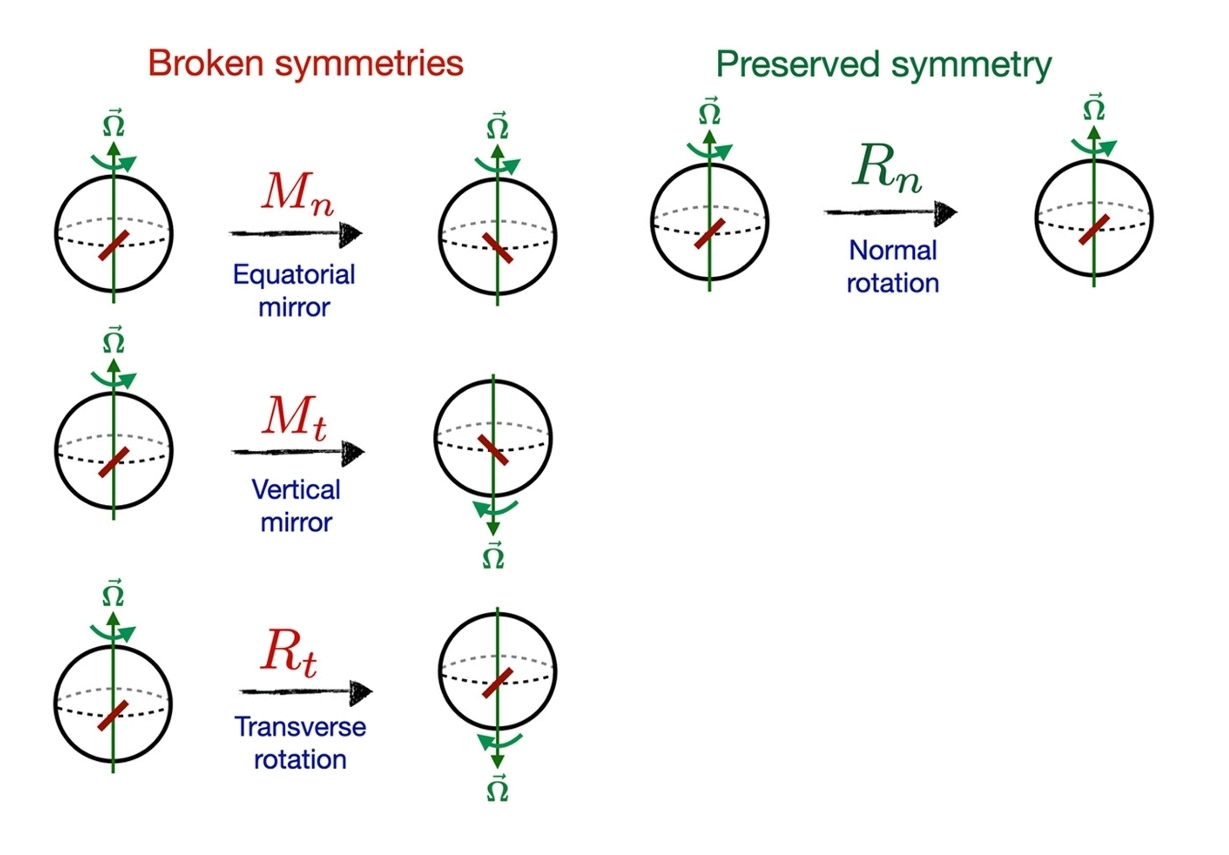
<< ️(AA) investigate a classical formulation of the Quantum Approximate Optimization Algorithm (QAOA), realized as a Hamiltonian dynamical system of classical kicked tops, which (They) call the Variational Iterative Rotation Algorithm (VIRAL). The variational parameters are the transverse and longitudinal rotation angles at each of the p layers of the circuit. >>

<< ️(They) find that VIRAL outperforms QAOA on the canonical Sherrington-Kirkpatrick spin-glass benchmark at all circuit depths, with the energy density converging to the ground state value linearly in 1/p. For large circuit depths, the optimized dynamics follows a Floquet protocol in which a pitchfork bifurcation destabilizes the equatorial fixed point and drives the spins toward polar Ising configurations. >>

<< ️(Their) results demonstrate that the effectiveness of QAOA-like protocols derives primarily from their underlying iterative rotation structure, and that a classical implementation of it outperforms its quantum counterpart. (They) further elucidate its efficiency by reducing the many-body classical evolution to an effective Landau-Lifshitz dynamics for a single spin in a stochastic magnetic field. In this picture, the covariance matrix of the effective field reveals a nearly rank-one structure in which a single mode dominates the stochastic dynamics. In contrast, quantum fluctuations make the noise covariance of the effective quantum model of higher rank, hampering the control of the system. >>

Flaviano Morone, Andrew D. Kent, Dries Sels. Variational Iterative Rotation Algorithm: Combinatorial Optimization with Classical Kicked Tops. arXiv: 2604.01512v1 [cond-mat.dis-nn]. Apr 2, 2026.


Keywords: gst, kicked top, rotation, pitchfork bifurcation, quantum fluctuations. 

martedì 13 agosto 2024

# gst: emergent chirality in active rotation even with spontaneous chiral symmetry breaking.


<< Collective cell dynamics play a crucial role in many developmental and physiological contexts. While two-dimensional (2D) cell migration has been widely studied, how three-dimensional (3D) geometry and topology interplay with collective cell behavior to determine dynamics and functions remains an open question. >>️

<< Using murine pancreas-derived organoids as a model system, (AA) find that epithelial spheres exhibit persistent rotation, rotational axis drift, and rotation arrest. Using a 3D vertex model, (they) demonstrate how the combined action of traction force and polarity alignment can account for these distinct rotational dynamics near a solid to flow transition. Furthermore, (their) analysis shows that the spherical tissue rotates as an active solid occasionally switching to a flowing state and exhibits spontaneous chiral symmetry breaking. >>️

Tzer Han Tan, Aboutaleb Amiri, et al. Emergent chirality in active solid rotation of pancreas spheres. PRX Life 2, 033006. Aug 8, 2024.

AA << say their work shows how symmetry-breaking processes in living active matter can be induced by the interplay of geometry, topology, and collective dynamics. >>️

Charles Day. Emergent Chirality in Active Rotation. Physics 17, s102. Aug 8, 2024. 

Also: chiral, transition, in https://www.inkgmr.net/kwrds.html 

Keywords: gst, transition, chiral, chiral symmetry breaking 


venerdì 12 novembre 2021

# gst: a screw mechanism to separate realistic racemic mixtures by local vorticity

AA developed << an explanatory "screw"  model for predicting the shear-flow separation of enantiomers >>

<< Enantiomers of chiral molecules are non-superposable mirror images with the same structural formula. In achiral environments, enantiomers have identical physical and chemical properties, and this prevents separation by classical methods. >>

<< A screw is a simple chiral object that couples rotation around one axis with displacement along that axis. This displacement is perpendicular to the plane of rotation and is characterized by the screw’s pitch (or lead). Here (it is defined) pitch (P) as the perpendicular distance advanced by a screw in a 2π-revolution. In a lab-fixed frame, left-and right-handed screws have pitches with the same magnitude, but with flipped signs, rotating in opposite directions to do the same task. This concept can be easily extended to chiral molecules by considering the translation-rotation coupling tensor (..). In a medium which induces rotation of molecules (as in a vortex flow), chiral molecules will translate in opposite directions. As a consequence, this asymmetry may enable the resolution of the enantiomers. >>

Thus  a << competition model and continuum drift diffusion equations are developed to predict separation of realistic racemic mixtures. (..) Additionally, (AA) find that certain achiral objects can also exhibit a non-zero molecular pitch. >>

<< Although it has been used << shear flow as the source to rotate the chiral molecules and achieve separation, it may be possible to use external forces to rotate the enantiomers >>️
Duraes A, Gezelter JD. Separation of Enantiomers through Local Vorticity: A Screw Model Mechanism. ChemRxiv. Cambridge: Cambridge Open Engage; Vers 1. doi: 10.33774/ chemrxiv-2021-196zw. Oct 04, 2021. 


keywords: gst, vortices, separation, enantiomeric separation, racemic mixture, screw mechanism, translation-rotation coupling, transitions.

mercoledì 15 novembre 2017

# gst: more on turbulence under rotation, by Biferale, Bonaccorso, Lanotte, et al.

AA << study turbulence under rotation in the presence of simultaneous direct and inverse cascades >>

AA << quantify (..) the effects of those coherent vertical structures on the preferential concentration of light and heavy particles >>

<< Rotating, turbulent flows are ubiquitous in nature >>

Biferale L, Bonaccorso F,  Lanotte AS, et al.  Coherent Structures and Extreme Events in Rotating Multiphase Turbulent Flows. Phys. Rev. X 6, 041036 doi: 10.1103/PhysRevX.6.041036  Nov 21, 2016

https://journals.aps.org/prx/abstract/10.1103/PhysRevX.6.041036

<< What can you find in the air, on an aeroplane, or even deep inside your heart? No, the answer isn’t love. It is, of course, turbulent flow >>

In a spin: studying turbulent flow under rotation. Nov 5, 2017

http://www.prace-ri.eu/spin-studying-turbulent-flow-rotation/

https://www.sciencedaily.com/releases/2017/11/171106100301.htm

lunedì 14 aprile 2025

# gst: switching from active Brownian motion to stationary rotation of Janus particles in a viscoelastic fluid.

<< Swimming micro-objects exist in viscoelastic fluids. Elucidating the effect of viscoelasticity on the motion of these objects is important for understanding their behavior. >>

AA << examined the motion of Janus particles self-propelled by induced charge electrophoresis over a wide range of speeds in semidilute polymer solutions. In (Their) system, the motion of Janus particles changed from active Brownian motion to stationary rotation as the speed increased. The torque for stationary rotation originates from the difference between the direction of self-propulsion and that of the time-delayed restoring force from the polymer solution, which has been reported in another self-propelled particle system. The switch from active Brownian motion to stationary rotation at different polymer concentrations can be explained by the Weisenberg number, which is defined as the ratio of the relaxation time of the polymer network to the travel time of the Janus particle to its size. >>

Keita Saito, Ryunosuke Kawano, et al. Self-propelled motion of induced-charge electrophoretic Janus particles in viscoelastic fluids. Phys. Rev. E 111, 045409. Apr 10, 2025.
Also: Janus, transition, particle, in FonT:

Keywords: gst, Janus, transitions, particles, self-propelled particles

sabato 3 gennaio 2026

# gst: settling dynamics of an oloid, experiments and simulations.


<< ️This (AA) study presents a combined experimental and computational investigation of an oloid shaped particle settling in a quiescent fluid. The oloid, a unique convex shape with anisotropic geometry, provides a distinctive model for exploring how a particle's shape and orientation affect its settling dynamics. >>

<< ️(AA) results indicate two distinct falling modes for the oloid, separated by Galileo number. The stable mode is characterised by a preferential orientation, with a rotation around the vertical axis, whereas the tumbling mode has randomly distributed orientation and rotation statistics. (They) characterise the falling velocity, orientation, and rotation dynamics of the oloids over a range of Galileo numbers. Additionally, the influence of the initial orientation is revealed to determine the rotation dynamics at low Galileo numbers. >>

Mees M. Flapper, Giulia Piumini, Roberto Verzicco, et al. Settling dynamics of an oloid: experiments and simulations. arXiv: 2511.05137v1 [physics.flu-dyn]. Nov 7, 2025.

Also: particle, transition, in https://www.inkgmr.net/kwrds.html 

Keywords: gst, particle, transitions, oloids, oloid shaped particles, multiple falling regimes, falling mode, tumbling mode.

giovedì 10 aprile 2025

# gst: multiparticle dispersion in rotating-stratified turbulent flows (when stratification increases turbulent fluctuations may not be weaker)

AA << study the relative movement of groups of two (pairs) and four (tetrahedra) Lagrangian particles using direct numerical simulations of the stably stratified Boussinsesq equations, with Brunt-Väisälä frequency 𝑁 and Coriolis parameter 𝑓. >>

<< In all cases considered, (AA) demonstrate that the relative particle motion differs depending on whether dispersion is considered forward or backward in time, although the asymmetry becomes less pronounced when stratification and rotation increase. On the other hand, the strong fluctuations in the dispersion between two particles become more extreme when 𝑁 and 𝑓  increase. (They) also find evidence for the formation of shear layers, which become more pronounced as 𝑁 and 𝑓  become larger. Finally, (They) show that the irreversibility on the dispersion of a set of particles initially forming a regular tetrahedron becomes weaker when the influence of stratification and rotation increases, a property that (They) relate to that of the perceived rate-of-strain tensor. >>️

<< Unexpectedly, (AA) observe that the higher moments of particle separation, in particular the normalized fourth-order central moment of the separation (the kurtosis Kr) is an increasing function of stratification and rotation. This is surprising, as when stratification increases the turbulent fluctuations are expected to be weaker, (..) >>️

Sebastian Gallon, Fabio Feraco, et al. Multiparticle dispersion in rotating-stratified turbulent flows. Phys. Rev. Fluids 10, 034605. Mar 17, 2025. 

Also: particle, turbulence, disorder & fluctuations, in https://www.inkgmr.net/kwrds.html 

Keywords: gst, particle, turbulence, disorder, fluctuations

mercoledì 6 maggio 2026

# gst: apropos of unsteady two-dimensional flows, the Lagrangian rotating contracting structures.

<< ️(AA) identify materially defined regions in unsteady two-dimensional flows that combine finite-time contraction with elevated accumulated intrinsic rotation along trajectories, which (They) term Lagrangian rotating contracting structures (LRCS). These regions are detected using existing objective diagnostics—the Lagrangian-averaged vorticity deviation (LAVD) together with direct tests of material contraction—without relying on the geometry of LAVD level sets. >>

<< ️In strongly deforming flows, LAVD maxima need not correspond to vortical regions or be enclosed by regular level sets, rendering geometry-based identification unreliable. Nevertheless, regions exhibiting inward spiraling motion and contraction can be extracted by combining LAVD with a contraction criterion. >>

<< ️Applications to atmospheric and oceanic flows show that such behavior arises both in twisted LAVD fields generated at submesoscales and in mesoscale flows where it is enhanced by inertial effects, with finite-time contraction providing the dynamical constraint that isolates materially organized regions with elevated intrinsic rotation. >>

F.J. Beron-Vera. Lagrangian Rotating Contracting Structures. arXiv: 2604.25036v1 [nlin.CD]. Apr 27, 2026.

Also: vortex, instability, twist, in https://www.inkgmr.net/kwrds.html 

Keywords: gst, vortex, instability, finite-time contraction, accumulated intrinsic rotation, Lagrangian rotating contracting 
structures, inward spiraling motion.

venerdì 9 marzo 2018

# astro: differential rotation in Jupiter

<< Jupiter's atmosphere is rotating differentially, with zones and belts rotating at speeds that differ by up to 100 metres per second >>

<< The discovery by the Juno spacecraft that Jupiter's gravity field is north–south asymmetric [..] demonstrates that the observed zonal cloud flow must persist to a depth of about 3,000 kilometres from the cloud tops >>

AA << find that the deep interior of the planet rotates nearly as a rigid body, with differential rotation decreasing by at least an order of magnitude compared to the atmosphere >>

AA << expect the outer, differentially rotating region to be at least three times deeper in Saturn and to be shallower in massive giant planets and brown dwarfs >>

Guillot T, Miguel Y, et al. A suppression of differential rotation in Jupiter’s deep interior. Nature. 2018; 555; 227 - 30.  doi: 10.1038/nature25775. Mar 8, 2018.

https://www.nature.com/articles/nature25775

<< Scientists have long wondered what lies beneath Jupiter's surface. Now, using data from NASA's Juno mission, four research teams have published studies revealing incredible new information about the gas giant >>

Chelsea Gohd.  We Now Know What Lies Beneath Jupiter's Clouds. Mar 7, 2018.

https://futurism.com/beneath-jupiters-clouds/

NASA Juno Findings - Jupiter's Jet - Streams Are Unearthly.  March 7, 2018.

https://www.nasa.gov/feature/jpl/nasa-juno-findings-jupiter-s-jet-streams-are-unearthly

venerdì 10 aprile 2026

# gst: phase-space organization of the elastic pendulum; chaotic fraction, energy exchanges, and the order-chaos-order transition.


<< ️(AA) study the phase-space organization of the planar elastic pendulum as a function of its two dimensionless control parameters: the reduced energy R and the squared frequency ratio µ. By randomly sampling the isoenergetic volume to classify trajectories as oscillatory, rotational, or chaotic across the (µ,R) parameter plane, (They) obtain a global portrait of the coexistence and competition between dynamical regimes. >>

<< ️The chaotic fraction is not uniformly distributed across the parameter plane but concentrates in a well-defined central cloud whose ridge follows a linear relation in the (µ,R) plane and whose maximum does not exceed 70% of the available phase space. The order-chaos-order transition is not a global property of the parameter plane but occurs specifically in the central region surrounding this cloud: along paths that traverse it, oscillatory orbits progressively give way to chaotic trajectories, which in turn yield to rotational orbits as the energy grows, revealing a clear sequential mechanism underlying the transition. >> 

<< ️The onset of rotational motion is gradual rather than sharp, reflecting a strong dependence on initial conditions. By decomposing the total energy into spring-like, pendulum-like, and coupling contributions, (They) establish a direct correspondence between the coupling power and the abundance of chaotic trajectories, showing that enhanced inter-mode energy exchange is a reliable indicator of dynamical complexity. >>

Juan P. Tarigo, Cecilia Stari, Edson D. Leonel, et al. Phase-space organization of the elastic pendulum: chaotic fraction, energy exchanges, and the order-chaos-order transition. arXiv: 2604.01503v1 [nlin.CD]. Apr 2, 2026.

Also: pendulum, transition, chaos, in https://www.inkgmr.net/kwrds.html 

Keywords: gst, pendulum, planar elastic pendulum, rotation, rotational motion, chaos, transitions, order-chaos-order transition. 


lunedì 17 giugno 2024

# gst: breakup of Janus droplet in a bifurcating microchannel

<< Droplet breakup is frequently observed in natural and industrial processes (..)  Although valuable insights on the breakup mechanisms of single-phase droplets in microchannels have been provided over the past decades, the breakup physics of complex emulsions is still poorly understood. >>️

<< Spatially asymmetric Janus microdroplets, distinct from single-phase or double emulsion droplets possessing one uniform interface with the ambient phase, are anticipated to show unique breakup behaviors, which has not been explored.  >>️

AA << conduct both microfluidic experiments and three-dimensional lattice Boltzmann simulations to investigate the dynamic breakup of ionic liquid (IL)-water Janus droplets in an assembled 3D-printed microchannel with a bifurcation. >>️

<< Three different flow regimes are identified: (i) division into two daughter Janus droplets, (ii) breakup into a single-phase droplet and a smaller Janus droplet, and (iii) nonbreakup.  >>️

AA << find that the strong constraint effect of the main channel and large Ca_av (average capillary numbers) values are essential to the symmetrical breakup of Janus droplets. The tunnel between the mother droplet and the wall of the main channel, which allows the lateral shift of the Janus droplet, and moderate flow rates facilitate the breakup of the IL single-phase portion of Janus droplets.  >>

<< Through 90° rotation of the splitting microchannel, (AA) elucidate the distinctions in Janus droplet behaviors under two baffle orientations. Potential impacts of the oblique flow characteristic of [bmim]⁢Fe⁢Cl4-water Janus droplets on the droplet breakup are discussed. >>️
Hao Wang, Shiteng Wang, et al. Dynamic breakup of Janus droplet in a bifurcating microchannel. Phys. Rev. Fluids 9, 064203. Jun 11, 2024. 


Also: 'drop', 'droplet', 'droploid', in https://www.inkgmr.net/kwrds.html 

Keywords: gst, Janus, drop, droplet, droploid


venerdì 8 novembre 2024

# gst: phase transitions in anisotropic turbulence.


<<  
Turbulence is a widely observed state of fluid flows, characterized by complex, nonlinear interactions between motions across a broad spectrum of length and time scales. While turbulence is ubiquitous, from teacups to planetary atmospheres, oceans and stars, its manifestations can vary considerably between different physical systems. For instance, three-dimensional (3D) turbulent flows display a forward energy cascade from large to small scales, while in two-dimensional (2D) turbulence, energy cascades from small to large scales. In a given physical system, a transition between such disparate regimes of turbulence can occur when a control parameter reaches a critical value. The behavior of flows close to such transition points, which separate qualitatively distinct phases of turbulence, has been found to be unexpectedly rich. Here, (AA) survey recent findings on such transitions in highly anisotropic turbulent fluid flows, including turbulence in thin layers and under the influence of rapid rotation. (They) also review recent work on transitions induced by turbulent fluctuations, such as random reversals and transitions between large-scale vortices and jets, among others. The relevance of these results and their ramifications for future investigations are discussed.
>>️

Adrian van Kan. Phase Transitions in Anisotropic Turbulence. arXiv: 2408.02844v1 [physics.flu-dyn]. Aug 5, 2024. 

Alsoturbulence, vortex, in https://www.inkgmr.net/kwrds.html 

Keywords: gst, turbulence, vortex


martedì 21 aprile 2020

# gst: apropos of strange fluctuations in oscillation and translation

<< The dynamical processes of the inner core rely significantly on the viscous strength of iron. Since plastic deformation of iron may produce crystallographic preferred orientations  (CPO), creep is commonly considered to be a potential source contributing to the seismic anisotropy observed in the inner core. The viscosity of the inner core also influences the rotational dynamics of the Earth. >>

AA << show  that  dislocation  creep  is  a key  mechanism driving  deformation  of  hcp (hexagonal  close  packed) iron  at  inner  core  conditions. The  associated  viscosity  agrees well  with  the  estimates  from  geophysical  observations  supporting  that  the  inner  core  is  significantly less  viscous  than  the  Earth’s  mantle. Such  low  viscosity  rules  out  inner  core  translation,  with  melting on one side  and  solidification  on  the  opposite,  but  allows  for  the  occurrence  of  the  seismically  observed fluctuations  in  inner  core  differential  rotation. >>

Sebastian Ritterbex & Taku Tsuchiya. Viscosity of hcp iron at Earth’s inner core conditions from density functional theory. Sci Rep 10, 6311 (2020). doi: 10.1038/s41598-020-63166-6. Apr 14, 2020.

https://www.nature.com/articles/s41598-020-63166-6

Is the Earth's inner core oscillating and translating anomalously? Ehime University.  Apr 14, 2020.

https://phys.org/news/2020-04-earth-core-oscillating-anomalously.html

giovedì 24 aprile 2025

# gst: stochastic surfing turbulent vorticity.

<< The chaotic dynamics of small-scale vorticity plays a key role in understanding and controlling turbulence, with direct implications for energy transfer, mixing, and coherent structure evolution. >>

Here AA << use a combination of experiments, theory and simulations to show that small magnetic particles of different densities, exploring flow regions of distinct vorticity statistics, can act as effective probes for measuring and forcing turbulence at its smallest scale. The interplay between the magnetic torque, from an externally controllable magnetic field, and hydrodynamic stresses, from small-scale turbulent vorticity, reveals an extremely rich phenomenology. >>

Notably, AA << present the first observation of stochastic resonance for particles in turbulence: turbulent fluctuations, effectively acting as noise, counterintuitively enhance the particle rotational response to external forcing. (They) identify a pronounced resonant peak in particle rotational phase-lag when the applied magnetic field matches the characteristic intensity of small-scale vortices. >>

<< Furthermore, (They) uncover a novel symmetry-breaking mechanism: an oscillating magnetic field with zero-mean angular velocity remarkably induces net particle rotation in turbulence with zero-mean vorticity, as turbulent fluctuations aid the particle in "surfing" the magnetic field. >>

Ziqi Wang, Xander M. de Wit, et al. Stochastic surfing turbulent vorticity. arXiv: 2504.08346v1 [physics.flu-dyn]. Apr 11, 2025. 

Also: vortex, turbulence, noise, transition, in https://www.inkgmr.net/kwrds.html 

Keywords: gst, vortices, turbulence, turbulent fluctuations, small-scale turbulent vorticity, stochastic resonance, noise, transitions 

sabato 16 maggio 2026

# gst: rigorous ultimate scaling in rapidly rotating steady convection.


<< ️Rapidly rotating Rayleigh-Bénard convection admits a class of exact steady single-mode solutions describing high-amplitude convection cells. Using a matched asymptotic analysis in the high-Rayleigh-number limit, (AA) obtain a rigorous characterization of their bulk and boundary-layer structure, yielding explicit scaling laws for the Nusselt and Reynolds numbers, including their dependence on the horizontal wavenumber. >>

<< (They) show that, for suitable wavenumbers, these solutions attain the diffusivity-free ultimate scalings frequently assumed for geophysical and astrophysical convection, with additional enhancing logarithmic corrections. This reveals a specific mechanism through which rapidly rotating convection can approach ultimate heat transport via coherent columnar structures with well-defined horizontal scales. >>

Gabriel Hadjerci, Shingo Motoki, Genta Kawahara. Rigorous ultimate scaling in rapidly rotating steady convection. arXiv: 2605.05574v1 [physics.flu-dyn]. May 7, 2026.

Also: waves, vortex, in https://www.inkgmr.net/kwrds.html 

Keywords: gst, waves, vortex, convection, convection cells, Rayleigh-Bénard convection, bulk and boundary-layer structure, rotation, rotating convection.

venerdì 7 febbraio 2025

# life: spontaneous emergence of run-and-tumble-like dynamics in coupled self-propelled bots.


<< Drawing inspiration from the motility behaviour of microorganisms, we introduce a highly tunable, robotic system self-actuating into the run-and-tumble (RT)-like motion. It comprises two disk-shaped, centimeter-scale programmable robots individually programmed to perform overdamped active Brownian (AB) motion and connected by a rigid rod. The rod is attached to pivot points located on off-centered, mirror-symmetric points on each robot, allowing for its free rotation at both ends. >>

AA << show that the collective dynamics of this system execute RT-like motion with characteristic sharp tumble events and exponentially distributed run times, similar to those observed in microorganisms. (They) further quantify emerging dynamics in terms of tumbling frequency and tune it over a wide range of experimental parameters. >>

AA << also develop a theoretical model that reproduces our experimental results and elucidates the underlying physical mechanisms governing the rich phase behavior of RT motion. >>
 ️
Somnath Paramanick, Umashankar Pardhi, et al. Spontaneous emergence of run-and-tumble-like dynamics in coupled self-propelled robots: experiment and theory. arXiv: 2502.01257v1 [cond-mat.soft]. Feb 3, 2025.

Also: behav, evolution, bot, in https://www.inkgmr.net/kwrds.html 

Keywords: gst, life, behavior, evolution, bots, self-propelled bots, run-and-tumble motion 


lunedì 4 gennaio 2021

# gst: apropos of waves perturbed by weak turbulences

<< Wave phenomena are ubiquitous at all scales throughout the Universe, and where there are waves, there’s the potential for wave turbulence. Wave turbulence is the physical state that arises in a continuous medium when a large number of wave modes interact with each other randomly. >>

<< A specific case of wave turbulence in which weakly nonlinear waves propagate in an unbounded space is described by weak turbulence theory. Capturing the dynamics of this regime will be helpful to accurately model large fluid systems. >>

<< In a rotating fluid, the predicted wave spectrum for interacting weakly nonlinear inertial waves is perturbed by the formation of geostrophic modes—columnar vortices aligned with the rotation axis (..) (AA) successfully suppress geostrophic modes with the addition of two honeycomb-patterned plates, allowing them to confirm the predictions of weak turbulence theory. >>

Sergey Nazarenko. Verifying Weak Turbulence Theory.  Physics 13, 194. Dec 14, 2020. 


Eduardo Monsalve, Maxime Brunet, et al. Quantitative Experimental Observation of Weak Inertial-Wave Turbulence. Phys. Rev. Lett. 125, 254502. Dec 14, 2020.


lunedì 19 dicembre 2022

# gst: behavior of microswimmers in a vortex with translational and rotational noise

AA << propose a theoretical model to investigate the dynamics of elongated microswimmers in elementary vortices, namely active particles in two- and three-dimensional rotlets. A deterministic model first reveals the existence of bounded orbits near the centre of the vortex and unbounded orbits elsewhere. (AA) further discover a conserved quantity of motion that allows (..) to map the phase space according to the type of the orbit (bounded vs unbounded). (They) next introduce translational and rotational noise into the system. Using a Fokker--Planck formalism, (AA) quantify the quality of trapping near the centre of the vortex by examining the probability of escape and the mean time of escape from the region of deterministically bounded orbits. (AA) finally show how to use these findings to formulate a prediction for the radius of the depletion zone, which compares favourably with the experiments of Sokolov and Aranson (2016). >>

Ivan Tanasijevic, Eric Lauga. Microswimmers in vortices: Dynamics and trapping. arXiv: 2211.05866v1 [physics.bio-ph].  Nov 10, 2022. 

Also

'microswimmers' in FonT 

Keywords: gst, behav, translation,  rotation, trapping, noise, swimmer, swimming,  microswimmers, fluid dynamics, vortex, vortices, vortexes, vorticity


venerdì 6 settembre 2019

# gst: apropos of swirling granular media, a geometric frustration; will these entities turn left or right?

<< Granular material in a swirled container exhibits a curious transition as the number of particles is increased: At low densities, the particle cluster rotates in the same direction as the swirling motion of the container, while at high densities it rotates in the opposite direction.  >>

AA << show that the transition to counterrotation is friction dependent. At high particle densities, frictional effects result in geometric frustration, which prevents particles from cooperatively rolling and spinning. Consequently, the particle cluster rolls like a rigid body with no-slip conditions on the container wall, which necessarily counterrotates around its own axis. Numerical simulations verify that both wall-disk friction and disk-disk friction are critical for inducing counterrotation. >>

Lisa M. Lee, John Paul Ryan, et al. Geometric frustration induces the transition between rotation and counterrotation in swirled granular media. Phys. Rev. E 100, 012903. July 8, 2019.     https://journals.aps.org/pre/abstract/10.1103/PhysRevE.100.012903  

Leah Burrows. Solving the pancake problem. Harvard University. Aug 30, 2019.    https://m.phys.org/news/2019-08-pancake-problem.html  

sabato 18 agosto 2018

# gst: ordered patterns found when mixing granular matter

AA << report remarkably persistent mixing and non-mixing regions in a three-dimensional dynamical system where randomness is expected. A spherical shell half-filled with dry non-cohesive particles and periodically rotated about two horizontal axes generates complex structures that vary non-trivially with the rotation angles. >>

Zafir Zaman, Mengqi Yu, et al.  Persistent structures in a three-dimensional dynamical system with flowing and non-flowing regions. Nature Comm vol 9, no 3122 (2018)  doi: 10.1038/s41467-018-05508-7

https://www.nature.com/articles/s41467-018-05508-7   

Emily Ayshford. When mixing granular matter, order among disorder. Northwestern University. Aug 14, 2018.

https://m.phys.org/news/2018-08-granular-disorder.html