Translate

sabato 22 marzo 2025

# gst: First-passage-time statistics of active Brownian particles: a perturbative approach.


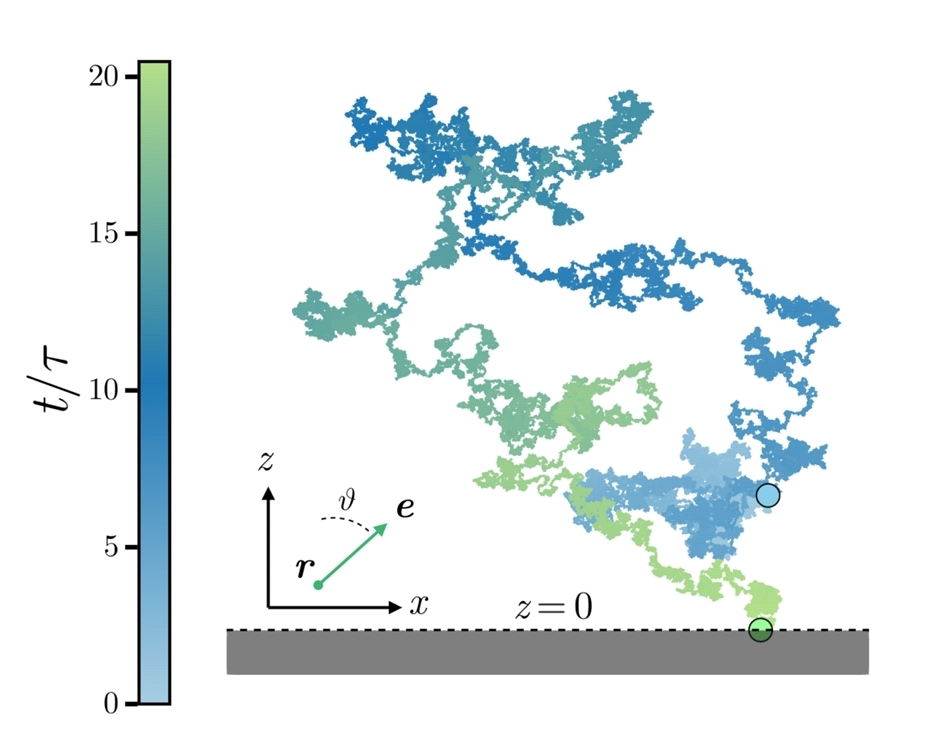
AA << study the first-passage-time (FPT) properties of active Brownian particles to reach an absorbing wall in two dimensions. Employing a perturbation approach (They) obtain exact analytical predictions for the survival and FPT distributions for small Péclet numbers, measuring the importance of self-propulsion relative to diffusion. >>

<< While randomly oriented active agents reach the wall faster than their passive counterpart, their initial orientation plays a crucial role in the FPT statistics. Using the median as a metric, (AA) quantify this anisotropy and find that it becomes more pronounced at distances where persistent active motion starts to dominate diffusion. >>️

Yanis Baouche, Magali Le Goff, et al. First-passage-time statistics of active Brownian particles: a perturbative approach. arXiv: 2503.05401v1 [cond-mat.soft]. Mar 7, 2025.

Also: particle, random, in https://www.inkgmr.net/kwrds.html 

Keywords: gst, particles, active particles, perturbation approach, randomness, stochasticity, stochastic resetting, rotational diffusion, anisotropy

venerdì 21 marzo 2025

# poe: onda di gioco

<<  
Nota a far mescole coll' endogeno docile avo melode /
declamando su traccia nevale di dondolio di geco /
l' evento d' onde nella forma di compressa logica ode /
che, se liberata, s' autoespande in frange d' agile eco.
>>

14.31 13/09/2004

'solebat quid esset litus ita definire: "qua fluctus eluderet"'. In: Cicerone. 'de natura deorum'.


Anchewaves, in   
Notes (quasi-stochastic poetry)  https://inkpi.blogspot.com/search?q=onda 

Anche: World Poetry Day, in

Keywords: poe, poetry, quasi-stochastic poetry, PoetryDay, WorldPoetryDay, InternationalPoetryDay, waves, rogue waves, shock waves, solitons, turbulence, instability

giovedì 20 marzo 2025

# aibot: I think, therefore I hallucinate: minds, machines, and the art of being wrong.

<< This theoretical work examines 'hallucinations' in both human cognition and large language models, comparing how each system can produce perceptions or outputs that deviate from reality. Drawing on neuroscience and machine learning research, (AA) highlight the predictive processes that underlie human and artificial thought. >>

<< In humans, complex neural mechanisms interpret sensory information under uncertainty, sometimes filling in gaps and creating false perceptions. This inference occurs hierarchically: higher cortical levels send top-down predictions to lower-level regions, while mismatches (prediction errors) propagate upward to refine the model. LLMs, in contrast, rely on auto-regressive modeling of text and can generate erroneous statements in the absence of robust grounding. >>

<< Despite these different foundations - biological versus computational - the similarities in their predictive architectures help explain why hallucinations occur. (AA) propose that the propensity to generate incorrect or confabulated responses may be an inherent feature of advanced intelligence. In both humans and AI, adaptive predictive processes aim to make sense of incomplete information and anticipate future states, fostering creativity and flexibility, but also introducing the risk of errors. (Their) analysis illuminates how factors such as feedback, grounding, and error correction affect the likelihood of 'being wrong' in each system. (AA) suggest that mitigating AI hallucinations (e.g., through improved training, post-processing, or knowledge-grounding methods) may also shed light on human cognitive processes, revealing how error-prone predictions can be harnessed for innovation without compromising reliability. By exploring these converging and divergent mechanisms, the paper underscores the broader implications for advancing both AI reliability and scientific understanding of human thought. >>️

Sebastian Barros. I Think, Therefore I Hallucinate: Minds, Machines, and the Art of Being Wrong. arXiv: 2503.05806v1 [q-bio.NC]. 4 Mar 4, 2025.

Also: brain, curiosity, novelty, uncertainty, error, mistake, jazz, ai (artificial intell), in https://www.inkgmr.net/kwrds.html 

Keywords: brain, cognition, perceptions, curiosity, novelty, hallucinations, errors, prediction, prediction errors, error-prone predictions, AI, artificial intelligence, LLMs
mercoledì 19 marzo 2025

# behav: the benefit of ignorance for traffic through a random congestible network.


<< When traffic is routed through a network that is susceptible to congestion, the self-interested decisions made by individual users do not, in general, produce the optimal flow. This discrepancy is quantified by the so-called "price of anarchy." >>

AA << consider whether the traffic produced by self-interested users is made better or worse when users have uncertain knowledge about the cost functions of the links in the network, and define a parallel concept that (They) call the "price of ignorance."  >>

AA << introduce a simple model in which fast, congestible links and slow, incongestible links are mixed randomly in a large network and users plan their routes with finite uncertainty about which of the two cost functions describes each link. >>

<< One of (Their) key findings is that a small level of user ignorance universally improves traffic, regardless of the network composition. Further, there is an optimal level of ignorance which, in (the) model, causes the self-interested user behavior to coincide with the optimum. Many features of (AA) model can be understood analytically, including the optimal level of user ignorance and the existence of critical scaling near the percolation threshold for fast links, where the potential benefit of user ignorance is greatest. >>️

Alican Saray, Calvin Pozderac, et al. The benefit of ignorance for traffic through a random congestible network. arXiv: 2503.09684v1 [cond-mat.dis-nn]. Mar 12, 2025.

Alsonetwork, behav, random, uncertainty, in https://www.inkgmr.net/kwrds.html 

Keywords: gst, networks, behavior,  randomness, uncertainty, price of anarchy, price of ignorance

martedì 18 marzo 2025

# qubit: stability of classical shadows under gate-dependent noise

<< Expectation values of observables are routinely estimated using so-called classical shadows—the outcomes of randomized bases measurements on a repeatedly prepared quantum state. In order to trust the accuracy of shadow estimation in practice, it is crucial to understand the behavior of the estimators under realistic noise. >>

<< In this Letter, (AA) prove that any shadow estimation protocol involving Clifford unitaries is stable under gate-dependent noise for observables with bounded stabilizer norm—originally introduced in the context of simulating Clifford circuits. In contrast, (They) demonstrate with concrete examples that estimation of “magic” observables can lead to highly misleading results in the presence of miscalibration errors and a worst case bias scaling exponentially in the system size. >>

AA << further find that so-called robust shadows, aiming at mitigating noise, can introduce a large bias in the presence of gate-dependent noise compared to unmitigated classical shadows. Nevertheless, (AA) guarantee the functioning of robust shadows for a more general noise setting than in previous works. On a technical level, (They) identify average noise channels that affect shadow estimators and allow for a more fine-grained control of noise-induced biases. >>️

Raphael Brieger, Markus Heinrich, et al. Stability of Classical Shadows under Gate-Dependent Noise. Phys. Rev. Lett. 134, 090801. Mar 4, 2025. 

Also: qubit, in FonT  https://flashontrack.blogspot.com/search?q=qubit  noise, ai (artificial intell) (bot), in https://www.inkgmr.net/kwrds.html   

Keywords: qubit, noise, realistic noise, shadows, robust shadows


lunedì 17 marzo 2025

# gst: apropos of degeneration, the topological degeneracy induced by twisting.

<< In recent years, twisting has emerged as a new degree of freedom that plays an increasingly important role in Bloch bands of various physical systems. However, there is currently a lack of reports on the nontrivial physics of topological degeneracy in twisted systems. >>

AA << investigated the intrinsic physical correlation between twisting and topological degeneracy. (They) found that twisting not only breaks the symmetry of the system but also introduces topological degeneracy that does not exist under the original symmetric system without twisting. >>

<< Furthermore, the topological degeneracy can be easily tuned through twisting. This new twist-induced topological degeneracy gives rise to a unique polarization-degenerate birefringent medium, wherein the twist angle acts as a novel degree of freedom for dispersion and polarization management of interface states. >> 

<< Exhibiting fascinating properties and experimental feasibilities, (AA) Letter points to new possibilities in the research of various topological physics in twisted photonics. >>️

Han Peng, Qiang Wang, et al. Topological degeneracy induced by twisting. Phys. Rev. Lett. 134, 106601. Mar 11, 2025.


Keywords: gst, degeneration, twisting 

sabato 15 marzo 2025

# qubit: communication power of a noisy qubit.


<< A fundamental limitation of quantum communication is that a single qubit can carry at most one bit of classical information. For an important class of quantum communication channels, known as entanglement breaking, this limitation holds even if the sender and receiver share entangled particles. But does this mean that, for the purpose of communicating classical messages, a noisy entanglement-breaking qubit channel can be replaced by a noisy bit channel? >>

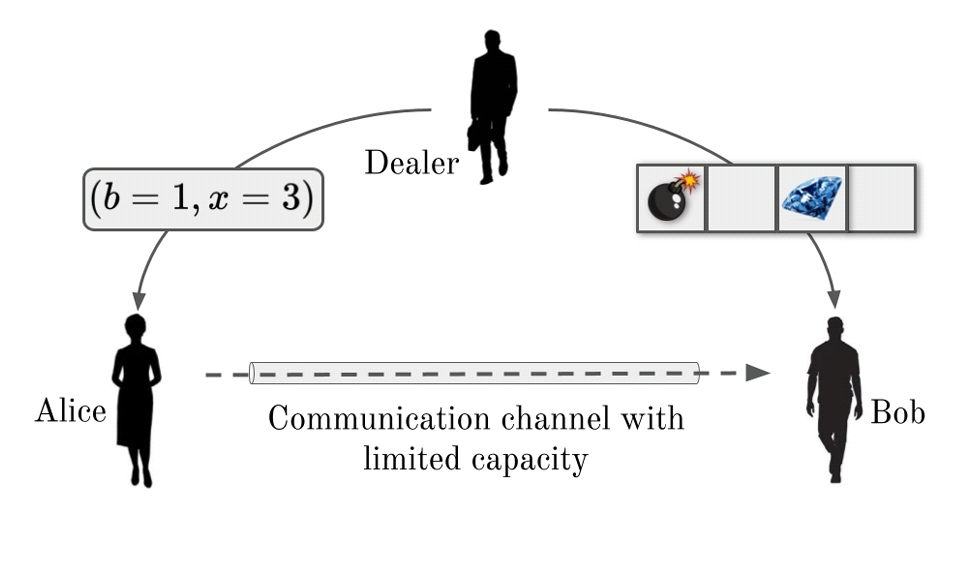
Here AA << answer the question in the negative. (They) introduce a game, similar to the Monty Hall problem in classical statistics, where a sender assists a receiver in finding a valuable item (the “prize”) hidden in one of four possible boxes, while avoiding a hazardous item (the “bomb”) hidden in one of the remaining three boxes. (AA) show that no classical strategy using a noisy bit channel can ensure that the bomb is avoided, even if the sender and receiver share arbitrary amounts of randomness. >>

<< In contrast, communication of a qubit through a class of noisy entanglement-breaking channels, which (They) call quantum not channels, allows the players to deterministically avoid the bomb and to find the prize with a guaranteed nonzero probability. >>

AA << findings show that the communication of classical messages through a noisy entanglement-breaking qubit channel assisted by quantum entanglement cannot, in general, be simulated by communication through a noisy bit channel assisted by classical correlations. >>️

Giulio Chiribella, Saptarshi Roy, et al. Communication Power of a Noisy Qubit. Phys. Rev. Lett. 134, 080803. Feb 28, 2025. 


Keywords: qubit, games, noise