Translate

lunedì 30 giugno 2025

# gst: topological phase transition under infinite randomness

<< In clean and weakly disordered systems, topological and trivial phases having a finite bulk energy gap can transit to each other via a quantum critical point. In presence of strong disorder, both the nature of the phases and the associated criticality can fundamentally change. >>

Here AA << investigate topological properties of a strongly disordered fermionic chain where the bond couplings are drawn from normal probability distributions which are defined by characteristic standard deviations. Using numerical strong disorder renormalization group methods along with analytical techniques, (AA) show that the competition between fluctuation scales renders both the trivial and topological phases gapless with Griffiths like rare regions. >>

<< Moreover, the transition between these phases is solely governed by the fluctuation scales, rather than the means, rendering the critical behavior to be determined by an infinite randomness fixed point with an irrational central charge. (AA) work points to a host of novel topological phases and atypical topological phase transitions which can be realized in systems under strong disorder. >>

Saikat Mondal, Adhip Agarwala. Topological Phase Transition under Infinite Randomness. arXiv: 2506.19913v1 [cond-mat.dis-nn]. Jun 24, 2025.

Also: order, disorder, disorder & fluctuations, random, transition, forms of power, in https://www.inkgmr.net/kwrds.html 

Keywords: gst, order, disorder, disorder & fluctuations, randomness, criticality, transitions, forms of power

FonT: who knows if during some master's courses on the organization and evolution of social enclosures, held by the legendary "Frattocchie School" ( https://it.m.wikipedia.org/wiki/Scuola_delle_Frattocchie ) during the early 80s (but also early 90s) some bizarre theoretician advanced the imaginative, up in the air, absolutely unfounded hypothesis (here it is emphasized: absolutely), about the possibility of an immediate cracking of a social structure due to the action of idiots (?) disguised as idiots until the complete, universal, ontheback breakthrough anzicheforse?

sabato 28 giugno 2025

# gst: predicting the response of structurally altered and asymmetrical networks.

AA << investigate how the response of coupled dynamical systems is modified due to a structural alteration of the interaction. The majority of the literature focuses on additive perturbations and symmetrical interaction networks. >>

<< Here, (AA) consider the challenging problem of multiplicative perturbations and asymmetrical interaction coupling. (They) introduce a framework to approximate the averaged response at each network node for general structural perturbations, including non-normal and asymmetrical ones. >>

Their << findings indicate that both the asymmetry and non-normality of the structural perturbation impact the global and local responses at different orders in time. (AA) propose a set of matrices to identify the nodes whose response is affected the most by the structural alteration. >>

Melvyn Tyloo. Predicting the response of structurally altered and asymmetrical networks. arXiv: 2506.14609v1 [cond-mat.dis-nn]. Jun 17, 2025.


Keywords: gst, networks, multiplicative perturbations, asymmetrical interaction coupling

venerdì 27 giugno 2025

# gst: random interaction in active matter models; critical changes in Vicsek's scenario.


<< Randomness plays a key role in the order transition of active matter but has not yet been explicitly considered in pairwise interaction connection. In this paper, (AA) introduce the perception rate 𝑃 into the Vicsek model as the probability of the interaction connections and model the connections as superposition states. (They) show that with increasing 𝑃, the polar order number undergoes an order transition and then saturation. >>

<< The order transition is a first-order phase transition with band formation, and the effect of 𝑃 is different from density. The change of the order number is linked with the interaction structure. The order transition, order saturation, and phase separation correspond to different critical changes in the local interaction number. >>

<< The global interaction structure is further analyzed as a network. The decrease of 𝑃 is comparable to random edge removal, under which the network experiences modal transitions near the critical points of the order number, and the network exhibits surprising robustness.  (AA) results suggest that random interaction can be a new important factor in active matter models, with potential applications in robotic swarms and social activities. >>

Ruizhi Jin, Kejun Dong. Role of random interaction connection in the order transition of active matter based on the Vicsek model. Phys. Rev. E 111, 064122. Jun 17, 2025.

arXiv: 2501.10669v1 [cond-mat.soft]. Jan 18, 2025. 

Also: network, random, perception, transition, swarm, in https://www.inkgmr.net/kwrds.html 

Keywords: gst, active matter, network, randomness, perception, criticality, transitions, swarm.

mercoledì 25 giugno 2025

# gst: interactive anisotropic walks in 2D generated from a 3-state opinion dynamics model.


<< A system of interacting walkers is considered in a two-dimensional hypothetical space, where the dynamics of each walker are governed by the opinion states of the agents of a fully connected three-state opinion dynamics model. Such walks, studied in different models of statistical physics, are usually considered in one-dimensional virtual spaces. >>

In this article AA has performed the mapping << in such a way that the walk is directed along the 𝑌 axis while it can move either way along the 𝑋 axis. The walk shows that there are three distinct regions as the noise parameter, responsible for driving a continuous phase transition in the model, is varied. In absence of any noise, the scaling properties and the form of the distribution along either axis do not follow any conventional form. >>

<< For any finite noise below the critical point the bivariate distribution of the displacements is found to be a modified biased Gaussian function while above it, only the marginal distribution along one direction is Gaussian. The marginal probability distributions can be extracted and the scaling forms of different quantities, showing power-law behavior, are obtained. The directed nature of the walk is reflected in the marginal distributions as well as in the exponents. >>

Surajit Saha, Parongama Sen. Interactive anisotropic walks in two dimensions generated from a three-state opinion dynamics model. Phys. Rev. E 111, 064123. Jun 18, 2025.

arXiv: 2409.10413v3 [cond-mat.stat-mech]. Apr 28, 2025. 

Also: walk, noise, random, transition, in https://www.inkgmr.net/kwrds.html 

Keywords: gst, walk, walking, random walk, randomness, noise, transitions, noise-induced transitions, criticality.

martedì 24 giugno 2025

# gst: far-from-equilibrium complex landscapes


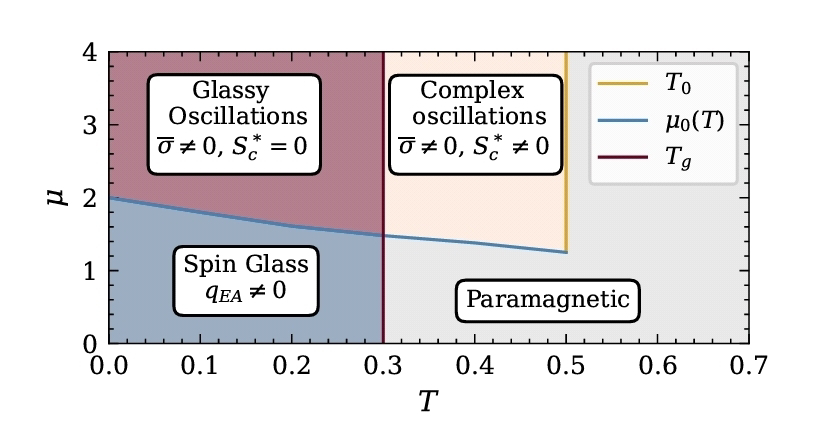
<< Systems with a complex dynamics like glasses or models of biological evolution are often pictured in terms of a complex landscape, with a large number of possible collective states. (AA) show on the example of a stochastic spin model with nonreciprocal and heterogeneous interactions how the complex landscape picture can be generalized far from equilibrium, where collective states may become time-dependent and exhibit, e.g., spontaneous oscillations, often hidden by the presence of disorder. >>

AA << identify relevant observables, like the density of entropy production rate, to unveil the spontaneous collective time dependence, and  determine a configurational entropy which counts the number of oscillating collective states when this number grows exponentially with system size. >>

Laura Guislain, Eric Bertin. Far-from-equilibrium complex landscapes. Phys. Rev. E 111, L062101 Jun 16, 2025.

arXiv: 2405.08452v1 [cond-mat.dis-nn]. May 14, 2024.

Also: evolution, order, disorder, disorder & fluctuations, chaos, in https://www.inkgmr.net/kwrds.html 

Keywords: gst, evolution, complexity, entropy, configurational entropy, order, disorder, disorder & fluctuations, spontaneous oscillations, chaos.

lunedì 23 giugno 2025

# gst: active drive towards elastic spinodals


<< Active matter, exemplified by adaptive living materials such as the actomyosin cytoskeleton, can navigate material parameter space, leading to unconventional mechanical responses. In particular, it can self-drive toward elastic spinodal regimes, where inhomogeneous floppy modes induce elastic degeneracy and enable a controlled interplay between rigidity loss and recovery. Proximity to such marginal states leads to stress localization and the formation of force chains that can be actively assembled and disassembled. >> 

Here AA << extend the classical notion of spinodal states to active solids and demonstrate how these extreme mechanical regimes can be actively accessed. Moreover, (They) show that in a nonlinear setting, crossing elastic spinodals generates new energy wells and makes force channeling an intrinsic feature of the emerging microstructure. >>

Ayan Roychowdhury, Madan Rao, Lev Truskinovsky. Active drive towards elastic spinodals. Phys. Rev. E 111, 065416. Jun 20, 2025.

arXiv: 2403.17517v3 [cond-mat.soft]. May 20, 2025.

Also: elastic, transition, instability, disorder & fluctuations, self-assembly, in https://www.inkgmr.net/kwrds.html 

Keywords: gst, transitions, instability, disorder & fluctuations, active matter, elasticity, elastic forces, elastic deformation, elastic spinodals, self-assembly.

sabato 21 giugno 2025

# gst: a note on spinning billiards and chaos


AA << investigate the impact of internal degrees of freedom - specifically spin - on the classical dynamics of billiard systems. While traditional studies model billiards as point particles undergoing specular reflection, (AA) extend the paradigm by incorporating finite-size effects and angular momentum, introducing a dimensionless spin parameter that characterizes the moment of inertia. Using numerical simulations across circular, rectangular, stadium, and Sinai geometries, (AA) analyze the resulting trajectories and quantify chaos via the leading Lyapunov exponent. >>

<< Strikingly, (They) find that spin regularizes the dynamics even in geometries that are classically chaotic: for a wide range of α, the Lyapunov exponent vanishes at late times in the stadium and Sinai tables, signaling suppression of chaos. This effect is corroborated by phase space analysis showing non-exponential divergence of nearby trajectories. >>

AA << results suggest that internal structure can qualitatively alter the dynamical landscape of a system, potentially serving as a mechanism for chaos suppression in broader contexts. >>

Jacob S. Lund, Jeff Murugan, Jonathan P. Shock. A Note on Spinning Billiards and Chaos. arXiv: 2505.15335v1 [nlin.CD]. May 21, 2025.

Also: billiard, chaos, in https://www.inkgmr.net/kwrds.html 

Keywords: gst, billiard, spinning billiards, chaos.