Translate

Visualizzazione post con etichetta order. Mostra tutti i post

lunedì 27 luglio 2026

# gst: interwoven long-range order induced by random fields.

<< (AA) propose a distinct type of long-range ordered phase that can occur in classical and quantum many-particle systems. It is induced by impurities and defects that locally break a subset of the order-parameter symmetries, i.e., by random-field disorder that couples to a composite vestigial order parameter. >>

<< The proposed ``implectic'' phase is characterized by spontaneous symmetry breaking on the background of the spatially interwoven domain structure created by the random fields. (They) explicitly demonstrate the existence of this phase in a layered J1−J2 Ising magnet by means of large-scale Monte Carlo simulations. (AA) then discuss numerous potential applications in systems featuring charge and spin density wave order including frustrated magnets, cuprate and iron-based superconductors, and ultracold atoms. >>

Jeremiah Bender, Thomas Vojta. Interwoven long-range order induced by random fields. arXiv: 2607.10337v1 [cond-mat.dis-nn]. Jul 11, 2026.

Also: particle, waves, order, disorder, fracture, crack, random, transition, in https://www.inkgmr.net/kwrds.html 

Keywords: gst, particle, waves, order, disorder, fracture, crack, transitions, impurities, defects, locally break, spontaneous symmetry breaking, random-field disorder, implectic long-range ordered phases.

sabato 25 luglio 2026

# gst: twisted state stability under local order parameter adaptation.

<< ️Twisted states commonly arise in nonlocally coupled ring networks. (AA) study the stability of twisted states in networks with higher-order interactions under the adaptive mechanism based on the local order parameter. >>

<< ️The adaptive feedback dynamically regulates the coupling strength and thus reshapes the collective dynamics of the system. Analytical and numerical results show that higher-order adaptivity reduces the linear stability of twisted states, whereas pairwise adaptivity enhances it. Numerical simulations further demonstrate that increasing the exponent of higher-order adaptation drives the system toward more ordered states and correspondingly enlarges the basin of twisted states. >>

<< Moreover, a larger coupling range reduces twisted-state stability, while in random hypergraphs, higher-order adaptivity enlarges the synchronization basin without significantly changing the linear stability. These findings reveal a nonequilibrium relationship between linear stability and basin stability and highlight the important role of adaptive regulation in higher-order network dynamics. >>

Xueqin Wang, Hong He, Wende Tang, et al. Twisted state stability under local order parameter adaptation. Phys. Rev. E 114, 014209. Jul 13, 2026. 

Also: network, stability, chimera, order, disorder, fluctuations, random, twist, in https://www.inkgmr.net/kwrds.html 

Keywords: gst, networks, stability, chimera, order, disorder, fluctuations, randomness, synchronization, coupled oscillators, adaptive feedbacks, twisted states, basin stability. 

venerdì 17 luglio 2026

# gst: spatially heterogeneous noise restructures flocking into geometry-locked and vortex states.


<< ️Spatially heterogeneous environments continually challenge the ability of active matter to sustain coherent collective motion. Understanding how collective motion remains robust under changing environments is central to both the functioning of biological systems and the design of smart active matter. >>

<< ️Here, (AA) extend the Vicsek model to include a circular non-noisy region surrounded by a noisy environment - a configuration in which the noise difference sets up a contrast in local directional order between the two regions. (They) find that, as the surrounding noise is increased, the system passes through three distinct dynamical regimes: (i) conventional global flocking at low noise; (ii) geometry-locked motion, aligned with simulation boundaries, at intermediate noise; and (iii) vortical motion within the non-noisy region at high noise. >>

<< Extending the environment to multiple non-noisy regions, (AA) find that the geometry-locked regime can develop a directional coupling, while the vortex mode leads to antiferromagnetic order between the regions. Taken together, (Their) results demonstrate that the spatial modulation of order and disorder offers a powerful and generic strategy for steering active matter, aligning with recent experimental observations of active particles in patterned landscapes. >>

Ankush Semwal, Mahak Poonia, Pintu Patra. Spatially heterogeneous noise restructures flocking into geometry-locked and vortex states. arXiv: 2607.05870v1 [cond-mat.soft]. Jul 7, 2026.

Also: particle, noise, vortex, order, disorder, in https://www.inkgmr.net/kwrds.html 

Keywords: gst, particle, noise, vortex, order, disorder, active matter, steering active matter, coherent collective motion, noisy environment, vortical motion, geometry-locked regime. 

mercoledì 3 giugno 2026

# gst: describing a universal critical behavior in a transition from order to chaos.

<< ️(AA) present a comprehensive discussion of a transition from integrability to nonintegrability in an oval billiard with a static boundary. This transition is controlled by a deformation parameter 𝜀, which modifies the boundary shape from circular, corresponding to 𝜀=0 and an integrable dynamics, to oval for 𝜀≠0, where nonintegrability emerges. >>

<< ️The deformation of the circular billiard gives rise to a chaotic layer that develops along a well-defined stripe in phase space. By introducing a set of transformations that isolate this chaotic stripe, (They) characterize the diffusive spreading of ensembles of trajectories and identify an observable, 𝜔_(rms,sat), which plays the role of an order parameter for the transition. >>

<< For small deformations, the saturation value of the diffusion obeys the scaling law 𝜔_(rms,sat)∝𝜀^(˜𝛼), with a critical exponent ˜𝛼=0.507⁢(2), vanishing continuously as 𝜀→0. The associated susceptibility, 𝜒=𝑑⁢𝜔_(rms,sat)/𝑑⁢𝜀, diverges in the same limit, signaling the presence of critical behavior analogous to that observed in second-order (continuous) phase transitions in statistical mechanics. >>

Edson D. Leonel, Mayla A. M. de Almeida, Juan Pedro Tarigo, et al. Describing a universal critical behavior in a transition from order to chaos. Phys. Rev. E 113, 054220. May 28, 2026.

arXiv: 2602.17810v1 [nlin.CD]. Feb 19, 2026.

Also: billiard, transition, order, disorder, chaos, in https://www.inkgmr.net/kwrds.html 

Keywords: gst, billiard, oval billiard, transitions, order, disorder, elementary excitations, small deformations, topological defects, criticality, chaotic stripes, chaos.

lunedì 13 aprile 2026

# gst: evolving fractal dimensions in iterative bicolored percolation.


<< ️Criticality is traditionally regarded as an unstable, fine-tuned fixed point of the renormalization group. (AA)  introduce an iterative bicolored percolation process in two dimensions and show that it can both preserve criticality and transform fractal dimensions. >>

<< ️Starting from critical configurations, such as the O⁡(𝑛) loop and fuzzy Potts models, successive coarse graining generates a hierarchy of distinct yet critical generations. Using the conformal loop ensemble, (They) derive exact, generation-dependent fractal dimensions, which are quantitatively confirmed by large-scale Monte Carlo simulations. The evolutionary trajectory depends not only on the universality class of the initial state but also on whether it possesses a two-state critical structure, leading to different critical exponents starting from site and bond percolation. >>

<< ️These results establish a general geometric mechanism for evolving fractal dimensions, in which scale invariance persists across generations. >>

Shuo Wei, Haoyu Liu, Xin Sun, et al. Evolving fractal dimensions in iterative bicolored percolation. Phys. Rev. E 113, L032102. Mar 23, 2026.

arXiv: 2511.18462v2 [cond-mat.stat-mech]. Mar 24, 2026. 

Also: order, disorder, fluctuations, transition, in https://www.inkgmr.net/kwrds.html 

Keywords: gst, order, disorder, fluctuations, percolation, fractal dimensions, criticality, coarse-graining transformations.

sabato 14 febbraio 2026

# gst: spatial self-organization driven by temporal noise.

<< ️The counterintuitive emergence of order from noise is a central phenomenon in science, ranging from pattern formation and synchronization to order-by-disorder in frustrated systems. While large-scale spatial self-organization induced by local spatial noise is well studied, whether temporal noise can also drive such organization remains an open question. >>

<< ️Here, by studying interacting particle systems, (AA) show that temporally correlated noise can lead to a self-organized state with suppressed long-range density fluctuations, or hyperuniformity. Further, (They) develop a fluctuating hydrodynamic theory that quantitatively explains the origin of this phenomenon. >>

<< ️Finally, by casting the dynamics as a stochastic optimization problem, (They) show that temporal correlations lead to better solutions, akin to perturbed gradient descent in neural networks -- where noise is injected during training to escape poor minima. This reveals a striking correspondence between perturbed gradient descent dynamics on the energy landscapes of particle systems and the loss landscapes of neural networks. >>

Satyam Anand, Guanming Zhang, Stefano Martiniani. Spatial self-organization driven by temporal noise. arXiv: 2601.23098v1 [cond-mat.soft]. Jan 30, 2026.

Also: self-assembly, noise, order, disorder, disorder & fluctuations, particle, escape, network, in https://www.inkgmr.net/kwrds.html 

Keywords: gst, self-assembly, noise, order, disorder, disorder & fluctuations, particles, networks, neural networks, spatial noise, temporal noise, noise-driven self-organization.

lunedì 26 gennaio 2026

# gst: quantum avalanche stability of many-body localization with power-law interactions.


<< ️(AA) investigate the stability of the many-body localized (MBL) phase against quantum avalanche instabilities in a one-dimensional Heisenberg spin chain with long-range power-law interactions (V ∝ r−α). >>

<< ️(They) finite-size scaling analysis of entanglement entropy identifies a critical interaction exponent αc ≈ 2, which separates a fragile regime, characterized by an exponentially diverging critical disorder, from a robust short-range regime. >>

<< ️(AA) results confirm that the MBL phase remains asymptotically stable in the thermodynamic limit when disorder exceeds an interaction-dependent threshold. >>

Longhui Shen, Bin Guo, Zhaoyu Sun. Quantum Avalanche Stability of Many-Body Localization with Power-Law Interactions. arXiv: 2601.13485v1 [cond-mat.dis-nn]. Jan 20, 2026.


Keywords: gst, disorder, avalanche, avalanche stability, entanglement entropy, criticality. 

domenica 30 novembre 2025

# gst: apropos of Parrondo paradox, controlling quantum chaos via Parrondo strategies on noisy intermediate-scale quantum hardware


<< ️Advancements in noisy intermediate-scale quantum (NISQ) computing are steadily pushing these systems toward outperforming classical supercomputers on specific well-defined computational tasks. In this work (AA) explore and control quantum chaos in NISQ systems using discrete-time quantum walks (DTQWs) on cyclic graphs. To efficiently implement quantum walks on NISQ hardware, (They) employ the quantum Fourier transform to diagonalize the conditional shift operator, optimizing circuit depth and fidelity. >>

<< ️(AA) experimentally realize the transition from quantum chaos to order via DTQW dynamics on both odd and even cyclic graphs, specifically 3- and 4-cycle graphs, using the counterintuitive Parrondo paradox strategy across three different NISQ devices. >>

<< ️While the 4-cycle graphs exhibit high-fidelity quantum evolution, the 3-cycle implementation shows significant fidelity improvement when augmented with dynamical decoupling pulses. (Their) results demonstrate a practical approach to probing and harnessing controlled chaotic dynamics on real quantum hardware, laying the groundwork for future quantum algorithms and cryptographic protocols based on quantum walks. >>

Aditi Rath, Dinesh Kumar Panda, Colin Benjamin. Controlling quantum chaos via Parrondo strategies on noisy intermediate-scale quantum hardware. Phys. Rev. E 112, 054219. Nov 18, 2025.

arXiv: 2506.11225v2 [quant-ph]. Nov 4, 2025.

Also: parrondo, noise, walk, walking, order, chaos, transition, in https://www.inkgmr.net/kwrds.html 

Keywords: gst, parrondo, noise, walk, walking, quantum walk, order, chaos, quantum chaos, transition, dynamical decoupling pulses, cryptography.

mercoledì 5 novembre 2025

# gst: long-range resonances in quasiperiodic many-body localization.

<< ️(AA) investigate long-range resonances in quasiperiodic many-body localized (MBL) systems. (..) Contrary to the expectation that the ergodic-MBL transition in quasiperiodic systems should be sharper due to the absence of Griffiths regions, (They) uncover a broad unconventional regime at strong quasiperiodic potential, characterized by fat-tailed distributions of longitudinal correlations at long distance. This reveals the presence of atypical eigenstates with strong long-range correlations in a regime where standard diagnostics indicate stable MBL. >>

<< ️(AA) further identify these anomalous eigenstates as quasi-degenerate pairs of resonant cat states, which exhibit entanglement at long distance. These findings advance the understanding of quasiperiodic MBL and identify density-correlation measurements in ultracold atomic systems as a probe of long-range resonances. >>

Ashirbad Padhan, Jeanne Colbois, et al. Long-range resonances in quasiperiodic many-body localization. arXiv: 2510.24704v1 [cond-mat.dis-nn]. Oct 28, 2025.

Also: order, disorder, transition, in https://www.inkgmr.net/kwrds.html 

Keywords: gst, order, disorder, transitions, interplay between disorder and interactions, long-range resonances, strong long-range correlations, many-body localization (MBL), entanglement at long distance, atypical eigenstates.

mercoledì 15 ottobre 2025

# gst: effects of inertia on the asynchronous state of a disordered Kuramoto model.

<< ️(AA) investigate the role of inertia in the asynchronous state of a disordered Kuramoto model. (They) extend an iterative simulation scheme to the case of the Kuramoto model with inertia in order to determine the self-consistent fluctuation statistics, specifically, the power spectra of network noise and single oscillators. >>

<< ️Comparison with network simulations demonstrates that this works well whenever the system is in an asynchronous state. >>
 
 << ️(AA) also find an unexpected effect when varying the degree of inertia: the correlation time of the oscillators becomes minimal at an intermediate mass of the oscillators; correspondingly, the power spectra appear flatter and thus more similar to white noise around the same value of mass. (They) also find a similar effect for the Lyapunov spectra of the oscillators when the mass is varied. >>

Yagmur Kati, Ralf Toenjes, Benjamin Lindner. Effects of inertia on the asynchronous state of a disordered Kuramoto model. Phys. Rev. E 112, 044301. Oct 6, 2025.

Also: network, noise, order, disorder, disorder & fluctuations, transition, in https://www.inkgmr.net/kwrds.html 

Keywords: gst, networks, noise, order, disorder, fluctuations, inertia, asynchronous states, transitions, Kuramoto model.

lunedì 30 giugno 2025

# gst: topological phase transition under infinite randomness

<< In clean and weakly disordered systems, topological and trivial phases having a finite bulk energy gap can transit to each other via a quantum critical point. In presence of strong disorder, both the nature of the phases and the associated criticality can fundamentally change. >>

Here AA << investigate topological properties of a strongly disordered fermionic chain where the bond couplings are drawn from normal probability distributions which are defined by characteristic standard deviations. Using numerical strong disorder renormalization group methods along with analytical techniques, (AA) show that the competition between fluctuation scales renders both the trivial and topological phases gapless with Griffiths like rare regions. >>

<< Moreover, the transition between these phases is solely governed by the fluctuation scales, rather than the means, rendering the critical behavior to be determined by an infinite randomness fixed point with an irrational central charge. (AA) work points to a host of novel topological phases and atypical topological phase transitions which can be realized in systems under strong disorder. >>

Saikat Mondal, Adhip Agarwala. Topological Phase Transition under Infinite Randomness. arXiv: 2506.19913v1 [cond-mat.dis-nn]. Jun 24, 2025.

Also: order, disorder, disorder & fluctuations, random, transition, forms of power, in https://www.inkgmr.net/kwrds.html 

Keywords: gst, order, disorder, disorder & fluctuations, randomness, criticality, transitions, forms of power

FonT: who knows if during some master's courses on the organization and evolution of social enclosures, held by the legendary "Frattocchie School" ( https://it.m.wikipedia.org/wiki/Scuola_delle_Frattocchie ) during the early 80s (but also early 90s) some bizarre theoretician advanced the imaginative, up in the air, absolutely unfounded hypothesis (here it is emphasized: absolutely), about the possibility of an immediate cracking of a social structure due to the action of idiots (?) disguised as idiots until the complete, universal, ontheback breakthrough anzicheforse?

martedì 24 giugno 2025

# gst: far-from-equilibrium complex landscapes


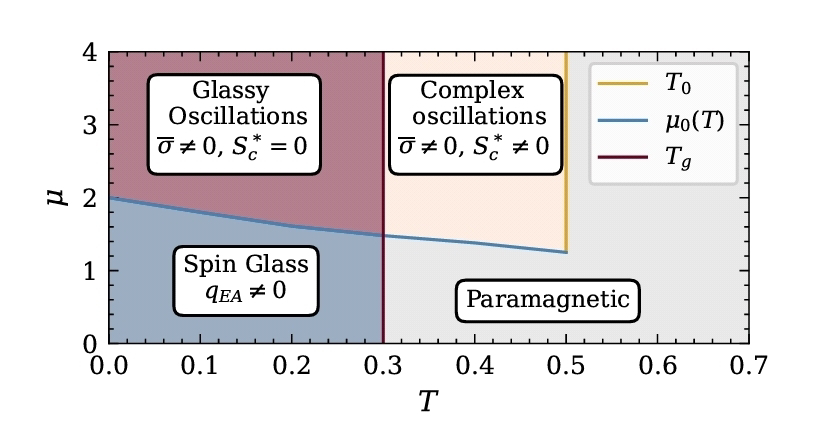
<< Systems with a complex dynamics like glasses or models of biological evolution are often pictured in terms of a complex landscape, with a large number of possible collective states. (AA) show on the example of a stochastic spin model with nonreciprocal and heterogeneous interactions how the complex landscape picture can be generalized far from equilibrium, where collective states may become time-dependent and exhibit, e.g., spontaneous oscillations, often hidden by the presence of disorder. >>

AA << identify relevant observables, like the density of entropy production rate, to unveil the spontaneous collective time dependence, and  determine a configurational entropy which counts the number of oscillating collective states when this number grows exponentially with system size. >>

Laura Guislain, Eric Bertin. Far-from-equilibrium complex landscapes. Phys. Rev. E 111, L062101 Jun 16, 2025.

arXiv: 2405.08452v1 [cond-mat.dis-nn]. May 14, 2024.

Also: evolution, order, disorder, disorder & fluctuations, chaos, in https://www.inkgmr.net/kwrds.html 

Keywords: gst, evolution, complexity, entropy, configurational entropy, order, disorder, disorder & fluctuations, spontaneous oscillations, chaos.

mercoledì 9 aprile 2025

# gst: conventional and anomalous mobility edges in a quasiperiodic chain.

<< Mobility edges (MEs) constitute the energies separating the localized states from the extended ones in disordered systems. Going beyond this conventional definition, recent proposal suggests for an ME which separates the localized and multifractal states in certain quasiperiodic systems - dubbed as the anomalous mobility edges (AMEs). >>

<< In this study, (AA) propose an exactly solvable quasiperiodic system that hosts both the conventional and anomalous mobility edges under proper conditions. (They) show that with increase in quasiperiodic disorder strength, the system first undergoes a delocalization to localization transition through an ME of conventional type. >>

<< Surprisingly, with further increase in disorder, (They) obtain that a major fraction of the localized states at the middle of the spectrum turn multifractal in nature. Such unconventional behavior in the spectrum results in two AMEs, which continue to exist even for stronger quasiperiodic disorder. >>

AA << numerically obtain the signatures of the coexisting MEs complement it through analytical derivation using Avila's global theory. In the end (They) provide important signatures from the wavepacket dynamics. >>️

Sanchayan Banerjee, Soumya Ranjan Padhi, Tapan Mishra. Emergence of distinct exact mobility edges in a quasiperiodic chain. arXiv: 2503.19834v1 [cond-mat.quant-gas]. Mar 25, 2025.️

Also: edge, order, disorder, waves, transition,  in https://www.inkgmr.net/kwrds.html 

Keywords: gst, edge, order, disorder, waves, transition 

giovedì 3 aprile 2025

# gst: when a phase transition could be controlled by a fixed point of infinite disorder

AA << apply a real-space block renormalization group approach to study the critical properties of the random transverse-field Ising spin chain with multispin interactions. First (They) recover the known properties of the traditional model with two-spin interactions by applying the renormalization approach for arbitrary size of the block. For the model with three-spin couplings (They) calculate the critical point and demonstrate that the phase transition is controlled by an infinite disorder fixed point. (AA) have determined the typical correlation-length critical exponent, which seems to be different from that of the random transverse Ising chain with nearest-neighbor couplings. Thus this model represents a new infinite disorder universality class. >>️

Ferenc Iglói, Yu-Cheng Lin. Random quantum Ising model with three-spin couplings. arXiv:2503.18690v1 [cond-mat.dis-nn]. Mar 24, 2025.

Also: disorder, order, transition, in https://www.inkgmr.net/kwrds.html 

Keywords: gst, disorder, order, transition

martedì 11 marzo 2025

# gst: emergent flocking in mixtures of antialigning self-propelled particles.

FIG. 4. (c) Mean field phase diagram with disorder (green triangles), polarized moving bands (blue circles), and polarized patches (orange squares).


AA << observe a flocking mechanism, the emergence of a state with global polar order, in mixed systems of self-propelled particles with purely antialigning interactions, i.e., the ground state for any pair of particles is to be opposedly oriented. In binary mixtures, (They) find that flocking can be realized by cross-species antialigning that is dominant compared to intraspecies antialignment. >>

<< While the key mechanism can be understood within a mean-field description, beyond mean-field (AA) develop an asymptotically exact Boltzmann-scattering theory from first principles.  This theory yields analytical predictions for the flocking transition and shows excellent quantitative agreement with simulations of dilute systems. For large systems, (They) find either microphase separation or static patterns with patches or stripes that carry different polarization orientations. >>️

Rüdiger Kürsten, Jakob Mihatsch, Thomas Ihle. Emergent flocking in mixtures of antialigning self-propelled particles. Phys. Rev. E 111, L023402. Feb 21, 2025.

Also: particle, flock, flocking, swarmorder, disorder, transition, in https://www.inkgmr.net/kwrds.html 

Keywords: gst, particles, self-propelled particles, flock, flocking, swarm, order, disorder, transitions

lunedì 24 febbraio 2025

# gst: when homogeneous systems meet dissipation and disorder.

AA << investigate the localization and topological properties of the non-equilibrium steady state (NESS) in a one-dimensional homogeneous system. (Their) results demonstrate that, despite the absence of disorder in the initial system, the NESS can exhibit localization under bond dissipation. >>

<< Conversely, for an initially flat-band system with compactly localized wave functions, the NESS is delocalized. >>

<< Furthermore, (They) find that the initial localization characteristics of the system significantly influence the localization properties of the NESS. Drawing upon the concept of Bose-Einstein condensate broadening in cold-atom experiments, along with experimental data, (AA) systematically characterize the impact of disorder on the localization and topological properties of the NESS. >>

<< The phase diagram reveals that the NESS can be topologically non-trivial even when the initial state is topologically trivial, and that the topological triviality of the initial state weakens the topological non-triviality of the NESS. >>

Xixi Feng, Ao Zhou, et al. When Homogeneous Systems Meet Dissipation and Disorder. arXiv: 2502.11383v1 [cond-mat.dis-nn]. Feb 17, 2025. 

Also: order, disorder, disorder & fluctuations, transition, in https://www.inkgmr.net/kwrds.html 

Keywords: gst, order, disorder, disorder & fluctuations, transitions


sabato 22 febbraio 2025

# gst: order and chaos in systems of coaxial vortex pairs

Fig. B.12: Ex. with 4 interact. vortex pairs

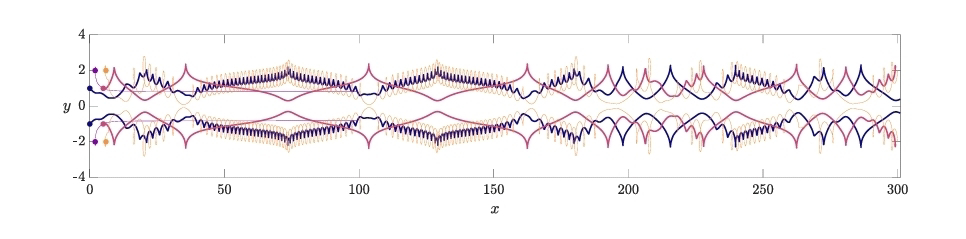
AA << have analyzed interactions between two and three coaxial vortex pairs, classifying their dynamics as either ordered or chaotic based on strengths, initial sizes, and initial horizontal separations.  >>️

They << found that periodic cases are scattered among chaotic ones across different initial configurations. Quasi-periodic leapfrogging typically occurs when the initial distances between the vortex pairs are small and cannot coexist with vortex-pair overtake. When the initial configuration splits into two interacting vortex pairs and a single propagating vortex pair, the two interacting pairs consistently exhibit periodic leapfrogging. For the smallest initial horizontal separations, the system predominantly exhibits chaotic or quasi-periodic motions rather than periodic leapfrogging with a single frequency. This behavior is due to the strong coupling between all three vortex pairs. When the pairs are in close proximity, more complex and chaotic dynamics emerge instead of periodic motion. >>

Their << findings indicate that quasi-periodic leapfrogging and chaotic interactions generally occur when the three vortex pairs have similar strengths and initial sizes. Conversely, discrepancies in these parameters cause the system to disintegrate into two subsystems: a single propagating vortex pair and two periodically leapfrogging pairs. >>️
Christiana Mavroyiakoumou, Wenzheng Shi. Order and Chaos in Systems of Coaxial Vortex Pairs. arXiv: 2502.07002v1 [physics.flu-dyn]. Feb 10, 2025. ️

Also: chaos, vortexorder, disorder, disorder & fluctuations, in https://www.inkgmr.net/kwrds.html 

Keywords: gst, chaos, vortex, order, disorder, disorder & fluctuations


lunedì 17 febbraio 2025

# gst: intrinsic disorder bars intruders (from biomolecular condensates)


<< It was recently discovered that eukaryotic cells are host to a multiplicity of biomolecular condensates. These condensates typically contain protein and/or RNA components with intrinsically disordered regions (IDRs). While IDRs have been proposed and demonstrated to play many roles in condensate biology, (AA) suggest here an additional crucial role of IDRs, which is to exclude unwanted “intruders” from condensates. This exclusion effect arises from the large conformational entropy of IDRs; i.e., there is a high free-energy cost to occupying space that would otherwise be available to the IDRs. By combining polymer theory with sticker-spacer simulations, (They) show that the relevant insertion free energy increases with the concentration of IDRs in the condensate as well as with intruder size, attaining a linear scaling with surface area for large intruders. >>

AA << find that at realistic IDR concentrations, particles as small as the size of an average protein (4 nm in diameter) can be 97% excluded from condensates. To overcome this entropic barrier, molecules must interact favorably with condensate components to be recruited as clients. Application of the developed size-exclusion theory to biological condensates suggests that condensate IDRs may play a generic exclusionary role across organisms and types of condensates. >>️

Vladimir Grigorev, Ned S. Wingreen, Yaojun Zhang. Conformational Entropy of Intrinsically Disordered Proteins Bars Intruders from Biomolecular Condensates. PRX Life 3, 013011. Feb 14, 2025.

Also: order, disorder, disorder & fluctuations, transition, in https://www.inkgmr.net/kwrds.html 

Keywords: gst, order, disorder, disorder & fluctuations, transitions


sabato 8 febbraio 2025

# gst: criticality and multistability in quasi-2D turbulence

       Fig. 1(a) Helmholtz resonators


<< Two-dimensional (2D) turbulence, despite being an idealization of real flows, is of fundamental interest as a model of the spontaneous emergence of order from chaotic flows. The emergence of order often displays critical behavior, whose study is hindered by the long spatial and temporal scales involved. >>

Here AA << experimentally study turbulence in periodically driven nanofluidic channels with a high aspect ratio using superfluid helium. (They) find a multistable transition behavior resulting from cascading bifurcations of large-scale vorticity and critical behavior at the transition to quasi-2D turbulence consistent with phase transitions in periodically driven many-body systems. >>

AA << demonstrate that quasi-2D turbulent systems can undergo an abrupt change in response to a small change in a control parameter, consistent with predictions for large-scale atmospheric or oceanic flows. >>️

Filip Novotny, Marek Talir, et al. Critical behavior and multistability in quasi-two-dimensional turbulence. arXiv: 2406.08566v1 [physics.flu-dyn]. Jun 12, 2024.

Also: order, disorder, disorder & fluctuations, turbulence, transition, in https://www.inkgmr.net/kwrds.html 

Keywords: gst, order, disorder, disorder & fluctuations, criticality, turbulence, transition 


venerdì 12 luglio 2024

# gst: apropos of the transition of order from chaos, a universal behavior near a critical point.

<< As the Reynolds number is increased, a laminar fluid flow becomes turbulent, and the range of time and length scales associated with the flow increases. Yet, in a turbulent reactive flow system, as we increase the Reynolds number, (AA) observe the emergence of a single dominant timescale in the acoustic pressure fluctuations, as indicated by its loss of multifractality. >>️

AA << study the evolution of short-time correlated dynamics between the acoustic field and the flame in the spatiotemporal domain of the system.   >>️

<< the susceptibility of the order parameter, correlation length, and correlation time diverge at a critical point between chaos and order. (AA) results show that the observed emergence of order from chaos is a continuous phase transition (..) the critical exponents characterizing this transition fall in the universality class of directed percolation. >>️

The << paper demonstrates how a real-world complex, nonequilibrium turbulent reactive flow system exhibits universal behavior near a critical point. >>️

Sivakumar Sudarsanan, Amitesh Roy, et al. Emergence of order from chaos through a continuous phase transition in a turbulent reactive flow system. Phys. Rev. E 109, 064214. Jun 20, 2024. 

Also: order, chaos, transition, in https://www.inkgmr.net/kwrds.html 

Keywords: gst, order, chaos, transition