Translate

lunedì 23 giugno 2025

# gst: active drive towards elastic spinodals


<< Active matter, exemplified by adaptive living materials such as the actomyosin cytoskeleton, can navigate material parameter space, leading to unconventional mechanical responses. In particular, it can self-drive toward elastic spinodal regimes, where inhomogeneous floppy modes induce elastic degeneracy and enable a controlled interplay between rigidity loss and recovery. Proximity to such marginal states leads to stress localization and the formation of force chains that can be actively assembled and disassembled. >> 

Here AA << extend the classical notion of spinodal states to active solids and demonstrate how these extreme mechanical regimes can be actively accessed. Moreover, (They) show that in a nonlinear setting, crossing elastic spinodals generates new energy wells and makes force channeling an intrinsic feature of the emerging microstructure. >>

Ayan Roychowdhury, Madan Rao, Lev Truskinovsky. Active drive towards elastic spinodals. Phys. Rev. E 111, 065416. Jun 20, 2025.

arXiv: 2403.17517v3 [cond-mat.soft]. May 20, 2025.

Also: elastic, transition, instability, disorder & fluctuations, self-assembly, in https://www.inkgmr.net/kwrds.html 

Keywords: gst, transitions, instability, disorder & fluctuations, active matter, elasticity, elastic forces, elastic deformation, elastic spinodals, self-assembly.

sabato 21 giugno 2025

# gst: a note on spinning billiards and chaos


AA << investigate the impact of internal degrees of freedom - specifically spin - on the classical dynamics of billiard systems. While traditional studies model billiards as point particles undergoing specular reflection, (AA) extend the paradigm by incorporating finite-size effects and angular momentum, introducing a dimensionless spin parameter that characterizes the moment of inertia. Using numerical simulations across circular, rectangular, stadium, and Sinai geometries, (AA) analyze the resulting trajectories and quantify chaos via the leading Lyapunov exponent. >>

<< Strikingly, (They) find that spin regularizes the dynamics even in geometries that are classically chaotic: for a wide range of α, the Lyapunov exponent vanishes at late times in the stadium and Sinai tables, signaling suppression of chaos. This effect is corroborated by phase space analysis showing non-exponential divergence of nearby trajectories. >>

AA << results suggest that internal structure can qualitatively alter the dynamical landscape of a system, potentially serving as a mechanism for chaos suppression in broader contexts. >>

Jacob S. Lund, Jeff Murugan, Jonathan P. Shock. A Note on Spinning Billiards and Chaos. arXiv: 2505.15335v1 [nlin.CD]. May 21, 2025.

Also: billiard, chaos, in https://www.inkgmr.net/kwrds.html 

Keywords: gst, billiard, spinning billiards, chaos.

venerdì 20 giugno 2025

# life: Ozzy's unexpected, on the air, sweet gift to future generations; 'Clone Me, You Bastards'

<< Yes, we really got the Prince of Darkness to drink from 10 cans of our low-calorie Iced Tea. And yes, he actually crushed each can himself. In the process, he left behind trace DNA from his saliva that you can now own. He even hand-signed each packaging label. >>

<< Now, when technology and federal law permits, you’ll be able to replicate Ozzy Osbourne and enjoy him for hundreds of years into the future. But you better hurry, there are only 10 Infinitely Recyclable Ozzy cans available to buy here:   https://liquiddeath.com/en-it/pages/ozzy >>

Buy Ozzy Osbourne's DNA From Liquid Death. youtube.com. Jun 17, 2025.

   << 
  Flavors
● Sweet Reaper.
● Blueberry Buzzsaw.
● Slaughter Berry.
● Green Guillotine.
● Dead Billionaire.
● Rest In Peach.
   >>


<< The Prince of Darkness is teaming up with Liquid Death to sell empty iced tea cans he's drank from. >>

Marina Watts. Ozzy Osbourne Sells His DNA on Liquid Death Cans for the Low Price of $450: 'Clone Me, You Bastards'. People. Jun 18, 2025. 


Also: saliva, are you ready, in https://www.inkgmr.net/kwrds.html 

Also: a different way to approach cloning: exponential post-Donald (without Donald), how AI could interfere (drive) next political elections. FonT. May 9, 2023.   https://flashontrack.blogspot.com/2023/05/life-exponential-post-donald-without.html


Keywords: life, saliva, human cloning, are you ready

mercoledì 18 giugno 2025

# gst: spontaneous flow instability in active nematics; when quiescent and flowing states may coexist.


<< Active nematics exhibit spontaneous flows through a well-known linear instability of the uniformly aligned quiescent state. Here, (AA) show that even a linearly stable uniform state can experience a nonlinear instability, resulting in a discontinuous transition to spontaneous flows. In this case, quiescent and flowing states may coexist. >>

<< Through a weakly nonlinear analysis and a numerical study, (AA) trace the bifurcation diagram of striped patterns and show that the underlying pitchfork bifurcation switches from supercritical (continuous) to subcritical (discontinuous) by varying the flow-alignment parameter. >>

AA << predict that the discontinuous spontaneous flow transition occurs for a wide range of parameters, including systems of contractile flow-aligning rods. (AA) predictions are relevant to active nematic turbulence and can potentially be tested in experiments on either cell layers or active cytoskeletal suspensions. >>

Ido Lavi, Ricard Alert, et al. Nonlinear Spontaneous Flow Instability in Active Nematics. Phys. Rev. Lett. 134, 238301. Jun 9, 2025.

arXiv: 2403.16841v1 [cond-mat.soft].

Also: instability, turbulence, transition, in https://www.inkgmr.net/kwrds.html 

Also: Active nematics, in A. Doostmohammadi, et al. Nat Comm vol 9, no 3246 (2018). 

Keywords: gst, instability, turbulence, transitions, supercritical-- subcritical bifurcations, active nematics.

martedì 17 giugno 2025

# gst: early warning skill, extrapolation and tipping for accelerating cascades; if the upstream system crosses a tipping point, this can shorten the timescale of valid extrapolation.

AA << investigate how nonlinear behaviour (both of forcing in time and of the system itself) can affect the skill of early warning signals to predict tipping in (directionally) coupled bistable systems when using measures based on critical slowing down due to the breakdown of extrapolation. (They) quantify the skill of early warnings with a time horizon using a receiver-operator methodology for ensembles where noise realisations and parameters are varied to explore the role of extrapolation and how it can break down. >>

AA << highlight cases where this can occur in an accelerating cascade of tipping elements, where very slow forcing of a slowly evolving ``upstream'' system forces a more rapidly evolving ``downstream'' system. If the upstream system crosses a tipping point, this can shorten the timescale of valid extrapolation. >>

<< In particular, ``downstream-within-upstream'' tipping will typically have warnings only on a timescale comparable to the duration of the upstream tipping process, rather than the timescale of the original forcing. >>

Peter Ashwin, Robbin Bastiaansen, et al. Early warning skill, extrapolation and tipping for accelerating cascades.arXiv: 2506.01981v1 [nlin.CD]. May 16, 2025.

Also: crack, fracture, noise, track changes in noise, in https://www.inkgmr.net/kwrds.html 

Keywords: gst, climate, early warning, tipping prediction, accelerating cascade, crossing a tipping point, multiple tipping points, fragmented tipping, criticality, noise, noise-induced tipping, crack, fracture

sabato 14 giugno 2025

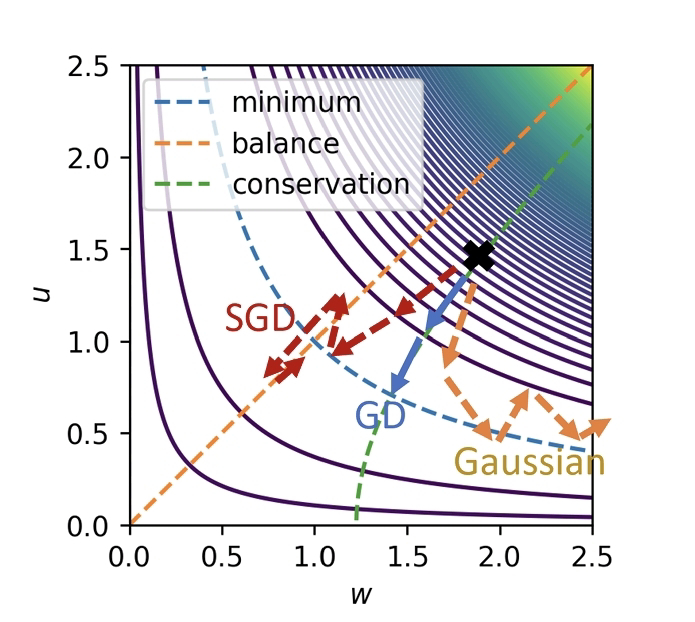
# aibot: noise balance and stationary distribution of stochastic gradient descent.


<< The stochastic gradient descent (SGD) algorithm is the algorithm (is used) to train neural networks. However, it remains poorly understood how the SGD navigates the highly nonlinear and degenerate loss landscape of a neural network. >>

<< In this work, (AA) show that the minibatch noise of SGD regularizes the solution towards a noise-balanced solution whenever the loss function contains a rescaling parameter symmetry. Because the difference between a simple diffusion process and SGD dynamics is the most significant when symmetries are present, (AA) theory implies that the loss function symmetries constitute an essential probe of how SGD works. (They) then apply this result to derive the stationary distribution of stochastic gradient flow for a diagonal linear network with arbitrary depth and width. >>

<< The stationary distribution exhibits complicated nonlinear phenomena such as phase transitions, broken ergodicity, and fluctuation inversion. These phenomena are shown to exist uniquely in deep networks, implying a fundamental difference between deep and shallow models. >>

Liu Ziyin, Hongchao Li, Masahito Ueda. Noise balance and stationary distribution of stochastic gradient descent. Phys. Rev. E 111, 065303. Jun 6, 2025.

Also: ai (artificial intell) (bot), network, noise, disorder & fluctuations, in https://www.inkgmr.net/kwrds.html 

Keywords: ai, artificial intelligence, noise, stochasticity, networks, neural networks, deep learning,stochastic gradient descent (SGD), transitions, phase transitions, broken ergodicity, fluctuation inversion

venerdì 13 giugno 2025

# gst: self-organization to multicriticality; when a system can self-organize to a new type of phase transition while staying on the verge of another.

<< Self-organized criticality is a well-established phenomenon, where a system dynamically tunes its structure to operate on the verge of a phase transition. Here, (AA) show that the dynamics inside the self-organized critical state are fundamentally far more versatile than previously recognized, to the extent that a system can self-organize to a new type of phase transition while staying on the verge of another. >>

<< In this first demonstration of self-organization to multicriticality, (AA) investigate a model of coupled oscillators on a random network, where the network topology evolves in response to the oscillator dynamics. (They) 
 show that the system first self-organizes to the onset of oscillations, after which it drifts to the onset of pattern formation while still remaining at the onset of oscillations, thus becoming critical in two different ways at once. >>
 
<< The observed evolution to multicriticality is robust generic behavior that (AA) expect to be widespread in self-organizing systems. Overall, these results offer a unifying framework for studying systems, such as the brain, where multiple phase transitions may be relevant for proper functioning.>>

Silja Sormunen, Thilo Gross, Jari Saramäki. Self-organization to multicriticality. arXiv: 2506.04275v1 [nlin.AO]. Jun 4, 2025. 

Also: network, random, self-assembly, transition, brain, in https://www.inkgmr.net/kwrds.html 

Keywords: gst, network, random, self-assembly, transition, phase transition, multiple phase transitions, self-organizing systems, self-organized criticality, multicriticality, brain.