Translate

sabato 14 giugno 2025

# aibot: noise balance and stationary distribution of stochastic gradient descent.


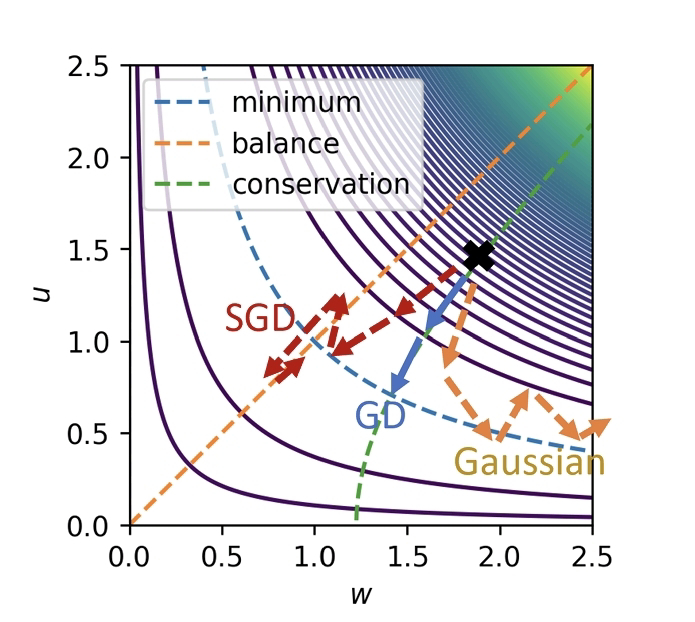
<< The stochastic gradient descent (SGD) algorithm is the algorithm (is used) to train neural networks. However, it remains poorly understood how the SGD navigates the highly nonlinear and degenerate loss landscape of a neural network. >>

<< In this work, (AA) show that the minibatch noise of SGD regularizes the solution towards a noise-balanced solution whenever the loss function contains a rescaling parameter symmetry. Because the difference between a simple diffusion process and SGD dynamics is the most significant when symmetries are present, (AA) theory implies that the loss function symmetries constitute an essential probe of how SGD works. (They) then apply this result to derive the stationary distribution of stochastic gradient flow for a diagonal linear network with arbitrary depth and width. >>

<< The stationary distribution exhibits complicated nonlinear phenomena such as phase transitions, broken ergodicity, and fluctuation inversion. These phenomena are shown to exist uniquely in deep networks, implying a fundamental difference between deep and shallow models. >>

Liu Ziyin, Hongchao Li, Masahito Ueda. Noise balance and stationary distribution of stochastic gradient descent. Phys. Rev. E 111, 065303. Jun 6, 2025.

Also: ai (artificial intell) (bot), network, noise, disorder & fluctuations, in https://www.inkgmr.net/kwrds.html 

Keywords: ai, artificial intelligence, noise, stochasticity, networks, neural networks, deep learning,stochastic gradient descent (SGD), transitions, phase transitions, broken ergodicity, fluctuation inversion

venerdì 13 giugno 2025

# gst: self-organization to multicriticality; when a system can self-organize to a new type of phase transition while staying on the verge of another.

<< Self-organized criticality is a well-established phenomenon, where a system dynamically tunes its structure to operate on the verge of a phase transition. Here, (AA) show that the dynamics inside the self-organized critical state are fundamentally far more versatile than previously recognized, to the extent that a system can self-organize to a new type of phase transition while staying on the verge of another. >>

<< In this first demonstration of self-organization to multicriticality, (AA) investigate a model of coupled oscillators on a random network, where the network topology evolves in response to the oscillator dynamics. (They) 
 show that the system first self-organizes to the onset of oscillations, after which it drifts to the onset of pattern formation while still remaining at the onset of oscillations, thus becoming critical in two different ways at once. >>
 
<< The observed evolution to multicriticality is robust generic behavior that (AA) expect to be widespread in self-organizing systems. Overall, these results offer a unifying framework for studying systems, such as the brain, where multiple phase transitions may be relevant for proper functioning.>>

Silja Sormunen, Thilo Gross, Jari Saramäki. Self-organization to multicriticality. arXiv: 2506.04275v1 [nlin.AO]. Jun 4, 2025. 

Also: network, random, self-assembly, transition, brain, in https://www.inkgmr.net/kwrds.html 

Keywords: gst, network, random, self-assembly, transition, phase transition, multiple phase transitions, self-organizing systems, self-organized criticality, multicriticality, brain.

giovedì 12 giugno 2025

# gst: unstable fixed points in chaotic networks

<< Understanding the high-dimensional chaotic dynamics occurring in complex biological systems such as recurrent neural networks or ecosystems remains a conceptual challenge. For low-dimensional dynamics, fixed points provide the geometric scaffold of the dynamics. However, in high-dimensional systems, even the location of fixed points is unknown. >>

Here, AA << analytically determine the number and distribution of fixed points for a canonical model of a recurrent neural network that exhibits high-dimensional chaos. This distribution reveals that fixed points and dynamics are confined to separate shells in state space. Furthermore, the distribution enables (AA) to determine the eigenvalue spectra of the Jacobian at the fixed points, showing that each fixed point has a low-dimensional unstable manifold. >>

<< Despite the radial separation of fixed points and dynamics, (They)  find that the principal components of fixed points and dynamics align and that nearby fixed points act as partially attracting landmarks for the dynamics. >>

AA results << provide a detailed characterization of the fixed point geometry and its interplay with the dynamics, thereby paving the way towards a geometric understanding of high-dimensional chaos through their skeleton of unstable fixed points. >>

Jakob Stubenrauch, Christian Keup, et al. Fixed point geometry in chaotic neural networks. Phys. Rev. Research 7, 023203. May 29, 2025.

Also: chaos, disorder & fluctuations, instability, transition, network, brain, in https://www.inkgmr.net/kwrds.html 

Keywords: gst, chaos, networks, neural networks, ecosystems, fixed points, unstable fixed points.

mercoledì 11 giugno 2025

# gst: apropos of weakness, weak but influential; nonlinear contributions of structural connectivity to human cognitive abilities and brain functions.

<< Diverse human cognitive abilities are rooted in brain structural connectivity which has weights spanning several orders of magnitude. However, due to false-positive challenges in tractography, weak connectivity has been often treated as noise and ignored - despite its prevalence across mammalian brains. >>

Here AA show << that weak connectivity significantly predicts human cognitive abilities and supports brain functions through amplification of its small weight in a nonlinear manner. >>

AA found that << weak connectivity involves high individual variability and significantly predicts general cognitive ability and memory in individuals, and it is also critical for whole-brain dynamic simulation and structure-function coupling. Importantly, fusing two post-tractography filtering methods of streamlines potentially results in more reliable connectivity that preserves weak links and outperforms conventional thresholding in predicting cognitive abilities and functional connectivity. >>

<< At the network level, weak connectivity expands the operational capacity of brain networks to enhance both global integration and fine-grained segregation, thereby supporting a functional balance essential for cognitive abilities. >>

<< Finally, (AA) identified a specific type of weak connectivity mainly linking visual/motor to limbic areas with negative gene co-expression, which has a disproportionately large impact on cognitive predictions and network dynamics. >>

Rong Wang, Zhao Chang, et al. Weak but influential: Nonlinear contributions of structural connectivity to human cognitive abilities and brain functions. arXiv: 2505.24125v1 [q-bio.NC]. May 30, 2025.

Also: brain, network, weak, noise, in https://www.inkgmr.net/kwrds.html 

Keywords: gst, brain, network, noise,  weakness, weak connectivity,  brain structural connectivity, tractography, multiple tractography algorithms, cognitive ability and memory, individual variability, global integration, fine-grained segregation, limbic areas.

martedì 10 giugno 2025

# gst: collective behavior based on topological vision.

<< The collective dynamics of active particles with topological vision are investigated. The topological vision, defined as a combination of the visual field and topological neighborhoods, breaks the action-reaction symmetry, thereby indicating that active particles exhibit the nonreciprocal topological interactions. >>

<< Furthermore, (AA) model considers position-based attractive force, wherein moving particles navigate using instantaneous visual information from neighboring particles within the topological vision, distinct from conventional models based on the velocity-velocity alignment. (They) demonstrate that the competition between the noise and the nonreciprocal topological interactions results in the emergence of four typical phases: gas phase, ordered phase, nematic bands, and aggregate traveling polar band. >>

<< Moreover, the nonreciprocal topological interactions impact both anomalous diffusion and ergodicity breaking. Specifically, the weak nonreciprocal topological interactions lead to ergodic subdiffusion, while the strong nonreciprocal topological interactions give rise to nonergodic superdiffusion. These findings provide a theoretical basis for understanding the nonequilibrium collective transport of active particles with topological vision. >>

Hongda Shi, Luchun Du, Wei Guo. Collective behavior based on topological vision. Phys. Rev. Research 7, 023234. Jun 6, 2025. 

Also: particle, noise, in https://www.inkgmr.net/kwrds.html 

Keywords: gst, particles, active 
particles, noise, topological vision, 
reciprocal- nonreciprocal topological interactions, gas phase, ordered phase, nematic bands, aggregate traveling polar band.

lunedì 9 giugno 2025

# gst: double burst transition in hypergraphs.

Fig.2 - Bifurcation diagram. A two-parameter stability diagram in K2-d_th space depicting the different synchronization transition regimes. Blue, gray, cyan, red, light green, magenta, and dark gray present the regimes for continuous, tiered, classical explosive, forward and  backward double jump, forward double jump, explosive with stable middle states, and backward double jump synchronization transitions, respectively

This AA study << aims to develop a generalized concept that will enable double explosive transitions in the forward and backward directions or a combination thereof. >>

AA << found two essential factors for generating such phase transitions: the use of higher-order (triadic) interactions and the partial adaptation of a global order parameter acting on the triadic coupling. A compromise between the two factors may result in a double explosive transition. >>

<< To reinforce numerical observations, (They) employed the Ott-Antonsen ansatz. (AA) observed that for a wide class of hypergraphs, combining two elements can result in a double explosive transition. >>

Sangita Dutta, Prosenjit Kundu, et al. Double explosive Kuramoto transition in hypergraphs. Phys. Rev. Research 7, L022049. June 2, 2025.

Also: transition, in https://www.inkgmr.net/kwrds.html 

Keywords: gst, transitions, phase transitions.

sabato 7 giugno 2025

# life: apropos of Trump-Musk dipole, an immediate MJQ apoptotic rift

<< In the last two days, the once powerful relationship between President Donald Trump and billionaire Elon Musk has unraveled as they took jabs at each other from their respective social media sites, X and Truth Social. Musk left his official role in the administration late last month. See how the digital confrontation devolved from complaints over the president’s tax bill to Musk alleging Trump was “in the Epstein files.” . >>

Rachel Lerman. A timeline of Musk and Trump’s devolving relationship. washingtonpost.com. Jun 6, 2025.

FonT: an Ivy League Academic (e.g. a Harvard academic) could, as a funny hypothesis (and just to check if and how it works), to try to restore this form of sadic intermittent acyclic pseudo MJQ dipole; in this regard He/She/? could be immediately operational as a catalytic fractal epizeusis entity (obviously without ideological prejudices) to play Parrondo game to drive a quasi-stochastic tit-for-tat cooperative strategy. 

Soloperosservarecosasuccedeanzicheforse ...

Also: tit-for-tat, game, Parrondo, 
game, apoptosis, Mr. Donald, in https://www.inkgmr.net/kwrds.html

Also: MJQ, in FonT https://flashontrack.blogspot.com/search?q=mjq. in Notes (quasi-stochastic poetry) Attrattore cooperativo bipolare (nell' elastici spigoli), Mar 5, 2007. https://inkpi.blogspot.com/2007/03/2124-attrattore-cooperativo-bipolare.html


Also: sadico, in Notes (quasi-stochastic poetry) https://inkpi.blogspot.com/search?q=sadico

Keywords: life, Parrondo, Tit-for-Tat, MJQ, epizeusis, POTUS, Mr.Donald, Trump-Musk, sadistic, apoptosis, billiards, dance.