Translate
venerdì 12 settembre 2025
# gst: shock waves in classical dust collapse.
mercoledì 19 agosto 2020
# gst: the role of surface tension during the collapse of a viscous bubble
sabato 6 marzo 2021
# gst: the dynamics of a collective bubble (in a foam) that collapse in a droplet
martedì 31 gennaio 2023
# gst: analogy between streamers in sinking spheroids, gyrotactic plumes and chemotactic collapse (when a plume structure blows up when a parm is above a threshold)
martedì 30 luglio 2024
# gst: collapse of a toroidal bubble inducing shock waves
giovedì 17 febbraio 2022
# gst: approaching the dynamics of nanobubble formation and collapse
lunedì 2 settembre 2019
# geo gst: even small flank failures can cause large tsunamis
<< Volcanogenic tsunamis are one of the deadliest volcanic phenomena. >>
<< Small flank failures causing large tsunamis represent a vastly underappreciated geohazards-current tsunami monitoring systems do not monitor for this kind of volcanic activity, instead focusing on large earthquakes or proxies related to unusual increases in magma intrusion. >>
<< This collapse was captured in unprecedented detail by satellite remote sensing, providing an opportunity to understand the collapse of the volcano (Anak Krakatau volcano, Indonesia) in a way that has not previously been possible at any volcanic island in the world. >>
Reconstructing the Anak Krakatau flank collapse that caused the December 2018 Indonesian tsunami. Geological Society of America. Aug 30, 2019. https://m.phys.org/news/2019-08-reconstructing-anak-krakatau-flank-collapse.html
<< the volume of material initially lost from the volcano flank failure (..) was relatively small (~0.1 km3) compared to the overall changes observed during the entire eruption, but it was nonetheless able to generate rapid tsunami waves with devastating impacts. The flank failure also changed the eruption style and the upper volcanic plumbing system, with the subsequent explosive eruptions destroying the summit and then partially rebuilding the lost flank. >>
Rebecca Williams, Pete Rowley, Matthew C. Garthwaite. Reconstructing the Anak Krakatau flank collapse that caused the December 2018 Indonesian tsunami. Geology. doi.org/10.1130/G46517.1. Aug 30, 2019. https://pubs.geoscienceworld.org/gsa/geology/article-abstract/573356/reconstructing-the-anak-krakatau-flank-collapse
martedì 4 febbraio 2025
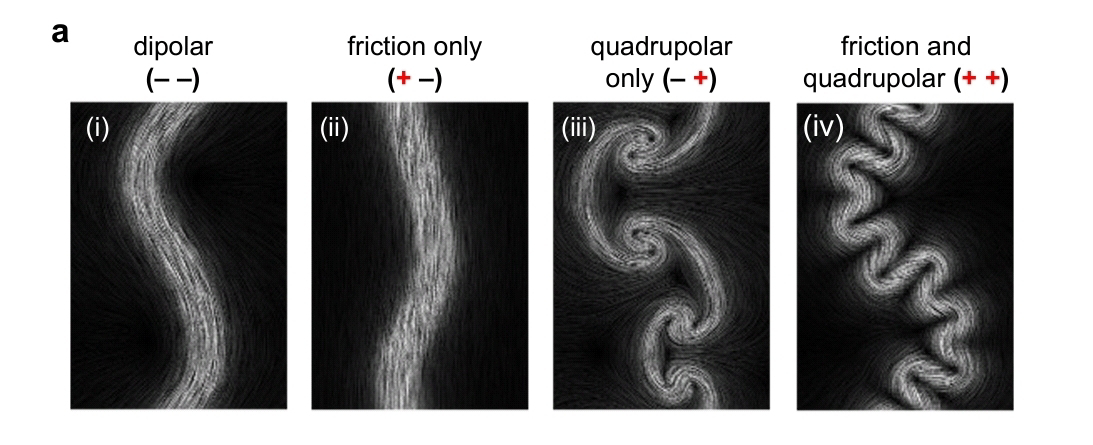
# gst: quadrupolar stress drives collapse of nematic order on frictional substrates.
lunedì 11 novembre 2024
# gst: apropos of bubbles, the case of bubbles collapsing near a wall.
lunedì 5 luglio 2021
# gst: apropos of (multitudes) of transitional droplets, when a liquid film collapses in a foam ...
martedì 11 giugno 2019
# gst: apropos of bubbles, how simple foams collapse
<< When a bubble breaks, (AA) found that a collapse event propagates via impact with the receding film and tiny scattered droplets breaking other bubbles. >>
<< A key finding was that changing the viscosity of the fluid did not lead to a significant change in the number of bubbles broken. Methods to stabilize foams commonly rely on changing the viscosity, yet the team's findings clearly show how both the number of bubbles collapsed and the velocity of the receding film are unaffected. >>
Two distinct physical mechanisms identified for how simple foams collapse. Tokyo Metropolitan University. June 10, 2019.
https://m.phys.org/news/2019-06-distinct-physical-mechanisms-simple-foams.html
Naoya Yanagisawa, Rei Kurita. In-situ observation of collective bubble collapse dynamics in a quasi-two-dimensional foam. Scientific Reports 9, Article number: 5152. March 26, 2019
sabato 19 luglio 2025
# gst: noise reinstates collapsed populations; stochastic reversal of deterministic extinction.
lunedì 6 novembre 2017
# astro: so strong concentration of 'dust pebbles' ultimately leads to a collapse
<< 'dust pebbles' are concentrated so strongly by an instability in the solar nebula that their joint gravitational force ultimately leads to a collapse >>
Comet mission reveals 'missing link' in our understanding of planet formation. Oct 25, 2017
https://m.phys.org/news/2017-10-comet-mission-reveals-link-planet.html
Jurgen Blum, Bastian Gundlach, et al. Evidence for the formation of comet 67P/Churyumov-Gerasimenko through gravitational collapse of a bound clump of pebbles. Monthly Notices of the Royal Astronomical Society, stx2741 doi: 10.1093/mnras/stx2741 Oct 25, 2017
https://academic.oup.com/mnras/article-abstract/doi/10.1093/mnras/stx2741/4564447
venerdì 15 giugno 2018
# gst: Sustainability, Die-off, Collapse, Oscillation: 4 classes of traject. to depict interactions of a resource-intensive tech species with its host planet.
AA << have used the formalism of dynamical systems theory to explore a highly simplified model for the interaction of a resource-intensive technological species with its host planet. >>
AA << find four distinct classes of trajectories (..)
Sustainability: For these classes, stable equilibria (..) exist which can be approached monotonically. The population rises smoothly to a steady-state value. The planetary environment is monotonically perturbed from its initial value e0 and reaches a new steady state that can support a large population.
Die-off: For these classes, stable equilibria (..) exist which cannot be approached monotonically. The population overshoots the environment's carrying capacity, reaches a peak, and is forced to decline as the environment reaches its new steady state.
Collapse: For these classes, stable equilibria with nonzero population do not exist. In these cases the population experiences a rapid decline after reaching its peak value. It is noteworthy that collapse can occur even though the population has begun leveling off due to the civilization's switching from high-impact to low-impact energy modalities.
Oscillation: In this class, a stable limit cycle exists rather than an equilibrium. The population and the planetary environment cycle between high and low values. >>
Frank A, Carroll-Nellenback Jonathan, et al. The Anthropocene Generalized: Evolution of Exo-Civilizations and Their Planetary Feedback. Astrobiology. 18 (5), May 1, 2018. doi: 10.1089/ast.2017.1671.
https://www.liebertpub.com/doi/10.1089/ast.2017.1671
Alien apocalypse: Can any civilization make it through climate change? University of Rochester. Jun 5, 2018.
https://m.phys.org/news/2018-06-alien-apocalypse-civilization-climate.html
giovedì 21 giugno 2018
# gst: to model a system that can "collapse without warning"
<< Volcanoes progressively weaken and may collapse without warning through hydrothermal alteration. These dangerous mass wasting processes occur less-frequently than eruptions or lahars but the resultant mass flows can be large in size, posing risk to local residents, and businesses. >>
<< Collapses are often multi-hazard events, with even small-scale landslides capable of triggering eruptions or creating break-out lahars. >>
<< These kind of events demonstrated the greater need to understand and assess this process >>
Gabor Kereszturi. Modelling volcanoes that "collapse without warning". Massey University. Jun 21, 2018.
venerdì 25 giugno 2021
# gst: apropos of transitions, tsunami waves generated by granular collapses.
martedì 18 novembre 2025
# gst: apropos of itinerant behaviors, from chaotic itinerancy to intermittent synchronization in complex networks.
martedì 6 novembre 2018
# gst: how a bubble pops
<< After a bubble bursts at a liquid surface, the collapse of the cavity generates capillary waves, which focus on the axis of symmetry to produce a jet. >>
AA << show that the time-dependent profiles of cavity collapse (..) and jet formation (..) both obey a inviscid scaling, which results from a balance between surface tension and inertia forces. >>
Ching-Yao Lai, Jens Eggers, and Luc Deike. Bubble Bursting: Universal Cavity and Jet Profiles. Phys. Rev. Lett. 121, 144501. Oct 2, 2018
https://journals.aps.org/prl/abstract/10.1103/PhysRevLett.121.144501
John Sullivan. Math describes how bubbles pop. Princeton University. Oct 31, 2018.
mercoledì 9 luglio 2025
# gst: the evasion of tipping; pattern formation near a Turing-fold bifurcation
martedì 8 ottobre 2019
# gst: a cylindrical solitonlike that collapses into a spherical shape, and, along the filaments, central cores of matter exhibit fuzzies
In AA simulation, << the dark matter filaments show coherent interference patterns on the boson de Broglie scale and develop cylindrical solitonlike cores, which are unstable under gravity and collapse into kiloparsec-scale spherical solitons. Features of the dark matter distribution are largely unaffected by the baryonic feedback. On the contrary, the distributions of gas and stars, which do form along the entire filament, exhibit central cores imprinted by dark matter-a smoking gun signature of FDM ("fuzzy" dark matter). >>
Philip Mocz, Anastasia Fialkov, et al. First Star-Forming Structures in Fuzzy Cosmic Filaments. Phys. Rev. Lett. 123, 141301. Oct 2, 2019. https://journals.aps.org/prl/abstract/10.1103/PhysRevLett.123.141301
Jennifer Chu. This is how a 'fuzzy' universe may have looked. Massachusetts Institute of Technology. Oct 3, 2019 https://m.phys.org/news/2019-10-fuzzy-dark-disrupts-conventional.html
FonT
intrigante qui come una simulazione di evoluzione cosmologica - filamenti strutturati a cilindro mutanti (collassanti) in strutture sferoidali (ma non a generica fluttuante frittella) formanti, nei filamenti di gas, serie (sciami?) di kernel a dinamiche fuzzy - possa far immaginare generici contesti altri ...