Translate

Visualizzazione dei post in ordine di data per la query escape. Ordina per pertinenza Mostra tutti i post

mercoledì 10 giugno 2026

# gst: localization of active particles on random arrays of parallel filaments.


<< ️Quenched disorder in the environment can fundamentally alter transport dynamics in both active and passive systems. (AA) explore how disordered arrays of filaments govern the distribution of intermittently moving particles which switch between diffusive and processive transport. >>

<<️ Motivated by the mixed-polarity arrangements of parallel microtubules observed in mammalian dendrites, (They) show that such arrays tend to result in localization of particles at regions of convergent filament orientation. In the rapid attachment-detachment limit, the disordered system can be described by a noisy one-dimensional effective energy landscape, whose structure is approximated by a random walk. >>

<< ️The depth and width of wells on this landscape are expressed as a function of the transport kinetics and system geometry. Localization is shown to be strongest at intermediate run-lengths, where biased transport persists long enough to sense the quenched filament polarity but not so long as to facilitate escape from local traps. >>

<< ️These (AA) results demonstrate robust localization of particles moving on random filament networks, highlighting the emergent spatial organization that arises from an interplay of active transport and quenched disorder. >>

Owen Santoso, Elena Koslover. Localization of Active Particles on Random Arrays of Parallel Filaments. arXiv: 2606.00286v1 [cond-mat.dis-nn]. May 29, 2026.

Also: noise, disorder, disorder & fluctuations, random, intermittency, escape, particle, in https://www.inkgmr.net/kwrds.html 

Keywords: gst, noise, disorder, disorder & fluctuations, randomness, intermittency, escape, particles, quenched disorder, transport dynamics, diffusive and processive transport, arrays of filaments, random walk, random filament networks, escape from local traps.

martedì 28 aprile 2026

# gst: transient chaos and Rayleigh particle escape out of a time modulated optical trap.


<< ️(AA) consider Rayleigh particles in a periodically modulated optical trap formed by two counterpropagating Gaussian beams. It is shown that for certain values of the parameters the system exhibits transient chaos which manifests itself in particle acceleration and subsequent directional ejection out of the trap. The escape flights are terminated at a distance of hundreds of wavelengths from the trap center and the particles return to the trap under the action of the Stokes force. The particle escape is shown to be a threshold effect that can be potentially employed for particle sorting. >>

Evgeny N. Bulgakov, Konstantin N. Pichugin, Dmitrii N. Maksimov. Transient chaos and Rayleigh particle escape out of a time modulated optical trap. Phys. Rev. E 113, 044216. Apr 23, 2026.

arXiv:2512.03403v1 [nlin.CD]. Dec 3, 2025.

Also: chaos, transition, particle, escape, in https://www.inkgmr.net/kwrds.html 

Keywords: gst, chaos, transitions, particle, escape, periodically modulated trap, threshold effect.

martedì 21 aprile 2026

# gst: quantum walk on a random comb.

<< ️(AA) study continuous time quantum walk on a random comb graph with infinite teeth. Due to localization effects along the spine, the walk cannot go to infinity in the spine direction, while it can escape to infinity along the teeth of the comb. Starting from an initial vertex the walk has a nonzero probability to stay trapped in a finite region. These results are obtained by studying the spectrum and eigenstates of the random Hamiltonian for the graph and analysing its properties. (They) use both analytic and numerical methods many of which come from the theory of Anderson localization in one dimension. >>

François David, Thordur Jonsson. Quantum walk on a random comb. arXiv: 2604.00908v1 [quant-ph]. Apr 1, 2026.

Also: Francois David, Thordur Jonsson (2021). Quantum walk on a comb with infinite teeth. 
https://arxiv.org/abs/2107.08866    Bergfinnur Durhuus, Thordur Jonsson, John Wheater (2005). Random walks on combs. 

Also: walk, random, escape, in https://www.inkgmr.net/kwrds.html 

Keywords: gst, combs, walk, quantum walk, escape, randomness.

sabato 11 aprile 2026

# gst: apropos of escape, Stochastic Web Map; survival probability and escape frequency.

<< ️(AA) study transport and escape in the Stochastic Web Map (SWM), an area-preserving system with phase-space structure controlled by a symmetry parameter q and nonlinearity K. By analyzing the survival probability P_S(n) and escape frequency P_E(lnn), (They) show that in the chaotic regime escape dynamics is governed by a single time scale n_(typ) ∝ K^(−2)h^(2); here h is the size of the escape horizon. Deviations at large K and small h indicate a breakdown of the quasilinear approximation. Then, upon rescaling the time by n_(typ), escape statistics becomes universal, independent of q. These results demonstrate that escape is controlled by global transport rather than symmetry. >>

K. B. Hidalgo-Castro, J. A. Méndez-Bermúdez, Edson D. Leonel. Stochastic Web Map: Survival probability and escape frequency. arXiv: 2603.20888v1 [nlin.CD]. Mar 21, 2026.

Also: escape, chaos, in https://www.inkgmr.net/kwrds.html 

Keywords: gst, escape, escape horizon, chaos, global transport.

sabato 14 febbraio 2026

# gst: spatial self-organization driven by temporal noise.

<< ️The counterintuitive emergence of order from noise is a central phenomenon in science, ranging from pattern formation and synchronization to order-by-disorder in frustrated systems. While large-scale spatial self-organization induced by local spatial noise is well studied, whether temporal noise can also drive such organization remains an open question. >>

<< ️Here, by studying interacting particle systems, (AA) show that temporally correlated noise can lead to a self-organized state with suppressed long-range density fluctuations, or hyperuniformity. Further, (They) develop a fluctuating hydrodynamic theory that quantitatively explains the origin of this phenomenon. >>

<< ️Finally, by casting the dynamics as a stochastic optimization problem, (They) show that temporal correlations lead to better solutions, akin to perturbed gradient descent in neural networks -- where noise is injected during training to escape poor minima. This reveals a striking correspondence between perturbed gradient descent dynamics on the energy landscapes of particle systems and the loss landscapes of neural networks. >>

Satyam Anand, Guanming Zhang, Stefano Martiniani. Spatial self-organization driven by temporal noise. arXiv: 2601.23098v1 [cond-mat.soft]. Jan 30, 2026.

Also: self-assembly, noise, order, disorder, disorder & fluctuations, particle, escape, network, in https://www.inkgmr.net/kwrds.html 

Keywords: gst, self-assembly, noise, order, disorder, disorder & fluctuations, particles, networks, neural networks, spatial noise, temporal noise, noise-driven self-organization.

lunedì 8 dicembre 2025

# gst: apropos of escape, qualitatively distinct mechanisms of noise-induced escape in diffusively coupled bistable elements.


<< ️The analysis of noise-induced escape in ensembles of bistable elements is challenging, because nonlinearity, coupling, and noise all play essential roles. (AA) show that the interplay of these three factors yields three qualitatively distinct escape mechanisms in diffusively coupled bistable elements, depending on the coupling strength. >> 

<< ️To clarify the relation between coupling strength and mean escape time, (They) derive effective one-dimensional dynamics: nonlinear mean-field Fokker-Planck equation in the weak-coupling regime, stochastic mean-field dynamics in the strong-coupling regime, and deterministic mean-field dynamics in the intermediate regime. >>

<< ️(AA) validate these reduced descriptions by comparing predictions with numerical simulations. (They) identify a distinct dominant driving factor of escape processes in each regime. Notably, the three escape mechanisms emerge through the interplay of nonlinearity, diffusive coupling, and dynamical noise -- rather than bifurcations of the noise-free system. >>

<< ️(AA) approach serves as a framework applicable to other diffusively coupled stochastic nonlinear systems, motivating a further search for similar synergistic phenomena. >>

Hidemasa Ishii, Hiroshi Kori. Qualitatively distinct mechanisms of noise-induced escape in diffusively coupled bistable elements. arXiv: 2512.01388v1 [nlin.AO]. Dec 1, 2025.

Also: noise, escape, in https://www.inkgmr.net/kwrds.html 

Keywords: gst, noise, escape, noise-induced escape, bistable elements, weak- mean- strong- regimes, stochasticity.

giovedì 23 ottobre 2025

# gst: gigantic dynamical spreading and anomalous diffusion of jerky active particles.


<< ️Jerky active particles are Brownian self-propelled particles which are dominated by “jerk,” the change in acceleration. They represent a generalization of inertial active particles. In order to describe jerky active particles, a linear jerk equation of motion which involves a third-order derivative in time, Stokes friction, and a spring force (AA) combined with activity modeled by an active Ornstein-Uhlenbeck process. This equation of motion (They) solved analytically and the associated mean-square displacement (MSD) is extracted as a function of time. >>

<< ️For small damping and small spring constants, the MSD shows an enormous superballistic spreading with different scaling regimes characterized by anomalous high dynamical exponents 6, 5, 4, or 3 arising from a competition among jerk, inertia, and activity. When exposed to a harmonic potential, the gigantic spreading tendency induced by jerk gives rise to an enormous increase of the kinetic temperature and even to a sharp localization-delocalization transition, i.e., a jerky particle can escape from harmonic confinement. >>

<< ️The transition can be either first or second order as a function of jerkiness. Finally (AA)  shown that self-propelled jerky particles governed by the basic equation of motion can be realized experimentally both in feedback-controlled macroscopic particles and in active colloids governed by friction with memory. >>

Hartmut Löwen. Gigantic dynamical spreading and anomalous diffusion of jerky active particles. Phys. Rev. E 112, 045412. Oct 17, 2025.
https://journals.aps.org/pre/abstract/10.1103/976t-qry7

Also: particle, colloids, transition, escape, in https://www.inkgmr.net/kwrds.html 

Keywords: gst, particles, colloids, self-propelled particles, active Brownian particles, Jerky active particles, jerkiness, transitions, superballistic spreading, escape.

sabato 18 ottobre 2025

# gst: apropos of waves that escape trapping; on internal wave whispering gallery modes in channels and critical-slope wave attractors.

<< ️Internal waves are an important feature of stratified fluids, both in oceanic and lake basins and in other settings. Many works have been published on the generic feature of internal wave trapping onto planar wave attractors and super-attractors in 2D & 3D and the exceptional class of standing global internal wave modes. >>

<< ️However, most of these works did not deal with waves that escape trapping. By using continuous symmetries (AA) analytically prove the existence of internal wave Whispering Gallery Modes (WGMs), internal waves that propagate continuously without getting trapped by attractors. WGMs neutral stability with respect to different perturbations enable whispering gallery beams, a continuum of rays propagating together coherently. The systems' continuous symmetries also enable projection onto 2D planes that yield effective 2D billiards preserving the original dynamics. >>

<< ️By examining rays deviating from these WGMs in parabolic channels (They) discover a new type of wave attractor which is located along the channel instead of across it as in previous works. This new wave attractor leads to a re-understanding of WGMs as sitting at the border between the two basins of attraction. >>

<< ️Finally, both critical-slope wave attractors and whispering gallery beams are used to propose explanations for along-channel energy fluxes in submarine canyons and tidal energy intensification near critical slopes. >>

Nimrod Bratspiess, Eyal Heifetz, Leo R. M. Maas. On internal wave whispering gallery modes in channels and critical-slope wave attractors. arXiv: 2510.07218v1 [physics.flu-dyn]. Oct 8, 2025.

Also: waves, billiard, in https://www.inkgmr.net/kwrds.html 

Keywords: gst, waves, internal waves, internal wave whispering gallery modes (WGMs), wave attractors, basins of attraction, billiards.

sabato 13 settembre 2025

# gst: intensity landscapes in elliptic and oval billiards with a circular absorbing region.


<< ️Billiard models of single particles moving freely in two-dimensional regions enclosed by hard walls have long provided ideal toy models for the investigation of dynamical systems and chaos. Recently, billiards with (semi)permeable walls and internal holes have been used to study open systems. >>

<< ️Here (AA) introduce a billiard model containing an internal region with partial absorption. The absorption does not change the trajectories but instead reduces an intensity variable associated with each trajectory. The value of the intensity can be tracked as a function of the initial configuration and the number of reflections from the wall and depicted in intensity landscapes over the Poincaré phase space. >>

<< ️This is similar in spirit to escape time diagrams that are often considered in dynamical systems with holes.  >>

<< ️(AA) analyze the resulting intensity landscapes for three different geometries: a circular, elliptic, and oval billiard, respectively, all with a centrally placed circular absorbing region. The intensity landscapes feature increasingly more complex structures, organized around the sets of points in phase space that intersect the absorbing region in a given iteration, which (They) study in some detail. On top of these, the intensity landscapes are enriched by effects arising from multiple absorption events for a given trajectory. >>

Katherine Holmes, Joseph Hall, Eva-Maria Graefe. Intensity landscapes in elliptic and oval billiards with a circular absorbing region. Phys. Rev. E 112, 034202. Sep 2, 2025.

Also: billiard, particle, escape, in https://www.inkgmr.net/kwrds.html 

Keywords: gst, billiard, particle, escape.

lunedì 2 dicembre 2024

# gst: apropos of diffusive anomalies, anomalous diffusion of active Brownian particles in responsive elastic gels.

Here, AA << examine via extensive computer simulations the dynamics of SPPs (self-propelled particles) in deformable gellike structures responsive to thermal fluctuations. (AA) treat tracer particles comparable to and larger than the mesh size of the gel. (They) observe distinct trapping events of active tracers at relatively short times, leading to subdiffusion; it is followed by an escape from meshwork-induced traps due to the flexibility of the network, resulting in superdiffusion. >>

AA << thus find crossovers between different transport regimes. (They) also find pronounced nonergodicity in the dynamics of SPPs and non-Gaussianity at intermediate times. The distributions of trapping times of the tracers escaping from “cages” in (..)  quasiperiodic gel often reveal the existence of two distinct timescales in the dynamics. At high activity of the tracers these timescales become comparable. >>

<< Furthermore, (AA) find that the mean waiting time exhibits a power-law dependence on the activity of SPPs (in terms of their Péclet number). (Their) results additionally showcase both exponential and nonexponential trapping events at high activities. Extensions of this setup are possible, with the factors such as anisotropy of the particles, different topologies of the gel network, and various interactions between the particles (also of a nonlocal nature) to be considered. >>

Koushik Goswami, Andrey G. Cherstvy, et al. Anomalous diffusion of active Brownian particles in responsive elastic gels: Nonergodicity, non-Gaussianity, and distributions of trapping times. Phys. Rev. E 110, 044609. Oct 29, 2024.

Also: particle, random, escape, network, in https://www.inkgmr.net/kwrds.html 

Keywords: gst, particle, random, random walks, escape, network


venerdì 18 ottobre 2024

# gst: isles of regularity (depending on the initial setup) in a sea of chaos amid the gravitational three-body problem.


AA << study probes the presence of regular (i.e. non-chaotic) trajectories within the 3BP (three-body problem) and assesses their impact on statistical escape theories. >>

AA << analysis reveals that regular trajectories occupy a significant fraction of the phase space, ranging from 28% to 84% depending on the initial setup, and their outcomes defy the predictions of statistical escape theories. The coexistence of regular and chaotic regions at all scales is characterized by a multi-fractal behaviour. >>

Alessandro Alberto Trani, Nathan W.C. Leigh, et al. Isles of regularity in a sea of chaos amid the gravitational three-body problem. A&A, 689, A24, Jun 25, 2024.

"Islands" of Regularity Discovered in the Famously Chaotic Three-Body Problem. University of Copenhagen. Oct 11, 2024.

Also: three balls, escape, chaos, transition, in https://www.inkgmr.net/kwrds.html 

Keywords: gst, three balls, escape, chaos, transition 


martedì 21 maggio 2024

# gst: relativistic chaotic scattering, scaling laws for trapped trajectories.


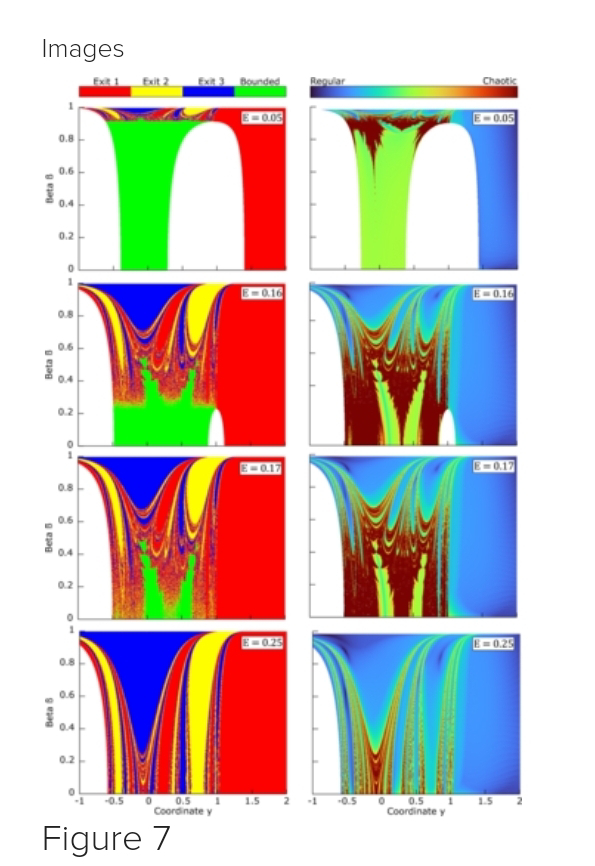
AA << study different types of phase space structures which appear in the context of relativistic chaotic scattering. By using the relativistic version of the Hénon-Heiles Hamiltonian, (They) numerically study the topology of different kind of exit basins and compare it with the case of low velocities in which the Newtonian version of the system is valid. >>

<< In all cases, fractal structures are present, and the escaping dynamics is characterized. In every case a scaling law is numerically obtained in which the percentage of the trapped trajectories as a function of the relativistic parameter β and the energy is obtained. >>

Their << work could be useful in the context of charged particles which eventually can be trapped in the magnetosphere, where the analysis of these structures can be relevant. >>️

Fernando Blesa, Juan D. Bernal, et al. Relativistic chaotic scattering: Unveiling scaling laws for trapped trajectories. Phys. Rev. E 109, 044204. Apr 5, 2024.

Also: chaos, chaotic, escape, particle, in https://www.inkgmr.net/kwrds.html 

Keywords: gst, chaos, chaotic, escape, escape trajectories


giovedì 9 maggio 2024

# gst: bubble phases sliding over periodically modulated substrates

AA << analyze a bubble-forming system composed of particles with competing long-range repulsive and short-range attractive interactions driven over a quasi-one-dimensional periodic substrate. >>️

They << find various pinned and sliding phases as a function of substrate strength and drive amplitude. When the substrate is weak, a pinned bubble phase appears that depins elastically into a sliding bubble lattice. For stronger substrates, (AA) find anisotropic bubbles, disordered bubbles, and stripe phases. Plastic depinning occurs via the hopping of individual particles from one bubble to the next in a pinned bubble lattice, and as the drive increases, there is a transition to a state where all of the bubbles are moving but are continuously shedding and absorbing individual particles. This is followed at high drives by a moving bubble lattice in which the particles can no longer escape their individual bubbles. >>️

<< When the bubbles shrink due to an increase in the attractive interaction term, they fit better inside the pinning troughs and become more strongly pinned, leading to a reentrant pinning phase. For weaker attractive terms, the size of the bubbles becomes greater than the width of the pinning troughs and the depinning becomes elastic with a reduced depinning threshold. >>
C. Reichhardt, C.J.O. Reichhardt. Sliding dynamics for bubble phases on periodic modulated substrates. Phys. Rev. Research 6, 023116. May 2, 2024.

Also: bubble, elastic, transition, in https://www.inkgmr.net/kwrds.html 

Keywords: gst, bubble, pinned bubble, elastic, transition


martedì 23 aprile 2024

# gst: Lévy flights and Lévy walks under stochastic resetting.

<< Stochastic resetting is a protocol of starting anew, which can be used to facilitate the escape kinetics. (AA)  demonstrate that restarting can accelerate the escape kinetics from a finite interval restricted by two absorbing boundaries also in the presence of heavy-tailed, Lévy-type, α
-stable noise. However, the width of the domain where resetting is beneficial depends on the value of the stability index α determining the power-law decay of the jump length distribution. For heavier (smaller α) distributions, the domain becomes narrower in comparison to lighter tails. >>

<< Additionally, (AA) explore connections between Lévy flights (LFs) and Lévy walks (LWs) in the presence of stochastic resetting. First of all, (They) show that for Lévy walks, the stochastic resetting can also be beneficial in the domain where the coefficient of variation is smaller than 1. Moreover, (They) demonstrate that in the domain where LWs are characterized by a finite mean jump duration (length), with the increasing width of the interval, the LWs start to share similarities with LFs under stochastic resetting. >>️

Bartosz Żbik, Bartłomiej Dybiec. Lévy flights and Lévy walks under stochastic resetting. Phys. Rev. E 109, 044147. April 22, 2024.

Also: keyword Lévy in FonT

Also: escape, noise, in https://www.inkgmr.net/kwrds.html 

Keywords: gst, escape, noise, stochastic resetting, Lévy


sabato 30 settembre 2023

# gst: wandering domains: a hypothetical scenario with bounded orbits.

<< A significant open question in transcendental dynamics asks if it is possible for a point, and thus all points, of a wandering domain to have a bounded orbit. >>

<< In other words, is there a transcendental entire function f with a wandering domain U such that its forward orbit, U_n≥0 f^n(U), is bounded? >>

AA << give a partial answer to this question by constructing an example of a such a wandering domain U which has a nearly bounded orbit; >>

<< In other words, the set of natural numbers n for which f^n(U) is contained in D has upper (and lower) natural density one. >>

<< This is in particularly strong contrast to all existing examples of wandering domains, for which the quantity (..) is equal to zero for any choice of bounded domain D. >>

Leticia Pardo-Simon, David J. Sixsmith. Wandering domains with nearly bounded orbits. arXiv: 2307.16682v1 [math.DS]. Jul 31, 2023. 

Also: Unbounded fast escaping wandering domains. https://arxiv.org/abs/2210.13350 ; Escaping sets of continuous functions. https://arxiv.org/abs/1601.04010 


Also: 'fuga', in Notes (quasi-stochastic poetry): https://inkpi.blogspot.com/search?q=fuga 

Keywords: gst, wandering domain, escape 


lunedì 19 dicembre 2022

# gst: behavior of microswimmers in a vortex with translational and rotational noise

AA << propose a theoretical model to investigate the dynamics of elongated microswimmers in elementary vortices, namely active particles in two- and three-dimensional rotlets. A deterministic model first reveals the existence of bounded orbits near the centre of the vortex and unbounded orbits elsewhere. (AA) further discover a conserved quantity of motion that allows (..) to map the phase space according to the type of the orbit (bounded vs unbounded). (They) next introduce translational and rotational noise into the system. Using a Fokker--Planck formalism, (AA) quantify the quality of trapping near the centre of the vortex by examining the probability of escape and the mean time of escape from the region of deterministically bounded orbits. (AA) finally show how to use these findings to formulate a prediction for the radius of the depletion zone, which compares favourably with the experiments of Sokolov and Aranson (2016). >>

Ivan Tanasijevic, Eric Lauga. Microswimmers in vortices: Dynamics and trapping. arXiv: 2211.05866v1 [physics.bio-ph].  Nov 10, 2022. 

Also

'microswimmers' in FonT 

Keywords: gst, behav, translation,  rotation, trapping, noise, swimmer, swimming,  microswimmers, fluid dynamics, vortex, vortices, vortexes, vorticity


lunedì 10 ottobre 2022

# gst: apropos of transitions, escape inside a noisy layered system

<< Noisy layered systems can exhibit amplified fluctuation patterns depending on their connectivity. Here (AA) showed that noise originally injected in one layer may induce faster basin escape in connected layers. This is both due to the amplification of the noise amplitude and the system specific correlations that the noise acquire while going through the first layer. Indeed, (..) one sees that the noise in the second is correlated in both space and time with clear dependence on the network structure. For networks with low algebraic connectivity, (AA) numerically showed that the first escape time is shorter in the two cases where (i) fluctuations are amplified in the second layer and (ii) noise in the second layer is rescaled in order to have the same variance in both layers. While point (i) is rather intuitive, i.e. larger fluctuations lead to shorter first escape times, point (ii) is more involved. Indeed, this indicates that noise with spatial and temporal correlations (..) selects directions that enable faster exits from the initial basin of attraction. >>

Melvyn Tyloo. Faster network disruption from layered oscillatory dynamics. arXiv: 2210.01180v1 [nlin.AO]. Oct 3, 2022. 

Also

keyword 'escape' in FonT


keyword 'escape' | 'fuga' in Notes 
(quasi-stochastic poetry)


Keywords: gst, transitions, escape, noise, noisy layered systems 


sabato 25 giugno 2022

# astro: eight new echoing black hole binaries (in Milky Way)

<< Scattered across our Milky Way galaxy are tens of millions of black holes—immensely strong gravitational wells of spacetime, from which infalling matter, and even light, can never escape. Black holes are dark by definition, except on the rare occasions when they feed. As a black hole pulls in gas and dust from an orbiting star, it can give off spectacular bursts of X-ray light that bounce and echo off the inspiraling gas, briefly illuminating a black hole's extreme surroundings. >>

<< In a study appearing (..) in the The Astrophysical Journal, (AA) report (..) eight new echoing black hole binaries in our galaxy. Previously, only two such systems in the Milky Way were known to emit X-ray echoes. >>️

 << Kara (Erin Kara) and her colleagues are using X-ray echoes to map a black hole's vicinity, much the way that bats use sound echoes to navigate their surroundings. (..)  As a side project, Kara is working with MIT education and music scholars, Kyle Keane and Ian Condry, to convert the emission from a typical X-ray echo into audible sound waves. >>️️

Jennifer Chu. Search reveals eight new sources of black hole echoes. MIT.  May 2, 2022. 


Jingyi Wang, Erin Kara, et al. The NICER "Reverberation Machine": A Systematic Study of Time Lags in Black Hole X-Ray Binaries. ApJ. 930, 18. May 2, 2022. 


Also

keyword 'black hole' in FonT


keyword 'waves' in FonT


keyword 'onda' in Notes 
(quasi-stochastic poetry)


Keywords: astro, black hole, echoes, waves

venerdì 22 ottobre 2021

# gst: the effect of noise on the dynamics of microswimmers in externally-driven fluid flows.

AA << have quantified the effect of noise on swimmer dynamics in a steady, two-dimensional hyperbolic fluid flow. In such a flow, swimmers are ultimately forced to escape to the left or the right, with their transient dynamics near the passive unstable fixed point determining which way they go. >>

<< Without noise, a swimmer’s fate is sealed based on its position relative to the SwIM (swimming invariant manifolds) in the xθ phase space. With noise, the swimmer’s motion is a stochastic process. >>

AA << calculated the steady-state orientation distributions of diffusive, run-and-tumble, or mixed swimmers in the hyperbolic flow. The fluctuations give some swimmers greater opportunity to cross the SwIM and exit on the opposite side than they would have without noise. There is however a maximal distance that swimmers can get on either side of the passive fixed point and still be able to swim back to the other side—this is where the stable BIMs (burning invariant manifolds) block inward swimming particles. >>

<< Fluctuations make it increasingly likely that a swimmer close to one of these BIMs does indeed end up crossing it, causing irreversible changes to the fluctuating swimmers’ trajectories (assuming negligible translational diffusion).  >>️

Simon A. Berman, Kevin A. Mitchell. Swimmer dynamics in externally-driven fluid flows: The role of noise. arXiv: 2108.10488v1 [physics.flu-dyn]. Aug 24, 2021.


keywords: gst, swimmer, swimming particle, fluid dynamics, chaotic dynamics, rotational diffusion, random fluctuation, tumbling, noise


martedì 20 luglio 2021

# life: some scientists hypothesize the possibility of (A) traveling faster than light, (B) visiting the interior of a black hole, (C) being already under observation by alien entities.

(A) traveling faster than light

<< Lentz (Erik Lentz. https://iopscience.iop.org/article/10.1088/1361-6382/abe692 ) proposes one such way we might be able to do this, thanks to what he calls a new class of hyper-fast solitons – a kind of wave that maintains its shape and energy while moving at a constant velocity (and in this case, a velocity faster than light). According to Lentz's theoretical calculations, these hyper-fast soliton solutions can exist within general relativity, and are sourced purely from positive energy densities, meaning there's no need to consider exotic negative- energy- density sources that haven't yet been verified. (..) With sufficient energy, configurations of these solitons could function as 'warp bubbles', capable of superluminal motion, and theoretically enabling an object to pass through space-time while shielded from extreme tidal forces. >>

<< another recent analysis, published only this month ( David Nield.  https://www.sciencealert.com/engineers-have-proposed-the-first-model-for-a-physical-warp-drive  ;  Alexey Bobrick, Gianni Martire. https://iopscience.iop.org/article/10.1088/1361-6382/abdf6e ), which also proposes an alternative model for a physically possible warp drive that doesn't require negative energy to function. >>️️

Peter Dockrill. Faster-Than-Light Travel Is Possible Within Einstein's Physics, Astrophysicist Shows. Mar 11, 2021.


(B) visiting the interior of a black hole

<<  if a person found an isolated supermassive black hole suitable for scientific study and decided to venture in, everything observed or measured of the black hole interior would be confined within the black hole's event horizon.
Keeping in mind that nothing can escape the gravitational pull beyond the event horizon, the in-falling person would not be able to send any information about their findings back out beyond this horizon. Their journey and findings would be lost to the rest of the entire universe for all time. But they would enjoy the adventure, for as long as they survived … maybe …. >>️

Leo Rodriguez, Shanshan Rodriguez. Could a human enter a black hole to study it? A person could travel past (certain) black holes' event horizons without dying immediately — here's how. Feb 7, 2021. 


(C) being already under observation by alien entities.

<< On June 25 the Pentagon and the Office of the Director of National Intelligence released their much hyped report on unidentified aerial phenomena, or UAP. (..) And while the report did not rule out an extraterrestrial origin for much of the documented UAP, it was short on details or bombshells. >> 

<<  we already know our world is easily detectable by extrasolar observers. A paper published on June 23 in Nature  
(Kaltenegger L., Faherty J.K.  https://www.nature.com/articles/s41586-021-03596-y ) shows that in the past 5,000 years, 1,715 stars have been in the right celestial position to view a populated Earth transiting the sun—with 319 more entering this sweet spot in the next 5,000 years. And seven of these far-off stars are known to have their own orbiting exoplanets that might support life. >>

<< Think of living in a room, and all the windows are open, and you do all your business, and you don’t know that all the windows are open, (..) Would you behave differently if you knew that you are being seen all your life? >>️  René Heller️
Tess Joosse. Aliens Might Already Be Watching Us. A new star map reveals more than 2,000 stars, some with their own planets, that have a direct view of our planetary presence. July 1, 2021