Translate

Visualizzazione dei post in ordine di data per la query walking. Ordina per pertinenza Mostra tutti i post

domenica 30 novembre 2025

# gst: apropos of Parrondo paradox, controlling quantum chaos via Parrondo strategies on noisy intermediate-scale quantum hardware


<< ️Advancements in noisy intermediate-scale quantum (NISQ) computing are steadily pushing these systems toward outperforming classical supercomputers on specific well-defined computational tasks. In this work (AA) explore and control quantum chaos in NISQ systems using discrete-time quantum walks (DTQWs) on cyclic graphs. To efficiently implement quantum walks on NISQ hardware, (They) employ the quantum Fourier transform to diagonalize the conditional shift operator, optimizing circuit depth and fidelity. >>

<< ️(AA) experimentally realize the transition from quantum chaos to order via DTQW dynamics on both odd and even cyclic graphs, specifically 3- and 4-cycle graphs, using the counterintuitive Parrondo paradox strategy across three different NISQ devices. >>

<< ️While the 4-cycle graphs exhibit high-fidelity quantum evolution, the 3-cycle implementation shows significant fidelity improvement when augmented with dynamical decoupling pulses. (Their) results demonstrate a practical approach to probing and harnessing controlled chaotic dynamics on real quantum hardware, laying the groundwork for future quantum algorithms and cryptographic protocols based on quantum walks. >>

Aditi Rath, Dinesh Kumar Panda, Colin Benjamin. Controlling quantum chaos via Parrondo strategies on noisy intermediate-scale quantum hardware. Phys. Rev. E 112, 054219. Nov 18, 2025.

arXiv: 2506.11225v2 [quant-ph]. Nov 4, 2025.

Also: parrondo, noise, walk, walking, order, chaos, transition, in https://www.inkgmr.net/kwrds.html 

Keywords: gst, parrondo, noise, walk, walking, quantum walk, order, chaos, quantum chaos, transition, dynamical decoupling pulses, cryptography.

venerdì 10 ottobre 2025

# gst: random trajectories in bounded domains


<< ️Can we deduce the total length of a random trajectory by observing only its local path segments within a confined domain? Surprisingly, the answer is yes—for curves randomly placed and oriented in space, whether stochastic or deterministic; generated by ballistic or diffusive dynamics; possibly interrupted by stopping or branching; and in two or more dimensions. More precisely, the mean total length ⟨𝐿⟩ relates to the mean in-domain path length ⟨ℓ⟩ and the mean chord length of the domain ⟨𝜎⟩ via the following simple and universal relation:

              1/⟨ℓ⟩ = 1/⟨𝐿⟩ + 1/⟨𝜎⟩

Here, ⟨𝜎⟩ is a purely geometric quantity, dependent only on the volume-to-surface ratio of the domain. Derived solely from the kinematic formula of integral geometry, the result is independent of step-length statistics, memory, absorption, and branching, making it equally relevant to photons in turbid tissue, active bacteria in microchannels, cosmic rays in molecular clouds, or neutron chains in nuclear reactors. Monte Carlo simulations spanning straight needles, Y shapes, and isotropic random walks in two and and three dimensions confirm the universality and demonstrate how a local measurement of ⟨ℓ⟩ yields ⟨𝐿⟩ without ever tracking the full trajectory. >>

T. Binzoni, E. Dumonteil, A. Mazzolo. Universal property of random trajectories in bounded domains. Phys. Rev. E 112, 044105. Oct 3, 2025.

arXiv: 2011.06343v3 [math-ph]. May 16, 2025. 

Also: random, walk, walking, in https://www.inkgmr.net/kwrds.html 

Also: voli a casaccio (quasi-stochastic poetry). Oct 01, 2006.

Keywords: gst, randomness, random trajectories,  walk, random walk, bounded domains.

sabato 27 settembre 2025

# gst: universal criterion for selective outcomes under stochastic resetting


<< ️Resetting plays a pivotal role in optimizing the completion time of complex first-passage processes with single or multiple outcomes and exit possibilities. While it is well established that the coefficient of variation—a statistical dispersion defined as a ratio of the fluctuations over the mean of the first-passage time—must be larger than unity for resetting to be beneficial for any outcome averaged over all the possibilities, the same cannot be said while conditioned on a particular outcome.  >>

<< ️The purpose of (AA) article is to derive a universal condition that reveals that two statistical metrics—the mean and coefficient of variation of the conditional times—come together to determine when resetting can expedite the completion of a selective outcome, and furthermore can govern the biasing between preferential and nonpreferential outcomes. The universality of this result is demonstrated for a one-dimensional diffusion process subjected to resetting with two absorbing boundaries. >>

<< ️Processes with multiple outcomes are abundant in nature starting from gated chemical reactions, enzymatic reactions, channel facilitated transport, directed intermittent search in cellular biology such as cytoneme based morphogenesis, motor driven intracellular transport and in artificial systems such as queues, algorithms and games. Many such systems have resetting integrated to their dynamics either intrinsically or externally (..).  >>

Suvam Pal, Leonardo Dagdug, et al. Universal criterion for selective outcomes under stochastic resetting. Phys. Rev. E 112, 034116. Sep 5, 2025.

arXiv: 2502.09127v1 [cond-mat.stat-mech]. Feb 13, 2025.


Also: walk, walking, random, in https://www.inkgmr.net/kwrds.html

Keywords: gst, walk, walking, random, resetting strategy,  stochastic resetting.

giovedì 4 settembre 2025

# gst: noisy active matter

<< ️Noise threads every scale of the natural world. Once dismissed as mere background hiss, it is now recognized as both a currency of information and a source of order in systems driven far from equilibrium. >>

<< ️From nanometer-scale motor proteins to meter-scale bird flocks, active collectives harness noise to break symmetry, explore decision landscapes, and poise themselves at the cusp where sensitivity and robustness coexist. >>

<< ️(AA) review the physics that underpins this paradox: how energy-consuming feedback rectifies stochastic fluctuations, how multiplicative noise seeds patterns and state transitions, and how living ensembles average the residual errors. Bridging single-molecule calorimetry, critical flocking, and robophysical swarms, (They) propose a unified view in which noise is not background blur but a tunable resource for adaptation and emergent order in biology and engineered active matter. >>

Atanu Chatterjee, Tuhin Chakrabortty, Saad Bhamla. Noisy active matter. arXiv:2508.16031v1 [cond-mat.soft]. Aug 22, 2025.

Also: transition, noise, track changes in noise, erratic, random, error, mistake, uncertainty, disorder & fluctuations, walk, walking, dance, jazz, in https://www.inkgmr.net/kwrds.html 

Keywords: gst, transitions, noise, track changes in noise, erratic, random, error, mistake, uncertainty, disorder & fluctuations, deposition (analogy, abstraction), walk, walking, life, dance, jazz. 

martedì 2 settembre 2025

# gst: dynamics and frictional dissipation for treading slowly in a puddle.

<< ️The process of producing a liquid column is common in daily life and industrial applications, such as walking through a puddle and roller printing. While governed by the Navier-Stokes equation, its dynamics are often studied by numerical means, which hinders a full understanding of the rich mixture of physics behind, for instance, the competition of surface and potential energies, and how the pinch off is affected by the kinetic energy and water jet when a large cylinder is used. For pedestrians rushing out of the rain, the water column inevitably involves turbulence and defies simple theoretical analyses.  >>

<< ️As a result, this (AA) work will focus only on cases with a low Reynolds number to enable laminar flow and the existence of reversible and quasistatic stages. Combined with simple models, (They) elucidate the mechanism that drives the change of morphology and derive analytic expressions for the critical height and upper radius for the liquid column when transiting between three stages. >>

<< ️Stage I is characterized by a static and reversible profile for the column whose upper radius 𝑟𝑡 equals that of the cylinder. The column becomes irreversible and 𝑟𝑡 starts shrinking upon entering stage II. It is not until 𝑟𝑡 stops shrinking that the column neck accelerates its contraction and descends toward the pool, the quantitative behavior of which is among the successful predictions of our theory. Pinch off dominates the second half of stage III without its usual signature of self-similarity. This is discussed and explained with an interesting incident involving a water jet similar to that made by a dropping stone. >>

Chung-Hao Chen, Zong-Rou Jiang, Tzay-Ming Hong. Dynamics and frictional dissipation for treading slowly in a puddle. Phys. Rev. E 112, 025105. Aug 25, 2025.

arXiv: 2310.09737v2 [physics.flu-dyn]. May 18, 2024.

Also: walk, walking, in https://www.inkgmr.net/kwrds.html 

Keywords: walk, walking.

lunedì 1 settembre 2025

# gst: apropos of (unexpected?) transitions; the bizarre role of noise as operational control

<< ️Stochastic systems have a control-theoretic interpretation in which noise plays the role of control. In the weak-noise limit, relevant at low temperatures or in large populations, this leads to a precise mathematical mapping: The most probable trajectory between two states minimizes an action functional and corresponds to an optimal control strategy.  >>

<< ️In Langevin dynamics, the noise term itself serves as the control. For general Markov jump processes, such as chemical reaction networks or electronic circuits, (AA) use the Doi-Peliti formalism to identify the “response” (or “momentum”) field 𝜋 as the control variable. This resolves a long-standing interpretational problem in the field-theoretic description of stochastic systems: Although 𝜋 evolves backward in time, it has a clear physical role as the control that steers the system along rare trajectories. >>

<< ️This implies that nature is constantly sampling control strategies.  >>

<< ️(AA) illustrate the mapping on multistable chemical reaction networks, systems with unstable fixed points, and specifically on stochastic resonance and Brownian ratchets. >>

<< ️ The noise-control mapping justifies agential descriptions of these phenomena and builds intuition for otherwise puzzling phenomena of stochastic systems: why probabilities are generically nonsmooth functions of state out of thermal equilibrium; why biological mechanisms can work better in the presence of noise; and how agential behavior emerges naturally without recourse to mysticism. >>

Eric De Giuli. Noise equals control. Phys. Rev. E 112, 024142. Aug 29, 2025.

arXiv:2503.15670v3 [q-bio.MN]. 

Also: transition, noise, track changes in noise, erratic, random, error, mistake, uncertainty, disorder & fluctuations, walk, walking, dance, jazz, in https://www.inkgmr.net/kwrds.html 

Keywords: gst, transition, noise, track changes in noise, erratic, random, error, mistake, uncertainty, disorder & fluctuations, deposition (analogy, abstraction), walk, walking, life, dance, jazz. 

lunedì 4 agosto 2025

# behav: souvenir collector's walk; the distribution of the number of steps of a continuous-time random walk ending at a given position.

AA << consider a random walker performing a continuous-time random walk (CTRW) with a symmetric step lengths' distribution possessing a finite second moment and with a power-law waiting time distribution with finite or diverging first moment. The problem (They) pose concerns the distribution of the number of steps of the corresponding CTRW conditioned on the final position of the walker at some long time 𝑡. >>

<< ️For positions within the scaling domain of the probability density function (PDF) of final displacements, the distributions of the number of steps show a considerable amount of universality, and are different in the cases when the corresponding CTRW corresponds to subdiffusion and to normal diffusion. >>

They << ️moreover note that the mean value of the number of steps can be obtained independently and follows from the solution of the Poisson equation whose right-hand side depends on the PDF of displacements only. >>

<< ️This approach works not only in the scaling domain but also in the large deviation domain of the corresponding PDF, where the behavior of the mean number of steps is very sensitive to the details of the waiting time distribution beyond its power-law asymptotics. >>

Igor M. Sokolov. Souvenir collector's walk: The distribution of the number of steps of a continuous-time random walk ending at a given position. Phys. Rev. E 112, 024101. Aug 1, 2025

Also: behav, walk, walking, random, in https://www.inkgmr.net/kwrds.html 

Keywords: behavior, walk, walking, random walks, randomness.

mercoledì 25 giugno 2025

# gst: interactive anisotropic walks in 2D generated from a 3-state opinion dynamics model.


<< A system of interacting walkers is considered in a two-dimensional hypothetical space, where the dynamics of each walker are governed by the opinion states of the agents of a fully connected three-state opinion dynamics model. Such walks, studied in different models of statistical physics, are usually considered in one-dimensional virtual spaces. >>

In this article AA has performed the mapping << in such a way that the walk is directed along the 𝑌 axis while it can move either way along the 𝑋 axis. The walk shows that there are three distinct regions as the noise parameter, responsible for driving a continuous phase transition in the model, is varied. In absence of any noise, the scaling properties and the form of the distribution along either axis do not follow any conventional form. >>

<< For any finite noise below the critical point the bivariate distribution of the displacements is found to be a modified biased Gaussian function while above it, only the marginal distribution along one direction is Gaussian. The marginal probability distributions can be extracted and the scaling forms of different quantities, showing power-law behavior, are obtained. The directed nature of the walk is reflected in the marginal distributions as well as in the exponents. >>

Surajit Saha, Parongama Sen. Interactive anisotropic walks in two dimensions generated from a three-state opinion dynamics model. Phys. Rev. E 111, 064123. Jun 18, 2025.

arXiv: 2409.10413v3 [cond-mat.stat-mech]. Apr 28, 2025. 

Also: walk, noise, random, transition, in https://www.inkgmr.net/kwrds.html 

Keywords: gst, walk, walking, random walk, randomness, noise, transitions, noise-induced transitions, criticality.

lunedì 2 giugno 2025

# gst: apropos of ambiguous scenarios, very persistent random walkers reveal transitions in landscape topology

AA << study the typical behavior of random walkers on the microcanonical configuration space of mean-field disordered systems. Passive walks have an ergodicity-breaking transition at precisely the energy density associated with the dynamical glass transition, but persistent walks remain ergodic at lower energies. >>

<< In models where the energy landscape is thoroughly understood, (They) show that, in the limit of infinite persistence time, the ergodicity-breaking transition coincides with a transition in the topology of microcanonical configuration space. (They) conjecture that this correspondence generalizes to other models, and use it to determine the topological transition energy in situations where the landscape properties are ambiguous. >>

Jaron Kent-Dobias. Very persistent random walkers reveal transitions in landscape topology. arXiv: 2505.16653v2 [cond-mat.dis-nn]. May 23, 2025. 

Also: random, walk, walking, disorder, transition, in https://www.inkgmr.net/kwrds.html

Also: ambiguity in FonT  https://flashontrack.blogspot.com/search?q=ambiguity     ambiguity in Notes (quasi-stochastic poetry)  https://inkpi.blogspot.com/search?q=ambiguita

Keywords: mean-field disordered systems, disorder, randomness, random walker, transitions, topological transition energy, ambiguity.

sabato 24 maggio 2025

# gst: apropos of absorbing targets, persistence exponents of self-interacting random walks


<< The persistence exponent, which characterizes the long-time decay of the survival probability of stochastic processes in the presence of an absorbing target, plays a key role in quantifying the dynamics of fluctuating systems. Determining this exponent for non-Markovian processes is known to be a difficult task, and exact results remain scarce despite sustained efforts. >> 

In their Letter, AA << consider the fundamental class of self-interacting random walks (SIRWs), which display long-range memory effects that result from the interaction of the random walker at time 𝑡 with the territory already visited at earlier times 𝑡′ <𝑡. (AA)  compute exactly the persistence exponent for all physically relevant SIRWs. As a byproduct, (They) also determine the splitting probability of these processes. >>

<< Besides their intrinsic theoretical interest, these results provide a quantitative characterization of the exploration process of SIRWs, which are involved in fields as diverse as foraging theory, cell biology, and nonreversible Monte Carlo methods. >>

J. Brémont, L. Régnier, et al. Persistence Exponents of Self-Interacting Random Walks. Phys. Rev. Lett. 134, 197103. May 16, 2025.

arXiv:2410.18699v1 [cond-mat.stat-mech]. 

Also: walk, walking, in https://www.inkgmr.net/kwrds.html 

Keywords: gst, walk, walking, self-interacting random walk, walker self-repulsion, walker self-attraction, stochasticity, absorbing targets.

sabato 16 marzo 2024

# gst: apropos of random walks, intermittent random walks under stochastic resetting

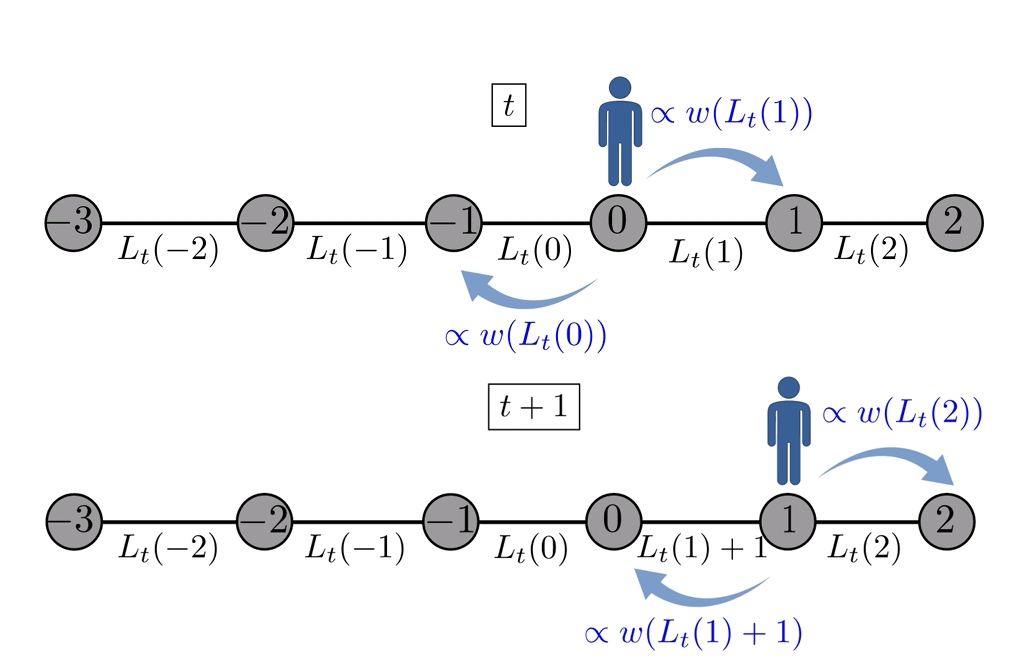
AA << analyze a one-dimensional intermittent random walk on an unbounded domain in the presence of stochastic resetting. In this process, the walker alternates between local intensive search, diffusion, and rapid ballistic relocations in which it does not react to the target. >>

AA << demonstrate that Poissonian resetting leads to the existence of a non-equilibrium steady state. (They) calculate the distribution of the first arrival time to a target along with its mean and show the existence of an optimal reset rate. In particular, (..) the initial condition of the walker, i.e., either starting diffusely or relocating, can significantly affect the long-time properties of the search process. >>

<< the presence of distinct parameter regimes for the global optimization of the mean first arrival time when ballistic and diffusive movements are in direct competition. >>️

Rosa Flaquer-Galmes, Daniel Campos,  Vicenc Mendez. Intermittent random walks under stochastic resetting. Phys. Rev. E 109, 034103. March 4, 2024. 

Also: walk, walking, random, in https://www.inkgmr.net/kwrds.html

Keywords: gst, walk, intermittent random walk, stochasticity, stochastic resetting


lunedì 14 agosto 2023

# gst: rich behaviors from stochastic walking with variable long jumps.


AA << propose a generalized model where the random walker takes stochastic jumps of lengths proportional to its present position with certain probability, otherwise it makes forward and backward jumps of fixed (unit) length with given rates. The model exhibits a rich stochastic dynamic behavior.  (AA) obtain exact analytic results for the first two moments of the walker's displacement and show that a phase transition from a diffusive to superdiffusive regime occurs if the stochastic jumps of lengths that are twice (or more) of its present positions are allowed. This phase transition is accompanied by a reentrant diffusive behavior. >> 

Upendra Harbola. Stochastic walker with variable long jumps. Phys. Rev. E 108, 014135. July 28, 2023. 

Also: walk, noise, fluctuations, dance,  in: https://www.inkgmr.net/kwrds.html

Keywords: gst, walks, random walks, noise, fluctuations


venerdì 31 marzo 2023

# gst: influence of disorder on the spreading and entanglement properties of coined quantum walks.


AA << investigate the influence of disorder on the spreading and entanglement properties of coined quantum walks. Specifically, (AA) consider quantum walks on the line and explore the effects of quenched disorder in the coin operations. (They) find that coin disorder alters the usual ballistic transport properties of coined quantum walks considerably and yields an extremely slow dynamics with strong evidence for localization behavior. (They) investigate this slow dynamics by comparing different properties of the walker occupation probability with the standard Hadamard walk. (They) find that the walker distribution, and a number of properties associated with it, are significantly altered by the coin disorder. Special focus is given to the influence of coin disorder on entanglement properties. (AA) observe that generically, coin disorder decreases the coin-walker entanglement. The behavior of the entanglement properties further supports the premise that coin disorder induces localization in coined quantum walks. >>

Louie Hong Yao, Sascha Wald. Coined Quantum Walks on the Line: Disorder, Entanglement and Localization. arXiv: 2303.15978v1 [quant-ph]. doi: 10.48550/ arXiv.2303.15978. 28 Mar 28, 2023.

Also

Voli a casaccio. Notes. Oct 01, 2006. 
(quasi-stochastic poetry)

keyword 'disorder' in FonT

keyword 'disordine' in Notes 
(quasi-stochastic poetry)

keyword 'walk' | 'walking' in FonT


keyword 'passo lieve' | 'walk' | 'walking' in Notes
(quasi-stochastic poetry)


Keywords: gst, disorder, quantum physics, walk, walking, coined quantum walks


venerdì 4 febbraio 2022

# gst: apropos of apparent erratic dynamics, the self-organization of drops bouncing on a vertically-vibrated surface

<< A drop bouncing on a vertically-vibrated surface may self-propel forward by Faraday waves and travels along a fluid interface. >>

<< A fine anal­ysis of the pairwise density function shows that while being dynamic, time-evolving and presenting many in­dications of a good mixing in the phase space, the sys­tem adopts in average preferred distances which origin has been rationalized by analysing the internal symme­try of the waves. Thus (AA) have shed light numerically on a statistical many-body wave self-organisation in an apparent erratic dynamics. >>

Adrien Hélias, Matthieu Labousse. Statistical self-organization of walking drops. arXiv:2201.07689v1 [cond-mat.soft]. Jan 19, 2022.


Also

keywords: gst, drops, self-organization, erratic dynamics, erraticity


martedì 4 gennaio 2022

# behav: learning walks related to home burrow navigation (among desert grassland scorpions Paruroctonus utahensis)


<< The Navigation by Chemotextural Familiarity Hypothesis (NCFH) suggests that scorpions use their midventral pectines to gather chemical and textural information near their burrows and use this information as they subsequently return home. For NCFH to be viable, animals must somehow acquire home-directed “tastes” of the substrate, such as through path integration (PI) and/or learning walks. >>️

AA << found that once animals established their home burrows, they immediately made one to several short, looping excursions away from and back to their burrows before walking greater distances. We also observed similar excursions when animals made burrows in level sand in the middle of the arena (i.e., no mound provided). These putative learning walks, together with recently reported PI in scorpions, may provide the crucial home-directed information requisite for NCFH. >>️

Douglas D. Gaffin, Maria G. Munoz, Marielle Hoefnagels. Evidence of learning walks related to scorpion home burrow navigation. bioRxiv 2021.12.28.474378; Dec 30, 2021. 


Also

keyword 'walk' | 'walking' in FonT


keyword 'passo lieve' | 'walk' | 'walking' in Notes (quasi-stochastic poetry)


Keywords: behav, walk, walking, learning walk, NCFH


martedì 10 novembre 2020

# brain: the hypothesis that a brain organoid (a lab-grown brain) can reach consciousness.

<< In Alysson Muotri’s laboratory, hundreds of miniature human brains, the size of sesame seeds, float in Petri dishes, sparking with electrical activity. 
These tiny structures, known as brain organoids, are grown from human stem cells and have become a familiar fixture in many labs that study the properties of the brain. Muotri, a neuroscientist at the University of California, San Diego (UCSD), has found some unusual ways to deploy his. He has connected organoids to walking robots, modified their genomes with Neanderthal genes, launched them into orbit aboard the International Space Station, and used them as models to develop more human-like artificial-intelligence (AI) systems. (..) But one experiment has drawn more scrutiny than the others. In August 2019, Muotri’s group published a paper in Cell Stem Cell (*) reporting the creation of human brain organoids that produced coordinated waves of activity, resembling those seen in premature babies. The waves continued for months before the team shut the experiment down. This type of brain-wide, coordinated electrical activity is one of the properties of a conscious brain. >> 

Sara Reardon. Can lab-grown brains become conscious? Nature 586, 658-661. doi: 10.1038/ d41586-020-02986-y. Oct 27, 2020. Correction Nov 4, 2020.


(*)  Trujillo CA, Gao R, et al. Complex Oscillatory Waves Emerging from Cortical Organoids Model Early Human Brain Network Development. Cell Stem Cell. 2019 Oct 3;25(4):558-569.e7. doi: 10.1016/ j.stem.2019.08.002. Aug 29, 2019. 


sabato 19 settembre 2020

# gst: assembling colloidal spheres into rods of several lengths to walk above a pattern.

<< Detailed control over the motion of colloidal particles is relevant in many applications in colloidal science such as lab-on-a-chip devices. Here, (AA) use an external magnetic field to assemble paramagnetic colloidal spheres into colloidal rods of several lengths. The rods reside above a square magnetic pattern and are transported via modulation of the direction of the external magnetic field. >>

<< The rods behave like bipeds walking above the pattern. Depending on their length, the bipeds perform topologically distinct classes of protected walks. >>

<< Using such loops, (they) induce the collision of reactant bipeds, their polymerization addition reaction to larger bipeds, the separation of product bipeds from the educts, the sorting of different product bipeds, and also the parallel writing of a word consisting of several letters. >>

Mahla Mirzaee-Kakhki, Adrian Ernst, et al. Simultaneous polydirectional transport of colloidal bipeds. Nat Commun 11, 4670. doi: 10.1038/ s41467-020-18467-9. Sep 16, 2020.


Controlled dynamics of colloidal rods. 
Bayreuth University. Sep 16, 2020. 


venerdì 4 settembre 2020

# gst: the generation of 'fuzzy' signals for fine skeletal muscle control

<< Minute differences in individual muscle cell contractions allow the entire muscle to flex with greater control and accuracy. Long dismissed as "noise" or error, experts now suspect that biological systems may have evolved to include unavoidable variation as a form of information in their communication channels. >>

Different responses in individual cells give muscles more control. University of Tokyo. Sep 01, 2020. 


Takumi Wada, Ken-ichi Hironaka, et al.  Single-Cell Information Analysis Reveals That Skeletal Muscles Incorporate Cell-to-Cell Variability as Information Not Noise.  Cell Rep. Vol 32, Issue 9, 108051.  doi: 10.1016/ j.celrep.2020.108051. Sep 01, 2020. 


Also

J. J. Collins and C. J. De Luca. Random Walking during Quiet Standing. Phys. Rev. Lett. 73, 764 – Aug 1, 1994.


lunedì 15 giugno 2020

# evol: traces of weird evolution, ancient crocodiles walked on two legs, like dinosaurs

<< some species of ancient crocodiles walked on their two hind legs like dinosaurs and measured over three meters in length. >>

<< At one site, the footprints were initially thought to be made by a giant bipedal pterosaur walking on the mudflat, we now understand that these were bipedal crocodile prints, (..) "And while footprints were everywhere on the site, there were no handprints. (..) Dinosaurs and their bird descendants walk on their toes. Crocodiles walk on the flat of their feet leaving clear heel impressions, like humans do. >> Anthony Romilio.

Ancient crocodiles walked on two legs like dinosaurs. University of Queensland. Jun 11, 2020.


Kim, K.S., Lockley, M.G., et al. Trackway evidence for large bipedal crocodylomorphs from the Cretaceous of Korea. Sci Rep 10, 8680. doi: 10.1038/ s41598-020-66008-7. 


lunedì 20 gennaio 2020

# behav: walking with turning

<< Normal human locomotion in daily life involves walking with turning, not just straight line walking. (..) the metabolic rate while walking in circles increases with decreasing radius for fixed speed. (..) this increase in energy cost for turning has behavioral implications >>

<< to save energy, (..) humans should walk slower in smaller circles, slow down when path curvature increases when traveling along more complex curves, turn in place around a particular optimal angular speed, and avoid sharp turns but use smooth gentle turns while navigating around obstacles or while needing to turn while walking. >>

Geoffrey L. Brown, Nidhi Seethapathi, Manoj Srinivasan. Walking with turning: energy optimality explains walking behavior while turning and path planning. arXiv: 2001.02287v1 [q-bio.NC]. Jan 7, 2020.

https://arxiv.org/abs/2001.02287