Translate

Visualizzazione dei post in ordine di data per la query behav. Ordina per pertinenza Mostra tutti i post

martedì 18 novembre 2025

# gst: apropos of itinerant behaviors, from chaotic itinerancy to intermittent synchronization in complex networks.

<< ️Although synchronization has been extensively studied, important processes underlying its emergence have remained hidden by the use of global order parameters. Here, (AA) uncover how the route unfolds through a sequential transition between two well-known but previously unconnected phenomena: chaotic itinerancy (CI) and intermittent synchronization (IS). >>

<< ️Using a new symbolic dynamics, (They) show that CI emerges as a collective yet unsynchronized exploration of different domains of the high-dimensional attractor, whose dimension is reduced as the coupling increases, ultimately collapsing back into the reference chaotic attractor of an individual unit. At this stage, the IS can emerge as irregular alternations between synchronous and asynchronous phases. The two phenomena are therefore mutually exclusive, each dominating a distinct coupling interval and governed by different mechanisms. >>

<< ️Network structural heterogeneity enhances itinerant behavior since access to different domains of the attractor depends on the nodes' topological roles. The CI--IS crossover occurs within a consistent coupling interval across models and topologies. Experiments on electronic oscillator networks confirm this two-step process, establishing a unified framework for the route to synchronization in complex systems. >>

I. Leyva, Irene Sendiña-Nadal, Christophe Letellier, et al. From chaotic itinerancy to intermittent synchronization in complex networks. arXiv: 2511.09253v1 [nlin.AO]. Nov 12, 2025.

Also: network, behav, intermittency, transition, attractor, chaos, collapse, in https://www.inkgmr.net/kwrds.html 

Keywords: gst, networks, behavior, intermittency, transitions, attractor, chaos, collapse, chaotic itinerancy, intermittent synchronization, structural heterogeneity, itinerant behavior.

lunedì 22 settembre 2025

# behav: two distinct attentional priorities guide exploratory and exploitative gaze in parallel

<< Gaze is directed to visual objects that are informative, reward-predictive, or novel. These gaze preferences may reflect the parallel influence of two separable attention systems: Exploratory attention prioritizing uncertainty and exploitative attention prioritizing learned information about reward. >>

<< (AA) tested this hypothesis in nonhuman primates learning feature-based attention to objects that had either previously learned reward associations or were novel. The reward history of features slowed down learning by attracting fixations of non-rewarded distractors that were previously targets. This reward history bias persisted in fixations used to choose objects even after choice accuracy stabilized. In contrast, fixational sampling that preceded a choice showed negligible history biases that were overcome quickly in favor of wider exploratory sampling. >>

<< Quantifying the exploratory value object features with a Parallel Belief States model of attention confirmed that exploratory fixational sampling was unaffected by reward history, while exploitative fixations that committed to a decision showed persistent target history biases. These findings suggest that gaze is guided by two separable attentional priorities in parallel. Exploratory attention prioritizes uncertain items and instantiates information sampling, while exploitative attentional priority guides gaze to current and previously goal-relevant features. >>

Xuan Wen, Alireza Seyed Hassani, et al. Two Distinct Attentional Priorities Guide Exploratory and Exploitative Gaze in Parallel. biorxiv.org. Sep 20, 2025.

Also: brain, behav, in https://www.inkgmr.net/kwrds.html 

Keywords: brain, behavior, cognition, attentional control, information seeking,  exploratory-- exploitative attentions.

martedì 26 agosto 2025

# life: self-reinforcing cascades: a spreading model for beliefs or products of varying intensity or quality


<< ️Models of how things spread often assume that transmission mechanisms are fixed over time. However, social contagions—the spread of ideas, beliefs, innovations—can lose or gain in momentum as they spread: ideas can get reinforced, beliefs strengthened, products refined. >>

<< ️(AA) study the impacts of such self-reinforcement mechanisms in cascade dynamics. (They) use different mathematical modeling techniques to capture the recursive, yet changing nature of the process. >>

<< ️(AA) find a critical regime with a range of power-law cascade size distributions with nonuniversal scaling exponents. This regime clashes with classic models, where criticality requires fine-tuning at a precise critical point. Self-reinforced cascades produce critical-like behavior over a wide range of parameters, which may help explain the ubiquity of power-law distributions in empirical social data. >>

Laurent Hébert-Dufresne, Juniper Lovato, et al. Self-Reinforcing Cascades: A Spreading Model for Beliefs or Products of Varying Intensity or Quality. Phys. Rev. Lett. 135, 087401. Aug 21, 2025.

Also: behav, random, noise, walk, self-assembly, in https://www.inkgmr.net/kwrds.html 

Keywords: life, behavior, walk, random, random walks, noise, criticality, self-assembly, social contagions, self-reinforced cascades.

giovedì 7 agosto 2025

# behav: make silence speak for itself.

<< ️Silence is a common phenomenon in classrooms, yet its implicit nature limits a clear understanding of students' underlying learning statuses. >>

<< ️This (AA) study proposed a nuanced framework to classify classroom silence based on class events and student status, and examined neurophysiological markers to reveal similarities and differences in silent states across achievement groups. (..) The study involved 54 middle school students during 34 math lessons, with simultaneous recordings of electroencephalogram (EEG), electrodermal activity (EDA), and heart rate signals, alongside video coding of classroom behaviors. >>

AA << found that high-achieving students showed no significant difference in mean EDA features between strategic silence (i.e., students choose silence deliberately) and active speaking during open questioning but exhibited higher EEG high-frequency relative power spectral density (RPSD) during strategic silence. In structural silence (i.e., students maintain silence following an external command) during directed questioning, they demonstrated significantly higher heart rates while listening to lectures compared to group activities, indicating heightened engagement. Both high- and medium-achieving students displayed elevated heart rates and EDA tonic components in structural silence during questioning compared to teaching. Furthermore, high-achieving students exhibited lower high-frequency RPSD during structural silence than strategic silence, a pattern not observed in other groups, highlighting group heterogeneity. >>

<< ️The (AA) findings contribute to validating the complexity of silence, challenge its traditional association with passivity, and offer a novel classification framework along with preliminary empirical evidence to deepen the understanding of silent learning behaviors in classroom contexts. >>

Mingxuan Gao, Jingjing Chen, et al. Make Silence Speak for Itself: a multi-modal learning analytic approach with neurophysiological data. arXiv: 2507.21063v1 [q-bio.NC]. May 23, 2025.

Also: silence, pause, behav, brain, in https://www.inkgmr.net/kwrds.html 

Keywords: behavior, brain, pause, silence, strategic silence, structural silence

lunedì 4 agosto 2025

# behav: souvenir collector's walk; the distribution of the number of steps of a continuous-time random walk ending at a given position.

AA << consider a random walker performing a continuous-time random walk (CTRW) with a symmetric step lengths' distribution possessing a finite second moment and with a power-law waiting time distribution with finite or diverging first moment. The problem (They) pose concerns the distribution of the number of steps of the corresponding CTRW conditioned on the final position of the walker at some long time 𝑡. >>

<< ️For positions within the scaling domain of the probability density function (PDF) of final displacements, the distributions of the number of steps show a considerable amount of universality, and are different in the cases when the corresponding CTRW corresponds to subdiffusion and to normal diffusion. >>

They << ️moreover note that the mean value of the number of steps can be obtained independently and follows from the solution of the Poisson equation whose right-hand side depends on the PDF of displacements only. >>

<< ️This approach works not only in the scaling domain but also in the large deviation domain of the corresponding PDF, where the behavior of the mean number of steps is very sensitive to the details of the waiting time distribution beyond its power-law asymptotics. >>

Igor M. Sokolov. Souvenir collector's walk: The distribution of the number of steps of a continuous-time random walk ending at a given position. Phys. Rev. E 112, 024101. Aug 1, 2025

Also: behav, walk, walking, random, in https://www.inkgmr.net/kwrds.html 

Keywords: behavior, walk, walking, random walks, randomness.

giovedì 17 aprile 2025

# gst: elastic instability of wormlike micelle solution flow in serpentine channels


AA << investigated the flow behavior of a highly elastic, shear-thinning, semi-dilute (Wormlike micelle) WLM solution in serpentine channels at low Reynolds number and moderate Weissenberg numbers. >>

Their << flow visualization experiments revealed three key phenomena: >>

1. << At low Wi, the base flow is steady and laminar but exhibits spatial asymmetry with wall slip, reflecting the shear-thinning and shear banding properties of the WLM solution. Above a critical Wi (..) the flow undergoes an elastic instability and transitions to a 3D unsteady flow state characterized by pronounced spatiotemporal velocity fluctuations. (..). >>

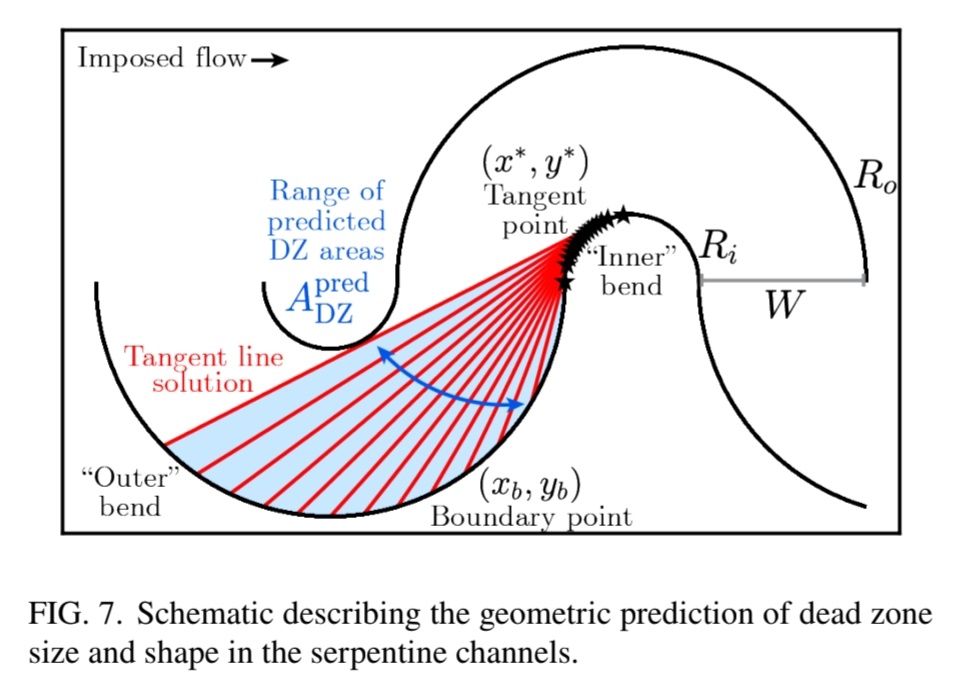
2. << Alongside this unstable bulk flow, dead zones of stagnant fluid form in the downstream portion of halfloops—reflecting the ability of the WLM solution to support shear localization, complementing reports of dead zone formation for other types of complex fluids (..). Due to coupling to the velocity fluctuations in the bulk flow, these dead zones fluctuate in their size; however, they are bounded by a maximalsize that minimizes the fluid streamline curvature, and therefore the generation of elastic stresses. Dead zones also exhibit multistable behavior—forming and persisting in some half-loops, not forming in other half-loops, and randomly switching between these two states. (..). >>

3. << The unstable flow state also features intermittent, 3D “twisting” velocity inversion events amid the spatiotemporally-fluctuating bulk flow. These twisting events reduce the hydrodynamic tortuosity compared to the base flow state, and their geometric structure can also be rationalized as minimizing the fluid streamline curvature, and therefore the generation of elastic stresses. >>

Emily Y. Chen, Sujit S. Datta. Elastic instability of wormlike micelle solution flow in serpentine channels. arXiv: 2504.02951v1 [physics.flu-dyn]. 

Also: elastic, instability, disorder & fluctuations, transition, behav, in https://www.inkgmr.net/kwrds.html 

Keywords: gst, elasticity, instability, disorder & fluctuations, transition, behavior, multistable behavior, randomly switch, twisting events, dead zone

mercoledì 19 marzo 2025

# behav: the benefit of ignorance for traffic through a random congestible network.


<< When traffic is routed through a network that is susceptible to congestion, the self-interested decisions made by individual users do not, in general, produce the optimal flow. This discrepancy is quantified by the so-called "price of anarchy." >>

AA << consider whether the traffic produced by self-interested users is made better or worse when users have uncertain knowledge about the cost functions of the links in the network, and define a parallel concept that (They) call the "price of ignorance."  >>

AA << introduce a simple model in which fast, congestible links and slow, incongestible links are mixed randomly in a large network and users plan their routes with finite uncertainty about which of the two cost functions describes each link. >>

<< One of (Their) key findings is that a small level of user ignorance universally improves traffic, regardless of the network composition. Further, there is an optimal level of ignorance which, in (the) model, causes the self-interested user behavior to coincide with the optimum. Many features of (AA) model can be understood analytically, including the optimal level of user ignorance and the existence of critical scaling near the percolation threshold for fast links, where the potential benefit of user ignorance is greatest. >>️

Alican Saray, Calvin Pozderac, et al. The benefit of ignorance for traffic through a random congestible network. arXiv: 2503.09684v1 [cond-mat.dis-nn]. Mar 12, 2025.

Alsonetwork, behav, random, uncertainty, in https://www.inkgmr.net/kwrds.html 

Keywords: gst, networks, behavior,  randomness, uncertainty, price of anarchy, price of ignorance

mercoledì 12 marzo 2025

# gst: tandem droplets accelerated by continuous uniform airflow.

<< In a dense droplet environment, droplets influence each other's motion, deformation, and breakup behavior. The tandem droplet is a particularly relevant case for the study of its unsteady dynamic behavior. >>

<< A three-dimensional numerical simulation study was conducted to investigate the deformation process of tandem droplets under different conditions. >>

<< The results of the research show that under conditions of high density ratio and a significant Reynolds number, the edge morphological characteristics of droplets are predominantly influenced by the Rayleigh-Taylor instability. In the case of low density ratios, the pressure drag force on the leeward side exerts a dominant influence on the accelerated motion of the leading droplet. The shape of the droplet is significantly influenced by the vortex ring present in the recirculation region. The perturbation of the liquid edge induces the vortex ring to split into secondary vortex rings, which act back on the droplet, thereby affecting its morphological characteristics. The trailing droplet is subject to a reduction in cross-flow radius, drag coefficient, minimum length, and expansion speed of the liquid bag due to the influence of the wake of the leading droplet. The decrease in Reynolds number and relative distance leads to a stronger suppression effect, while the decrease in density ratio shortens the length of the recirculation region, thereby weakening the suppression of trailing droplets. >>

Shuting Peng, Fuzhen Chen, et al. Three-dimensional numerical simulation of tandem droplets accelerated by continuous uniform airflow. Phys. Rev. Fluids 10, 024304. Feb 25, 2025. 

Also: droplet, instability, vortex, behav, in https://www.inkgmr.net/kwrds.html 

Keywords: gst, droplet, instability, vortex, behavior

martedì 4 marzo 2025

# game: strategic decision making in biological and artificial brains.

Figure 4: Cooperation rates across different learning scenarios in Agent vs. Agent experiments. 
(a) Constrained learning using cooperation (high initial variability) 
(b) Constrained learning using defection (high initial variability) 
(c) Constrained learning using cooperation (low variability) 
(d) Constrained learning using defection (low variability) 
(e) Unconstrained learning.
(...)

<< The aim of (AA) paper is twofold. First, it seeks to uncover the algorithms that humans and other animals employ for learning in decision-making strategies within non-zero-sum games, specifically focusing on fully observable iterated prisoner’s dilemma scenarios. Second, it aims to develop a new model to explain strategic decision-making which reflects previous neurobiological findings showing that different brain circuits are responsible for self-referential processing and understanding others. The model stems from the actor-critic framework and incorporates multiple critics to allow for distinct processing of both self and others’ state. >>

AA << validate the biological plausibility and transferability of (Their) algorithm through comparisons with experimental data from human on the iterated prisoner’s dilemma game. >>️

Anushka Deshpande. Strategic Decision Making in Biological and Artificial Brains. biorxiv. doi: 10.1101/ 2025.02.17.638746. Feb 24, 2025.

Also: behav, game, tit-for-tat, brain, in https://www.inkgmr.net/kwrds.html 

Keywords: behavior, games, tit-for-tat, brain 


sabato 1 marzo 2025

# behav: locomotion-dependent auditory gating to the parietal cortex guides multisensory decisions

<< Decision-making in mammals fundamentally relies on integrating multiple sensory inputs, with conflicting information resolved flexibly based on a dominant sensory modality. However, the neural mechanisms underlying state-dependent changes in sensory dominance remain poorly understood. >>

 AA << study demonstrates that locomotion in mice shifts auditory-dominant decisions toward visual dominance during audiovisual conflicts. Using circuit-specific calcium imaging and optogenetic manipulations, (They) found that weakened visual representation in the posterior parietal cortex (PPC) leads to auditory-dominant decisions in stationary mice. >>

<< Prolonged locomotion, however, promotes visual dominance by inhibiting auditory cortical neurons projecting to the PPC (ACPPC). This shift is mediated by secondary motor cortical neurons projecting to the auditory cortex (M2AC), which specifically inhibit ACPPC neurons without affecting auditory cortical projections to the striatum (ACSTR). >>

AA << findings reveal the neural circuit mechanisms underlying auditory gating to the association cortex depending on locomotion states, providing insights into the state-dependent changes in sensory dominance during multisensory decision-making. >>️

Ilsong Choi, Seung-Hee Lee. Locomotion-dependent auditory gating to the parietal cortex guides multisensory decisions. biorxiv. doi: 10.1101/ 2024.02.14.580296. Jan 24, 2025.

Also: Inchingolo G. Cultural transitions and epidemiology. Proceedings of the 13th Scientific Meeting of the International Epidemiological Association - IEA, Sydney, Australia, Sept 26--29, 1993: 129. Med Hypotheses 1994; 43(4): 201-206. https://pubmed.ncbi.nlm.nih.gov/7838001/     Inchingolo G. Placebo effects via deterministic chaos during traditional dances. Genova, 7 Marzo 1995: abstract. Proceedings of the 6th Congress of the International Association of Biomedical Gerontology - IABG, (Part 1, Oriental Medicine), Makuhari, Japan, August 20-26, 1995. INRCA, Technical Report, Genova, 18 August 1995: 1-26. https://www.inkgmr.net/papers.html 

Also: behav, dance, transition, brain, sound, ethno, in https://www.inkgmr.net/kwrds.html 

Keywords: behavior, dance, transition, brain, sound, ethno


lunedì 10 febbraio 2025

# gst: apropos of subdiffusive behaviors, the boomerang effect in classical stochastic models.

<< The phenomenon of Anderson localization, occurring in a disordered medium, significantly influences the dynamics of quantum particles. A fascinating manifestation of this is the “quantum boomerang effect” (QBE), observed when a quantum particle, propelled with a finite initial velocity, reverses its average trajectory, eventually halting at its starting point. >>

AA << uncover evidence of a similar effect in classical systems, characterized by the absence of typical diffusion processes. (Their) investigation encompasses both simplified probabilistic models and more complex phenomenological models that link classical with quantum mechanics. The results indicate that the boomerang effect is not confined to the quantum realm and may also be present in diverse systems exhibiting subdiffusive behavior. >>️

Santiago Zamora, Lisan M. M. Durao, et al. Boomerang effect in classical stochastic models. Phys. Rev. E 111, 024104. Feb 3, 2025.

Also: behav, particle, disorder, disorder & fluctuations, in https://www.inkgmr.net/kwrds.html 

Keywords: gst, behavior, particles, disorder, disorder & fluctuations, stocasticity, boomerang effect

venerdì 7 febbraio 2025

# life: spontaneous emergence of run-and-tumble-like dynamics in coupled self-propelled bots.


<< Drawing inspiration from the motility behaviour of microorganisms, we introduce a highly tunable, robotic system self-actuating into the run-and-tumble (RT)-like motion. It comprises two disk-shaped, centimeter-scale programmable robots individually programmed to perform overdamped active Brownian (AB) motion and connected by a rigid rod. The rod is attached to pivot points located on off-centered, mirror-symmetric points on each robot, allowing for its free rotation at both ends. >>

AA << show that the collective dynamics of this system execute RT-like motion with characteristic sharp tumble events and exponentially distributed run times, similar to those observed in microorganisms. (They) further quantify emerging dynamics in terms of tumbling frequency and tune it over a wide range of experimental parameters. >>

AA << also develop a theoretical model that reproduces our experimental results and elucidates the underlying physical mechanisms governing the rich phase behavior of RT motion. >>
 ️
Somnath Paramanick, Umashankar Pardhi, et al. Spontaneous emergence of run-and-tumble-like dynamics in coupled self-propelled robots: experiment and theory. arXiv: 2502.01257v1 [cond-mat.soft]. Feb 3, 2025.

Also: behav, evolution, bot, in https://www.inkgmr.net/kwrds.html 

Keywords: gst, life, behavior, evolution, bots, self-propelled bots, run-and-tumble motion 


martedì 14 gennaio 2025

# gst: dynamics of swarmalators in the presence of a contrarian.

<< Swarmalators are entities that combine the swarming behavior of particles with the oscillatory dynamics of coupled phase oscillators and represent a novel and rich area of study within the field of complex systems. >>

<< Unlike traditional models that treat spatial movement and phase synchronization separately, swarmalators exhibit a unique coupling between their positions and internal phases, leading to emergent behaviors that include clustering, pattern formation, and the coexistence of synchronized and desynchronized states, etc. >>

This AA paper << presents a comprehensive analysis of a two-dimensional swarmalator model in the presence of a predatorlike agent that (They) call a contrarian. The positions and the phases of the swarmalators are influenced by the contrarian and (They)  observe the emergence of intriguing collective states. >>

AA find << that swarmalator phases are synchronized even with negative coupling strength when their interaction with the contrarian is comparatively strong. Through a combination of analytical methods and simulations, (They) demonstrate how varying these parameters can lead to transitions between different collective states. >>

Gourab Kumar Sar, Sheida Ansarinasab, et al. Dynamics of swarmalators in the presence of a contrarian. Phys. Rev. E 111, 014209. Jan 7, 2025.

Also: swarm, swarmalators, transition, behav, in https://www.inkgmr.net/kwrds.html 

Keywords: gst, swarm, swarmalators, transitions, behavior, behaviour


sabato 30 novembre 2024

# life: apropos of interactions, “attacks” and “circling” of Zebrafish in the dynamics of dominance.


<< While two-body fighting behavior occurs throughout the animal kingdom to settle dominance disputes, important questions such as how the dynamics ultimately lead to a winner and loser are unresolved. Here (AA) examine fighting behavior at high resolution in male zebrafish. >>️

<< In the body point trajectories (AA) find a spectrum of timescales which (they) use to build informative joint coordinates consisting of relative orientation and distance. (AA) use the distribution of these coordinates to automatically identify fight epochs, and (then) demonstrate the postfight emergence of an abrupt asymmetry in relative orientations—a clear and quantitative signal of hierarchy formation. >>

AA << identify short-time, multi-animal behaviors as clustered transitions between joint configurations, and show that fight epochs are spanned by a subset of these clusters, which (they) denote as maneuvers. The resulting space of maneuvers is rich but interpretable, including motifs such as “attacks” and “circling.” In the longer-time dynamics of maneuver frequencies (AA) find differential and changing strategies, including that the eventual loser attacks more often towards the end of the contest. >>️

AA << results suggest a reevaluation of relevant assessment models in zebrafish, while our approach is generally applicable to other animal systems. >>️
Liam O'Shaughnessy, Tatsuo Izawa, et al. Dynamics of Dominance in Interacting Zebrafish. PRX Life 2, 043006. Oct 25, 2024.


Keywords: gst, behavior, behaviour


venerdì 1 novembre 2024

# gst: monitoring of stable crack growth; crack tip behavior at the nanoscale (during ceramic fracture).


<< To understand fracture and make brittle materials more ductile, (AA) rely on modeling what happens at a crack tip. However, observing a crack tip in a brittle material is challenging: cracks propagate fast, and the events that (AA) are interested in observing occur at the nanoscale or below. Up to now, (They) were not able to observe what happens ahead of a moving crack tip. >>

<< In this work, (AA) show how by carefully performing fracture experiments inside a transmission electron microscope (They) can grow stable cracks while observing the nanoscale events happening at the crack tip. >>️

Oriol Gavalda-Diaz, Max Emmanuel, et al. Observing the crack tip behavior at the nanoscale during fracture of ceramics. PNAS. 121 (43) e2408292121. Oct 17, 2024.

Also: fracture, crack, behav in https://www.inkgmr.net/kwrds.html 

Keywords: gst, fracture, crack, behavior


domenica 27 ottobre 2024

# life: landing on a swinging perch: peach-faced lovebirds (Agapornis roseicollis) prefer extremes.


<< Birds frequently must land safely and accurately on moving branches or power lines, and seemingly accomplish such maneuvers with acrobatic precision. To examine how birds target and land successfully on moving supports, (AA) investigated how peach-faced lovebirds (Agapornis roseicollis) approach and land on a swinging perch.  >>️

<< In support of (AA) hypothesis for stable landings, lovebirds timed their landings in a majority of trials (51.3%), when the perch was approaching either extreme of its motion with its velocity nearing zero (27.5% in the same direction as the bird’s approach – SDs, and 23.8% in the opposite direction to the bird’s approach – ODs). As a result, lovebirds exhibited a robust bimodal strategy for timing their landing to the phase of the swinging perch. Less commonly, lovebirds landed when the perch was moving at high velocity either toward the bird’s approach (12.3%) or in the same direction as the bird’s approach (11.5%); with the remainder (21.9%) of trials distributed over a broad range of swing phases. >>️

Partha S Bhagavatula, Andrew A. Biewener. Landing on a swinging perch: peach-faced lovebirds prefer extremes. biorxiv.org. Oct 8, 2024.

Also: behav, birdsextreme, jazz, Mr. Jelly Roll Morton, in: https://www.inkgmr.net/kwrds.html 

Keywords: life, birds, extreme,  behavior, behaviour, jazz, Mr. Jelly Roll Morton


venerdì 25 ottobre 2024

# life: fast-and-flexible decision-making with modulatory interactions


<< Multi-agent systems in biology, society, and engineering are capable of making decisions through the dynamic interaction of their elements. Nonlinearity of the interactions is key for the speed, robustness, and flexibility of multi-agent decision-making. >>

AA << introduce modulatory, that is, multiplicative, in contrast to additive, interactions in a nonlinear opinion dynamics model of fast-and-flexible decision-making. (..) Modulatory interactions introduce an extra source of nonlinearity that greatly enriches the model decision-making behavior in a mathematically tractable way. >>

AA << model provides new tools to understand the role of these interactions in networked decision-making and to engineer them in artificial systems. >>

Rodrigo Moreno-Morton, Anastasia Bizyaeva, et al. Fast-and-flexible decision-making with modulatory interactions. arXiv: 2410.00798v1 [math.DS]. Oct 1, 2024.

Also: behav, network, ai (artificial intell), in https://www.inkgmr.net/kwrds.html 

Keywords: life, decision-making, modulatory interactions, behavior, behaviour, network, ai, artificial intelligence


giovedì 24 ottobre 2024

# game: aperiodic Parrondo (behavior based on the binary Fibonacci, Thue–Morse and Rudin–Shapiro sequences); persistence and heterogeneity effects.

AA << study the effectiveness of employing archetypal aperiodic sequencing -- namely Fibonacci, Thue-Morse, and Rudin-Saphiro -- on the Parrondian effect. From a capital gain perspective, (their) results show that these series do yield a Parrondo's Paradox with the Thue-Morse based strategy outperforming not only the other two aperiodic strategies but benchmark Parrondian games with random and periodical (AABBAABB…) switching as well. The least performing of the three aperiodic strategies is the Rudin-Shapiro. >>

AA << analyze the cross-correlation between the capital generated by the switching protocols and that of the isolated losing games. This analysis reveals that a pronounced anti-correlation (below -0.95) with both isolated games is typically required to achieve a robust manifestation of Parrondo's effect. >>

About << the influence of the sequencing on the capital using the lacunarity and persistence measures (AA) observe that the switching protocols tend to become less performing in terms of the capital as one increases the persistence and thus approaches the features of an isolated losing game. >>

Respect to << lacunarity, a property related to heterogeneity, (AA) notice that for small persistence the performance increases with the lacunarity with a maximum (..). In respect of this, (AA) work shows that  the optimisation of a switching protocol is strongly dependent on a fine tune between persistence and heterogeneity. >>

Marcelo A. Pires, Erveton P. Pinto, et al. Parrondo's effects with aperiodic protocols. arXiv: 2410.02987v1 [physics.soc-ph]. Oct 3, 2024.

Also: Parrondo, tit-for-tat, game, behav, network, in https://www.inkgmr.net/kwrds.html 

Keywords: Parrondo, tit-for-tat, game, behavior, behaviour, network


martedì 22 ottobre 2024

# game: apropos of Parrondo's paradox, winning with losses driven by reputation and reciprocity


AA << investigate two such social behaviors, reputation and reciprocity, and their role in explaining Darwin’s survival of the fittest, examining how these fundamental principles govern individual interactions and shape broader social dynamics. >>

<< Current theories hint at two main facets of social interaction, reputation and reciprocity, as potential drivers behind this cooperative evolution. Reputation revolves around building and sustaining trust, social worth, and overall community standing. Conversely, reciprocity governs the mutual exchange of actions or benefits, influencing our choices. >>

<< One intriguing concept explored in this domain is Parrondo’s paradox: combining or switching between two losing strategies might surprisingly achieve a winning outcome. The role of Parrondo’s paradox in complex systems has sparked key research into chaotic many-body, quantum, and algorithmic network applications, where combining elements yields opposing beneficial results. Similarly, social physicists aim to uncover hidden mechanisms that govern societal phenomena by integrating the paradox’s counterintuitive principles. >>️

<< The game-theoretic Parrondo’s paradox emerges through multiple iterations of these interactions (..) A naive observation might conclude that in either scheme the chance of individuals losing to the environment is higher than gaining from the environment. For the reputation scheme, one is rewarded with a singular capital from the environment but is punished with two. Similarly, the reciprocity scheme only allows for the redistribution of capital or loss of capital. In reality, diverse schemes can be adopted by different individuals. Thus, (AA) suggest two forms of switching: (1) stochastic switching, where the individual randomly selects one of two schemes to employ with equal probability, and (2) rule-based switching, where the individual only selects the reputation scheme if it passes the reputation threshold ρ; otherwise, it employs the reciprocity scheme. >>

AA << also performed simulations on other network topologies (..) Parrondo’s paradox is strongly observed in small-world networks, weakly in the Erdős-Rényi network, and absent in scale-free networks. >>

To conclude, some of these observations << underscore the profound capability of rule-based switching mechanisms inherent in Parrondo’s paradox to emulate and forecast key aspects of real-world social phenomena. Such insights are invaluable for developing sophisticated models and strategies in various fields, ranging from social sciences to policy making, where accurate predictions of social behavior and dynamics are crucial. >>

Joel Weijia Lai, Kang Hao Cheong. Winning with Losses: The Surprising Success of Negative Strategies in Social Interaction Behavior. Phys. Rev. Lett. 133, 167401. Oct 16, 2024. 

Also: Parrondo, tit-for-tat, game, behav, network, in https://www.inkgmr.net/kwrds.html 

Keywords: Parrondo, tit-for-tat, game, behavior, behaviour, network


giovedì 22 agosto 2024

# gst: spontaneous bouncing, trampolining, and hovering behaviors of a levitating water droplet without constraints.


<< The levitating Leidenfrost (LF) state of a droplet on a heated substrate is often accompanied by fascinating behaviors such as star-shaped deformations, self-propulsion, bouncing, and trampolining. These behaviors arise due to the vapor flow instabilities at the liquid-vapor interface beneath the droplet at sizes typically comparable to the capillary length scale of the liquid. >>

AA << report on the spontaneous bouncing, trampolining, and hovering behavior of an unconstrained LF water droplet. (..) the water droplet exhibits an increase in bouncing height at specific radii with intermittent reduction in the height of bounce leading to a quiescent LF state. The reemergence of the trampolining behavior from the quiescent hovering state without any external forcing is observed at sizes as low as 0.1 times the capillary length. (AA) attribute the droplet bouncing behavior to the dynamics of vapor flow beneath the LF droplet. >>

AA << propose that the trampolining behavior of the droplet at specific radii is triggered by harmonic and subharmonic resonance between the natural frequency of the vapor layer and Rayleigh frequency of the droplet. This proposed mechanism of resonance-driven trampolining of LF droplets is observed to be applicable for different liquids irrespective of the initial volume and substrate temperatures, thus indicating a universality of the behavior. (AA) attribute the intermittent trampolining events to the change in the natural frequency of the droplet and the vapor layer due to evaporative mass loss. >>

Pranjal Agrawal, Susmita Dash. Reemergence of Trampolining in a Leidenfrost Droplet. arXiv: 2408.02335v1 [physics.flu-dyn]. Aug 5, 2024. 


Keywords: gst, drop, droplet, droploid, behav, behaviour