Translate

Visualizzazione dei post in ordine di pertinenza per la query dissipation. Ordina per data Mostra tutti i post

sabato 28 marzo 2026

# gst: apropos of different degrees of decimation, reduction of triadic interactions suppresses intermittency and anomalous dissipation in turbulence.

<< ️(AA) investigate how the defining statistical features of three-dimensional turbulence respond to systematic reductions of the Fourier-space triadic interaction network. Using direct numerical simulations of both fractally and homogeneously decimated Navier-Stokes dynamics, (They) show that progressive thinning of the set of active modes leads to a systematic suppression of intermittency and, most strikingly, to the vanishing of the mean dissipation rate in the large-Reynolds-number limit. >>

<< ️Structure-function exponents collapse onto their dimensional values, the multifractal singularity spectrum contracts, and the analyticity width extracted from the exponential spectral tail increases monotonically with decimation-each indicating a substantial regularization of the velocity field. >>

<< ️Together, these results provide direct evidence that anomalous dissipation in incompressible turbulence is not a generic property of the Navier-Stokes equations, but instead requires the full combinatorial richness of their triadic nonlinear interactions. >>

Anikat Kankaria, Ritwik Mukherjee, Sugan Durai Murugan, et al. Reduction of triadic interactions suppresses intermittency and anomalous dissipation in turbulence. arXiv: 2603.19180v1 [physics.flu-dyn]. Mar 19, 2026.

Also: turbulence, intermittency, dissipation, singularity, collapse, transition, network, in https://www.inkgmr.net/kwrds.html 

Keywords: gst, turbulence, three-dimensional turbulence, incompressible turbulence, intermittency, dissipation, anomalous dissipation, singularity, multifractal singularity spectrum contracts, collapse, transitions, networks, triadic interactions, progressive thinning, decimation.

venerdì 31 gennaio 2025

# gst: multiple Pareto-optimal solutions of the dissipation-adaptation trade-off

<< Adaptation refers to the ability to recover and maintain “normal” function on perturbations of internal or external conditions and is essential for sustaining life. Biological adaptation mechanisms are dissipative, i.e., they require a supply of energy such as the coupling to the hydrolysis of ATP. Via evolution the underlying biochemical machinery of living organisms evolved into highly optimized states. However, in the case of adaptation processes two quantities are optimized simultaneously, the adaptation speed or accuracy and the thermodynamic cost. In such cases one typically faces a trade-off, where improving one quantity implies worsening the other. The solution is no longer unique but rather a Pareto set—the set of all physically attainable protocols along which no quantity can be improved without worsening another. >> 

AA << investigate Pareto fronts in adaptation-dissipation trade-offs for a cellular thermostat and a minimal ATP-driven receptor-ligand reaction network. (They) find convex sections of Pareto fronts to be interrupted by concave regions, implying the coexistence of distinct optimization mechanisms. (They) discuss the implications of such “compromise-optimal” solutions and argue that they may endow biological systems with a superior flexibility to evolve, resist, and adapt to different environments. >>️

Jorge Tabanera-Bravo, Aljaz Godec. Multiple Pareto-optimal solutions of the dissipation-adaptation trade-off. 
Phys. Rev. Research 7, 013020. Jan 7, 2025.


Also: 'adaptation' in FonT  https://flashontrack.blogspot.com/search?q=adaptation   in Notes (quasi-stochastic poetry) (a) https://inkpi.blogspot.com/search?q=adaptation   

Keywords: gst, adaptation, dissipation


lunedì 13 gennaio 2020

# gst: a concrete image, chirality by dissipation, 'this effect actually owes its existence to dissipation'

<< Normally, dissipation alters or weakens existing quantum effects-but here we have an effect that actually owes its existence to dissipation, >>  Tilman Esslinger

<< "No scientist thinks in formulae," Albert Einstein allegedly once told his colleague Leopold Infeld. In fact, especially for physicists, who deal with such abstract things as quantum physics, it is often immensely useful to work with concrete images rather than mathematical symbols. >>

Oliver Morsch. Unexpected twist in a quantum system. ETH Zurich.  Jan 10, 2020.

https://m.phys.org/news/2020-01-unexpected-quantum.html

Nishant Dogra, Manuele Landini, et al.  Dissipation-induced structural instability and chiral dynamics in a quantum gas.  Science  20 Dec 2019:
Vol. 366, Issue 6472, pp. 1496-1499
DOI: 10.1126/science.aaw4465

https://science.sciencemag.org/content/366/6472/1496   

giovedì 14 maggio 2026

# gst: apropos of dissipation of fast tides, turbulent damping of fast tidal oscillations by three-dimensional Rayleigh-Bénard convection with a radiating free surface.

<< ️(AA) present three-dimensional Dedalus simulations of Rayleigh–Benard convection with a blackbody-radiating free upper surface, subject to a low-amplitude oscillatory forcing that mimics tidal perturbations in convective envelopes of stars and planets. The forcing period is 10–100 times shorter than the convective timescale, tconv. Using a Reynolds decomposition of the velocity field averaged over one oscillation period, in which the tidal oscillations naturally constitute the fluctuating field and xconvection the mean flow, (They) elucidate the kinetic energy exchange between the two. >>

<< ️Provided the oscillatory Reynolds number exceeds a modest threshold, (They) find that the oscillations systematically transfer kinetic energy to the mean flow at a volume-averaged rate D_R∼u′^(2)t^−1_conv, where u′ is the rms fluctuation velocity. This reflects strong, order-unity correlations between the fluctuation velocities and the mean flow. These arise because the oscillatory forcing displaces fluid elements that are then redirected by buoyancy and incompressibility in the same manner as the mean flow. >>

<< The transfer is dominated by correlations involving vertical velocity fluctuations and vertical gradients of the mean flow. The resulting energy transfer rate is consistent, within the equilibrium-tide framework, with the observed tidal circularisation of solar-type binaries and with the orbital evolution of moons of Jupiter and Saturn. This validates the formalism proposed by Terquem (2021) for the dissipation of fast tides, a longstanding problem. Replacing the free surface with a rigid upper boundary significantly and artificially modifies the correlations. >>

Caroline Terquem, Alexander Boone, Enrico Martinez. Turbulent damping of fast tidal oscillations by three-dimensional Rayleigh-Bénard convection with a radiating free surface. arXiv: 2605.05108v1 [astro-ph.SR]. May 6, 2026.

Also: turbulence, fluctuations, dissipation,  in https://www.inkgmr.net/kwrds.html 

Keywords: gst, turbulence, fluctuations, dissipation, turbulent damping, tidal oscillations, tidal perturbations, Rayleigh-Bénard convection, dissipation of fast tides.

venerdì 6 giugno 2025

# gst: symmetry breaking in time-dependent billiards.

AA << investigate symmetry breaking in a time-dependent billiard that undergoes a continuous phase transition when dissipation is introduced. The system presents unlimited velocity, and thus energy growth for the conservative dynamics. When inelastic collisions are introduced between the particle and the boundary, the velocity reaches a plateau after the crossover iteration. The system presents the expected behavior for this type of transition, including scale invariance, critical exponents related by scaling laws, and an order parameter approaching zero in the crossover iteration. >>

AA << analyze the velocity spectrum and its averages for dissipative and conservative dynamics. The transition point in velocity behavior caused by the physical limit of the boundary velocity and by the introduced dissipation coincides with the crossover interaction obtained from the Vrms (root mean sq V) curves. Additionally, (they) examine the velocity distributions, which lose their symmetry once the particle's velocity approaches the lower limit imposed by the boundary's motion and the system's control parameters. This distribution is also characterized analytically by an expression P(V,n), which attains a stationary state, with a well-defined upper bound, only in the dissipative case. >>

Anne Kétri Pasquinelli da Fonseca, Edson Denis Leonel. Symmetry breaking in time-dependent billiards. arXiv: 2505.20488v1 [nlin.CD]. May 26, 2025.

Also: billiard, transition, dissipation,  in https://www.inkgmr.net/kwrds.html 

Keywords: gst, billiard, particles, transitions, dissipation, symmetry breaking, inelastic collisions.

sabato 17 dicembre 2022

# gst: transitions, how two saddles can increase the transient times.

FIG. 8. Attractor and chaotic saddles (..) amplified around three bands of the chaotic attractor.  The global chaotic saddle is colored blue, and the local chaotic saddle is colored red. The attractors are colored black. 

AA << consider a dissipative version of the standard nontwist map. Nontwist systems present a robust transport barrier, called the shearless curve, that becomes the shearless attractor when dissipation is introduced. This attractor can be regular or chaotic depending on the control parameters. Chaotic attractors can undergo sudden and qualitative changes as a parameter is varied. These changes are called crises, and at an interior crisis the attractor suddenly expands. Chaotic saddles are nonattracting chaotic sets that play a fundamental role in the dynamics of nonlinear systems, they are responsible for chaotic transients, fractal basin boundaries, chaotic scattering and they mediate interior crises. >>

<< In this work (AA) discuss the creation of chaotic saddles in a dissipative nontwist system and the interior crises they generate. (They) show how the presence of two saddles increase the transient times and analyze the phenomenon of crisis induced intermittency. >>️

Rodrigo Simile Baroni, Ricardo Egydio de Carvalho, et al. Chaotic saddles and interior crises in a dissipative nontwist system. arXiv: 2211.06921v1 [nlin.CD]. Nov 13, 2022. 

Also

keyword 'intermittency' in FonT

keyword 'dissipation' in FonT

keyword 'saddle' in FonT

keyword 'chaos' | 'chaotic' in Font


keyword 'caos' | 'caotico' in Notes (quasi-stochastic poetry)


Keywords: gst, transitions, dissipation, 
dissipative systems, chaos, saddle, chaotic saddle, crisis, interior crisis, intermittency


lunedì 22 giugno 2026

# gst: dissipation-coherence tradeoff for stochastic oscillations.


<< ️Autonomous noisy oscillations in biochemical and mesoscopic systems require nonequilibrium driving and therefore dissipation. A striking conjecture by Oberreiter, Barato, and Seifert (OBS) proposes a universal lower bound on the entropy produced per oscillation period in terms of the coherence number of the slowest oscillatory mode (L. Oberreiter et al. [Phys. Rev. E 106, 014106 (2022)]). >>

<< ️Here (AA) derive a weaker but rigorous lower bound that preserves the OBS structure while introducing a mode-uniformity factor that quantifies how evenly the oscillatory eigenmode is distributed across states in the steady-state inner product. The result makes explicit that an eigenvalue-only prefactor can fail when the dominant oscillatory mode is localized. >>

<< ️(They) also outline a proof-of-principle route for estimating this factor from low-dimensional data under single-mode dominance and sufficiently informative measurements, and derive an eigenvector-free corollary using only the smallest stationary probability. >>

<< ️Translation-invariant Markov jump processes on a ring provide a symmetry-protected class with 𝜂=1, so the refinement reduces to the OBS form; the drift-diffusion limit on a circle saturates the bound. >>

Jie Gu. Dissipation-coherence tradeoff for stochastic oscillations. Phys. Rev. E 113, 064130.  Jun 15, 2026.
arXiv: 2606.05498v1 [cond-mat.stat-mech]. Jun 3, 2026.

Also: noise, disorder, transition, in https://www.inkgmr.net/kwrds.html 

Keywords: gst, noise, disorder, dissipation, entropy, stochasticity, stochastic processes, autonomous noisy oscillations, stochastic oscillations, disorder-induced localization, time series analysis, transitions.

martedì 7 luglio 2026

# gst: apropos of avalanche propagations (e.g. large cascades), sandpile models on complex networks.


<< ️(AA) investigate the sandpile model on complex networks by developing a branching-process framework that explicitly incorporates dissipation during avalanche propagation. Unlike classical branching descriptions, which assume conservative transport and locally tree-like independence, the present approach introduces grain-loss effects directly into the offspring distribution, yielding generalized generating functions for dissipative avalanche dynamics. >>

<< ️In the dissipative regime, avalanche-size distributions acquire exponential cutoffs while preserving topology-dependent scaling behavior. Numerical simulations confirm the theoretical predictions on sparse random networks and reveal systematic deviations in highly structured topologies. In particular, by using Holme-Kim clustered scale-free networks, (They) show that increasing clustering continuously lowers the avalanche exponent and enhances the probability of large cascades, demonstrating that short cycles generate strong correlations that invalidate the classical independent-branch approx imation. >>

<< ️Surprisingly, trees also exhibit substantial deviations from power-law because low edge density and the abundance of leaves constrain avalanche propagation. These results show that dissipation, clustering, and sparse connectivity fundamentally reshape avalanche size distribution of the sandpile model on networks and establish quantitative limits for branching-process descriptions of avalanche dynamics. >>

Komlan Fiagbe, Jean-François de Kemmeter, Timoteo Carletti. Sandpile Models on complex networks. arXiv: 2607.02023v1 [cond-mat.stat-mech]. Jul 2, 2026.

Also: network, dissipation, in https://www.inkgmr.net/kwrds.html 

Keywords: gst, network, dissipation, sandpile, branching-process framework, avalanche propagation, grain-loss effects, dissipative avalanche dynamics, sparse random networks, clustering, sparse connectivity.

lunedì 15 settembre 2025

# gst: dual role for heterogeneity in dynamic fracture.


<< ️(AA) approach the problem of heterogeneous dynamic fracture by considering spatiotemporal perturbations to planar crack fronts. Front propagation is governed by local energy balance between the elastic energy per unit area available to fracture 𝐺 and the dissipation in creating new surfaces. 𝐺 is known analytically as a perturbation series in the crack front fluctuation. >>

<< ️For dissipation that monotonically increases with the crack speed, (AA) derive an equation of motion for crack fronts that is second-order accurate. In the linear order, heterogeneity does not change the net speed of fracture. In the second order, nonlinear interactions of the front and the heterogeneous landscape populate an intermediate-scale fluctuation spectrum. >>

<< ️(AA) find that, when dissipation weakly grows with velocity, nonlinearities globally amplify dissipation and reduce the crack speed. Strong velocity dependence, however, mitigates toughening effects and may facilitate fracture. >>

Itamar Kolvin, Mokhtar Adda-Bedia, Dual Role for Heterogeneity in Dynamic Fracture. Phys. Rev. Lett. 135, 106201. Sep 3, 2025.

arXiv: 2407.02347v1 [cond-mat.mtrl-sci]. Jul 2,  2024.

Also: fracture, crack, in https://www.inkgmr.net/kwrds.html 

Keywords: gst, fracture, crack, front propagation

sabato 11 gennaio 2025

# gst: trade-off between coherence and dissipation for excitable phase oscillators.

<< Thermodynamic uncertainty relation (TUR) bounds coherence in stochastic oscillatory systems. In this paper, (AA) show that both dynamical and thermodynamic bounds play important roles for the excitable oscillators, e.g. neurons. >>

<< Excitable systems such as neurons have distinctive coherence features compared with other oscillators having no excitability. >>️

AA << combined the well-established results, i.e. the fluctuation of the ISI (inter-spike-interval) limited by 1/3 and the coherence resonance phenomenon, together with the TUR developed in recent years to investigate the coherence in the excitable phase oscillators. (AA) find quite different trade-off relation in the subthreshold (excitable) region and superthreshold (oscillatory) region, separated by the SNIC (saddle-node on an invariant circle) bound but meanwhile lower bounded by the TUR. Furthermore, (They) found that there is an optimal entropy production corresponding to the maximum coherence, which could serve as an alternative interpretation of the coherence resonance. It implies that more entropy production does not necessarily result in higher accuracy of currents. >>️

Chunming Zheng. Trade-off between coherence and dissipation for excitable phase oscillators. arXiv: 2412.16603v1 [cond-mat.stat-mech]. Dec 21, 2024.

Also: brain, entropy, dissipation, uncertainty, in https://www.inkgmr.net/kwrds.html 

Keywords: gst, brain, neurons, entropy, oscillators, excitable phase oscillators, coherence, dissipation, uncertainty


lunedì 24 febbraio 2025

# gst: when homogeneous systems meet dissipation and disorder.

AA << investigate the localization and topological properties of the non-equilibrium steady state (NESS) in a one-dimensional homogeneous system. (Their) results demonstrate that, despite the absence of disorder in the initial system, the NESS can exhibit localization under bond dissipation. >>

<< Conversely, for an initially flat-band system with compactly localized wave functions, the NESS is delocalized. >>

<< Furthermore, (They) find that the initial localization characteristics of the system significantly influence the localization properties of the NESS. Drawing upon the concept of Bose-Einstein condensate broadening in cold-atom experiments, along with experimental data, (AA) systematically characterize the impact of disorder on the localization and topological properties of the NESS. >>

<< The phase diagram reveals that the NESS can be topologically non-trivial even when the initial state is topologically trivial, and that the topological triviality of the initial state weakens the topological non-triviality of the NESS. >>

Xixi Feng, Ao Zhou, et al. When Homogeneous Systems Meet Dissipation and Disorder. arXiv: 2502.11383v1 [cond-mat.dis-nn]. Feb 17, 2025. 

Also: order, disorder, disorder & fluctuations, transition, in https://www.inkgmr.net/kwrds.html 

Keywords: gst, order, disorder, disorder & fluctuations, transitions


venerdì 23 maggio 2025

# gst: toy model of turbulent shear flow using vortons.

AA << introduce a toy model for shear flows, exploiting the spatial intermittency and the scale separation between large-scale flows and small-scale structures. The model is highly sparse, focusing exclusively on the most intense structures, which are represented by vortons—dynamically regularized quasisingularities that experience rapid distortion from the large-scale shear. The vortons, in turn, influence the large-scale flow through the subgrid stress tensor. >>

<< Despite its simplicity, the model displays an interesting transition between two distinct regimes: (i) a laminar regime, where dissipation is entirely attributed to the large-scale flow and the vortons dynamics is essentially diffusive, and (ii) a turbulent regime, in which most of the dissipation arises from the vortons. These regimes correspond to different scalings of dissipation and the Grashof number as functions of the Reynolds number, with power-law relationships that resemble those observed in classical turbulence. >>

Wandrille Ruffenach, Lucas Fery, Bérengère Dubrulle. Toy model of turbulent shear flow using vortons. Phys. Rev. Fluids 10, 054601. May 1, 2025.

arXiv:2501.05779v2 [physics.flu-dyn]. 

Also: turbulence, intermittency, transition, in https://www.inkgmr.net/kwrds.html 

Keywords: gst, turbulence, intermittency, transitions, vortons

mercoledì 10 maggio 2023

# gst: to find a separation between plunging and spilling wave breakers


<< While understanding breaking waves is crucial for the development of parametrizations used in ocean wave modeling for both deep and shallow water, the complete process of wave breaking is not well understood. Here (AA) present direct numerical simulations of two-dimensional solitary waves that shoal and break on a uniform beach in shallow water, with the presence of storm surge represented by an inshore region. >>️

They << classify wave breaker types and find a separation between plunging and spilling breakers when scaled by breaking amplitude and depth. (AA) compare energy dissipation during the breaking process with results from the literature without storm surge.  >>️

They << conclude that a previously developed shallow-water inertial dissipation model for wave breaking on a uniform slope can be extended to this storm surge environment with good data collapse, and further discuss possibilities for a general parametrization of wave breaking valid across different depth regimes. >>️

Hunter Boswell, Guirong Yan, Wouter Mostert. Characterizing energy dissipation of shallow-water wave breaking in a storm surge. Phys. Rev. Fluids 8, 054801. May 5, 2023. 

Also: waves, soliton, drop, in https://www.inkgmr.net/kwrds.html

Keywords: gst, waves, soliton, drop 


venerdì 7 marzo 2025

# gst: transition to inverse cascade in turbulent rotating convection in absence of the large-scale vortex.


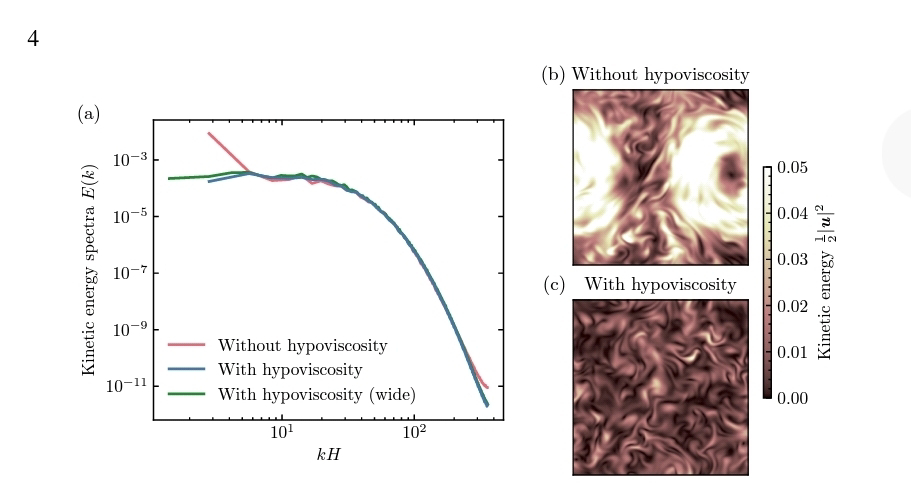
<< Turbulent convection under strong rotation can develop an inverse cascade of kinetic energy from smaller to larger scales. In the absence of an effective dissipation mechanism at the large scales, this leads to the pile-up of kinetic energy at the largest available scale, yielding a system-wide large-scale vortex (LSV). Earlier works have shown that the transition into this state is abrupt and discontinuous. >>

Here, AA << study the transition to the inverse cascade in the case where the inverse energy flux is dissipated before it reaches the system scale, suppressing the LSV formation. (They) demonstrate how this can be achieved in direct numerical simulations by using an adapted form of hypoviscosity on the horizontal manifold. (They) find that in the absence of the LSV, the transition to the inverse cascade becomes continuous. This shows that it is the interaction between the LSV and the background turbulence that is responsible for the observed discontinuity. >>

AA << furthermore show that the inverse cascade in absence of the LSV has a more local signature compared to the case with LSV. >>️

Xander M. de Wit. Transition to inverse cascade in turbulent rotating convection in absence of the large-scale vortex. arXiv: 2502.16275v1 [physics.flu-dyn]. Feb 22, 2025. 

Also: turbulence, dissipation, transition, vortex, in https://www.inkgmr.net/kwrds.html 

Keywords: gst, turbulence, dissipation, transitions, vortices


martedì 23 giugno 2026

# gst: on the geometry of spreading puddles.


<< ️(AA) develop a geometric model for the spreading of shallow, viscous puddles of arbitrary shape, building on the recent 'capillary current' model for axisymmetric droplets. In short, (They) assume that a spreading puddle remains close to instantaneous mechanical equilibrium as it spreads, with hydrostatic pressure balanced by surface curvature. In turn, its contact line advances so as to maximize the rate of energy loss subject to viscous dissipation. >>

<< ️The resulting system yields a natural geometric evolution equation for both the two-dimensional footprint and the three-dimensional depth profile of a spreading puddle. In appropriate limits, it recovers the classical spreading laws for axisymmetric droplets, a local version of the Hoffman-Voinov-Tanner law for small non-axisymmetric puddles, and a nonlocal Hele-Shaw-like description for large, relatively regular puddles. >>

David Darrow. On the Geometry of Spreading Puddles. arXiv: 2606.13893v1 [physics.flu-dyn]. Jun 11, 2026.

Also: drop, droplet, droploid, in https://www.inkgmr.net/kwrds.html 

Keywords: gst, drops, droplets, droploids, spreading puddle, axisymmetric droplets, surface curvature, viscous dissipation.

martedì 2 settembre 2025

# gst: dynamics and frictional dissipation for treading slowly in a puddle.

<< ️The process of producing a liquid column is common in daily life and industrial applications, such as walking through a puddle and roller printing. While governed by the Navier-Stokes equation, its dynamics are often studied by numerical means, which hinders a full understanding of the rich mixture of physics behind, for instance, the competition of surface and potential energies, and how the pinch off is affected by the kinetic energy and water jet when a large cylinder is used. For pedestrians rushing out of the rain, the water column inevitably involves turbulence and defies simple theoretical analyses.  >>

<< ️As a result, this (AA) work will focus only on cases with a low Reynolds number to enable laminar flow and the existence of reversible and quasistatic stages. Combined with simple models, (They) elucidate the mechanism that drives the change of morphology and derive analytic expressions for the critical height and upper radius for the liquid column when transiting between three stages. >>

<< ️Stage I is characterized by a static and reversible profile for the column whose upper radius 𝑟𝑡 equals that of the cylinder. The column becomes irreversible and 𝑟𝑡 starts shrinking upon entering stage II. It is not until 𝑟𝑡 stops shrinking that the column neck accelerates its contraction and descends toward the pool, the quantitative behavior of which is among the successful predictions of our theory. Pinch off dominates the second half of stage III without its usual signature of self-similarity. This is discussed and explained with an interesting incident involving a water jet similar to that made by a dropping stone. >>

Chung-Hao Chen, Zong-Rou Jiang, Tzay-Ming Hong. Dynamics and frictional dissipation for treading slowly in a puddle. Phys. Rev. E 112, 025105. Aug 25, 2025.

arXiv: 2310.09737v2 [physics.flu-dyn]. May 18, 2024.

Also: walk, walking, in https://www.inkgmr.net/kwrds.html 

Keywords: walk, walking.

mercoledì 10 dicembre 2025

# gst: degrees of universality in wave turbulence

<< ️Turbulence of weakly interacting waves displays a great deal of universality: independence of the details of the interaction and of the pumping and dissipation scales. Here (AA) study how inverse turbulent cascades (from small to large scales) transition from weak to strong. (They) find that while one-loop corrections can be dependent on excitation and dissipation scales, new types of universality appear in strong turbulence. (They) contrast turbulence of spin waves in ferromagnets with turbulent cascades in the Nonlinear Schrödinger Equation (NSE) and in an MMT-like (Majda-McLaughlin-Tabak) model in higher dimensions having a multiplicative interaction vertex: vertex renormalization gives rise to dependence on the pumping (UV scale) in the former but not in the latter. >>

<< ️As a result of this spectral nonlocality, spin-wave turbulence stops being weak if one is sufficiently far from the pumping scale, even when the interaction of waves with comparable wavenumbers is weak. (AA) paraphrase this as: nonlocality enhances nonlinearity. >>

<< ️(AA) then describe strong turbulence in a multi-component version of these models with a large number of components. (They) argue that strong spin-wave turbulence is similar to turbulence of the focusing NSE, as it realizes a critical-balance state. However, UV nonlocality causes the level of spin-wave turbulence at large scales to decrease with increasing pumping level, culminating in a state that is independent of the level of pumping. >>

Jiasheng Liu, Vladimir Rosenhaus, Gregory Falkovich. Degrees of universality in wave turbulence. arXiv: 2512.04866v1 [cond-mat.stat-mech]. Dec 4, 2025.

Also: waves, turbulence, transition, in https://www.inkgmr.net/kwrds.html 

Keywords: gst, waves, turbulence, transitions.

giovedì 6 novembre 2025

# gst: a probability space at inception of stochastic process.

<< ️Recently, progress has been made in the theory of turbulence, which provides a framework on how a deterministic process changes to a stochastic one owing to the change in thermodynamic states. It is well known that, in the framework of Newtonian mechanics, motions are dissipative; however, when subjected to periodic motion, a system can produce nondissipative motions intermittently and subject to resonance. It is in resonance that turbulence occurs in fluid flow, solid vibration, thermal transport, etc. In this, the findings from these physical systems are analyzed in the framework of statistics with their own probability space to establish their compliance to the stochastic process. >>

<< ️In particular, a systematic alignment of the inception of the stochastic process with the signed measure theory, signed probability space, and stochastic process was investigated. It was found that the oscillatory load from the dissipative state excited the system and resulted in a quasi-periodic probability density function with the negative probability regimes. In addition, the vectorial nature of the random velocity splits the probability density function along both the positive and negative axes with slight asymmetricity. By assuming that a deterministic process has a probability of 1, (AA) can express the inception of a stochastic process, and the subsequent benefit is that a dynamic fractal falls on the probability density function. Moreover, (They) leave some questions of inconsistency between the physical system and the measurement theory for future investigation. >>

Liteng Yang, Yuliang Liu, et al. A Probability Space at Inception of Stochastic Process. arXiv: 2510.20824v1 [nlin.CD]. Oct 8, 2025.

Also: turbulence, dissipation, intermittency, random, transition, in https://www.inkgmr.net/kwrds.html 

Keywords: gst, turbulence, dissipation, intermittency, randomness, transitions.

sabato 29 aprile 2023

# gst: pattern generation through turbulent cascades


<< Fully developed turbulence is a universal and scale-invariant chaotic state characterized by an energy cascade from large to small scales where the cascade is eventually arrested by dissipation. In this Letter, (AA) show how to harness these seemingly structureless turbulent cascades to generate patterns. Conceptually, pattern or structure formation entails a process of wavelength selection: patterns typically arise from the linear instability of a homogeneous state. By contrast, the mechanism (they) propose here is fully non-linear and triggered by a non-dissipative arrest of turbulent cascades. Instead of being dissipated, energy piles up at intermediate scales. Using a combination of theory and large-scale simulations, (AA) show that the tunable wavelength of these cascade-induced patterns is set by a non-dissipative transport coefficient called odd or gyro viscosity. This non-dissipative viscosity is ubiquitous in chiral systems (..). Beyond chiral fluids, cascade-induced pattern formation could occur in natural systems (..) as well as in industrial processes (..). >>

Xander M. de Wit, Michel Fruchart, et al. Pattern formation by non-dissipative arrest of turbulent cascades. arXiv: 2304.10444v1 [cond-mat.soft]. Apr 20, 2023.

Also: 'turbulence', 'vortex', 'game', 'evolution', 'ai' in https://www.inkgmr.net/kwrds.html

Keywords: gst, vortex, vorticity,  turbulence, turbulent cascade, pattern formation, game, evolution, ai (artificial intelligence)


mercoledì 28 agosto 2024

# gst: dynamics of small droplets in turbulent multiphase flows


AA << show unambiguously that the formation of small droplets is governed by the internal dynamics which occurs during the breakup of large drops and that the high vorticity and the extreme dissipation associated to these events are the consequence and not the cause of the breakup. >>️

M. Crialesi-Esposito, G. Boffetta, L. Brandt, et al. How small droplets form in turbulent multiphase flows. Phys. Rev. Fluids 9, L072301. Jul 29, 2024. 

Also: drop, bubble, transition, turbulence, intermittency, in https://www.inkgmr.net/kwrds.html 

Keywords: gst, drop, droplet, droploid,  bubble, transition, turbulence, intermittency