Translate

Visualizzazione dei post in ordine di data per la query collapse. Ordina per pertinenza Mostra tutti i post

giovedì 4 dicembre 2025

# gst: the way bubbles gallop.

<< ️Bubbles are more than fleeting pockets of air trapped in liquid: they exhibit an ever-expanding repertoire of intriguing behaviors. From da Vinci's sketches of their swirling paths to modern-day studies of their erratic dances under acoustic waves, the rich dynamics of bubbles have long captured the attention of everyday observers, engineers, and scientists alike. When exposed to periodic sound waves, bubbles can shift from regular pulsations to rapid zigzagging, mimicking the randomness of Brownian motion. Under sudden pressure changes, they may collapse violently, producing cavitation—intense shock waves capable of damaging solid surfaces. In extreme cases, the implosion may become so intense that the bubble emits a spark of light. >>

<< ️Bubbles can also challenge common intuition: they may appear to violate Archimedes' principle, sinking against gravity in oscillating fluids, and carbonated drinks. Despite centuries of explorations, new and often surprising bubble phenomena continue to emerge. One such example is the recently discovered “galloping” bubble, introduced in (AA) recent publication. Here, (They) showcase this new mechanism of bubble locomotion, highlighting its rich dynamics and striking visual appeal. >>

Jian H. Guan, Saiful I. Tamim, Connor W. Magoon, et al. The way bubbles gallop. Phys. Rev. Fluids 10, 110507. Nov 20, 2025.


Also: bubble, drop, droplet, droploid, instability, in https://www.inkgmr.net/kwrds.html 

Keywords: gst, bubble, galloping bubbles, galloping threshold, galloping motion, galloping mechanism, instability, galloping instability, drops, droplets, droploids, transitions.

martedì 18 novembre 2025

# gst: apropos of itinerant behaviors, from chaotic itinerancy to intermittent synchronization in complex networks.

<< ️Although synchronization has been extensively studied, important processes underlying its emergence have remained hidden by the use of global order parameters. Here, (AA) uncover how the route unfolds through a sequential transition between two well-known but previously unconnected phenomena: chaotic itinerancy (CI) and intermittent synchronization (IS). >>

<< ️Using a new symbolic dynamics, (They) show that CI emerges as a collective yet unsynchronized exploration of different domains of the high-dimensional attractor, whose dimension is reduced as the coupling increases, ultimately collapsing back into the reference chaotic attractor of an individual unit. At this stage, the IS can emerge as irregular alternations between synchronous and asynchronous phases. The two phenomena are therefore mutually exclusive, each dominating a distinct coupling interval and governed by different mechanisms. >>

<< ️Network structural heterogeneity enhances itinerant behavior since access to different domains of the attractor depends on the nodes' topological roles. The CI--IS crossover occurs within a consistent coupling interval across models and topologies. Experiments on electronic oscillator networks confirm this two-step process, establishing a unified framework for the route to synchronization in complex systems. >>

I. Leyva, Irene Sendiña-Nadal, Christophe Letellier, et al. From chaotic itinerancy to intermittent synchronization in complex networks. arXiv: 2511.09253v1 [nlin.AO]. Nov 12, 2025.

Also: network, behav, intermittency, transition, attractor, chaos, collapse, in https://www.inkgmr.net/kwrds.html 

Keywords: gst, networks, behavior, intermittency, transitions, attractor, chaos, collapse, chaotic itinerancy, intermittent synchronization, structural heterogeneity, itinerant behavior.

sabato 15 novembre 2025

# gst: vorticity-induced surfing and trapping in porous media

<< Microorganisms often encounter strong confinement and complex hydrodynamic flows while navigating their habitats. Combining finite-element methods and stochastic simulations, (AA) study the interplay of active transport and heterogeneous flows in dense porous channels. (They) find that swimming always slows down the traversal of agents across the channel, giving rise to robust power-law tails of their exit-time distributions. These exit-time distributions collapse onto a universal master curve with a scaling exponent of ≈ 3/2 across a wide range of packing fractions and motility parameters, which can be rationalized by a scaling relation. >> 

<< ️(AA) further identify a new motility pattern where agents alternate between surfing along fast streams and extended trapping phases, the latter determining the power-law exponent. Unexpectedly, trapping occurs in the flow backbone itself -- not only at obstacle boundaries -- due to vorticity-induced reorientation in the highly-heterogeneous fluid environment. >>

Pallabi Das, Mirko Residori, Axel Voigt, et al. Vorticity-induced surfing and trapping in porous media. arXiv: 2511.02471v1 [cond-mat.soft]. Nov 4, 2025.

Also: swim, microswimmers, intermittency, disorder, vortex, in https://www.inkgmr.net/kwrds.html 

Keywords: gst, swim, microswimmers, intermittency, disorder, vortex, self-propel, run-and-tumble dynamics, hop-and-trap pattern, surf-and-trap motility pattern.

venerdì 12 settembre 2025

# gst: shock waves in classical dust collapse.

<< ️During gravitational collapse of dust in spherical symmetry, matter particles may collide forming shell crossing singularities (SCSs) at which the Einstein equations become indeterminate. >>

<< ️(AA) show that in the case of marginally bound dust collapse, there is a unique evolution beyond SCSs such that a propagating shock wave forms, the metric remains continuous, and the stress-energy tensor dynamically becomes that of a thin shell. (They) give numerical simulations that exhibit this result. >>

Viqar Husain, Hassan Mehmood. Shock waves in classical dust collapse. Phys. Rev. Research 7, 033215. Sep 3, 2025.

arXiv: 2504.14883v1 [gr-qc]. Apr 21, 2025.

Also: particle, singularity, collapse, waves, in https://www.inkgmr.net/kwrds.html 

Keywords: gst, particles, singularity, shell crossing singularities, waves, shock waves, gravitational waves, collapse, dust collapse, gravitational collapse. 

sabato 19 luglio 2025

# gst: noise reinstates collapsed populations; stochastic reversal of deterministic extinction.

<< ️Conventional wisdom suggests that environmental noise drives populations toward extinction. In contrast, (AA) report a paradoxical phenomenon in which stochasticity reverses a deterministic tipping point, thereby preventing collapse. Using a hybrid model that integrates logistic growth with a density-triggered sigmoidal collapse, (They) uncover a striking reversal: deterministic fragility on one side, and stochastic rescue under weak noise on the other. >>

AA << analysis demonstrates that noise disrupts the convergence of deterministic trajectories toward extinction by altering the phase space topology, enabling back-transitions to viable states. This mechanism gives rise to noise-induced metastability and reveals a form of stochastic robustness not captured by deterministic models. >>

<< ️These findings suggest that natural fluctuations can serve as a stabilizing force in complex systems, offering a compelling counter-narrative to classical models in ecology, epidemiology, and beyond. (AA) advocate for a re-evaluation of stabilization strategies, emphasizing the constructive role of stochasticity in averting population collapse. >>

Vinesh Vijayan, B Priyadharshini, et al. Noise reinstates collapsed populations: stochastic reversal of deterministic extinction. arXiv:2507.03954v1 [q-bio.PE]. Jul 5, 2025.

Also:  noise, weak, disorder & fluctuations, transition, in https://www.inkgmr.net/kwrds.html 

Keywords: gst, noise, weakness, disorder,  
fluctuations, tipping point, transitions, stochasticity, stochastic reversal, stochastic rescue. 

mercoledì 9 luglio 2025

# gst: the evasion of tipping; pattern formation near a Turing-fold bifurcation

<< ️Model studies indicate that many climate subsystems, especially ecosystems, may be vulnerable to 'tipping': a 'catastrophic process' in which a system, driven by gradually changing external factors, abruptly transitions (or 'collapses') from a preferred state to a less desirable one. In ecosystems, the emergence of spatial patterns has traditionally been interpreted as a possible 'early warning signal' for tipping. More recently, however, pattern formation has been proposed to serve a fundamentally different role: as a mechanism through which an (eco)system may 'evade tipping' by forming stable patterns that persist beyond the tipping point. >>

<< ️Mathematically, tipping is typically associated with a saddle-node bifurcation, while pattern formation is normally driven by a Turing bifurcation. Therefore, (AA) study the co-dimension 2 Turing-fold bifurcation and investigate the question: 'When can patterns initiated by the Turing bifurcation enable a system to evade tipping?' >>

AA << develop (their) approach for a class of phase-field models and subsequently apply it to -component reaction-diffusion systems -- a class of PDEs often used in ecosystem modeling. (AA) demonstrate that a two-component system of modulation equations governs pattern formation near a Turing-fold bifurcation, and that tipping will be evaded when a critical parameter, β, is positive. (They) derive explicit expressions for β, allowing one to determine whether a given system may evade tipping. Moreover, (They) show numerically that this system exhibits rich behavior, ranging from stable, stationary, spatially quasi-periodic patterns to irregular, spatio-temporal, chaos-like dynamics. >>

Dock Staal, Arjen Doelman. The evasion of tipping: pattern formation near a Turing-fold bifurcation. arXiv: 2506.22251v1 [math.DS]. Jun 27, 2025.

Also: disorder & fluctuations, transition, in https://www.inkgmr.net/kwrds.html 

Keywords: gst, disorder & fluctuations, pattern formation, Turing-fold bifurcation, transitions, tipping, collapse

lunedì 19 maggio 2025

# life: the pervasive "soft power" of ancient India.

<< One of the big contentions of popular historian William Dalrymple’s latest book “The Golden Road: How Ancient India Transformed the World,” which came out in the United States a few weeks ago, is that the Indian subcontinent’s connections to the West, especially via the Roman Empire, were far richer than those of China (i.e. the “Silk Road” cited). Once the might of Rome reached Egypt and the maritime routes of the Red Sea, it brought the customers of the Mediterranean to India’s doorstep. It also saw Indian philosophy and mathematics travel west and east. >>

<< Once their economic links to the West thinned with the collapse of the Roman Empire, South Indian merchant guilds turned east, embarking on trade and contacts that spread Indian religion and ideas across a wide expanse of Asia and underlay the grandeur of centuries-old temple complexes like Angkor Wat in Cambodia or Borubudur in Indonesia. >>

<< it’s one of the great soft power miracles of world history, because unlike Islam and unlike quite a lot of Christianity, no one took Buddhism at the point of a sword. No one imposed Buddhism at any point. It was the sophistication of its ideas and particularly its attractiveness to the merchant classes, bizarrely. The Buddhist monasteries act as banks, as factories and as caravanserais. >>

Ishaan Tharoor with Rachel Pannett. How ancient India changed the world. WorldView (by mail). washingtonpost.com. May 19, 2025.

Alsoforms of power, waves, attractor, Zen, compassion, transition, in https://www.inkgmr.net/kwrds.html 

Keywords: life, forms of power, soft power, waves, attractors, Zen, compassion, transition.

martedì 4 febbraio 2025

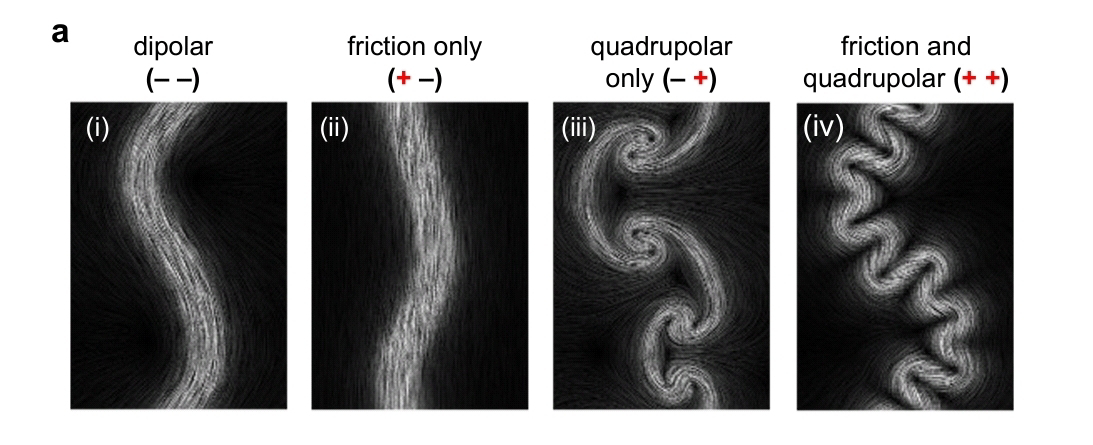
# gst: quadrupolar stress drives collapse of nematic order on frictional substrates.


<< The field of active nematics has traditionally employed descriptions based on dipolar activity, with interactions that align along a single axis. However, it has been theoretically predicted that interactions with a substrate, prevalent in most biological systems, would require novel forms of activity, such as quadrupolar activity, that are governed by hydrodynamic screening. >>

<< Here, by combining experiments and numerical simulations, (AA) show that upon light-induced solidification of the underlying medium, microtubule-kinesin mixtures undergo a transformation that leads to a biphasic active suspension. Using an active lyotropic model, (They) prove that the transition is governed by screening effects that alter the dominant form of active stress. Specifically, the combined effect of friction and quadrupolar activity leads to a hierarchical folding that follows the intrinsic bend instability of the active nematic layer. >>

AA << results demonstrate the dynamics of the collapse of orientational order in active nematics and present a new route for controlling active matter by modifying the activity through changing the surrounding environment. >>️

Aleksandra Ardaseva, Ignasi Velez-Ceron, et al. Beyond Dipolar Activity: Quadrupolar Stress Drives Collapse of Nematic Order on Frictional Substrates. arXiv: 2407.03723v3 [cond-mat.soft]. Jan 14, 2025. 

Also: transition, collapse, in https://www.inkgmr.net/kwrds.html 

Keywords: gst, transition, collapse, active nematics, stress 


lunedì 11 novembre 2024

# gst: apropos of bubbles, the case of bubbles collapsing near a wall.


AA << study examines the pressure exerted by a cavitation bubble collapsing near a rigid wall. A laser-generated bubble in a water basin undergoes growth, collapse, second growth, and final collapse. Shock waves and liquid jets from non-spherical collapses are influenced by the stand-off ratio γ, defined as the bubble centroid distance from the wall divided by the bubble radius. (AA) detail shock mechanisms, such as tip or torus collapse, for various γ values. High-speed and Schlieren imaging visualize the microjet and shock waves. The microjet's evolution is tracked for large γ, while shock waves are captured in composite images showing multiple shock positions. Quantitative analyses of the microjet interface, shock wave velocities, and impact times are reported. Wall-mounted sensors and a needle hydrophone measure pressure and compare with high-speed observations to assess the dominant contributions to pressure changes with γ, revealing implications for cavitation erosion mechanisms. >>️

Roshan Kumar Subramanian, Zhidian Yang, et al. Bubble collapse near a wall. Part 1: An experimental study on the impact of shock waves and microjet on the wall pressure. arXiv: 2408.03479v2 [physics.flu-dyn]. Aug 8, 2024. 

Also: bubble, drop, in https://www.inkgmr.net/kwrds.html 

Keywords: gst, bubble, bubble collapse 


martedì 30 luglio 2024

# gst: collapse of a toroidal bubble inducing shock waves

<< When bubbles collapse near a wall, they typically experience an asymmetric deformation. This collapse leads to the creation of a jet that strikes the bubble interface, causing the formation of a toroidal bubble and the subsequent release of a water-hammer shock. >>️

AA << findings demonstrate that shock waves emitted from the toroidal bubble consistently propagate toward the central axis of the torus, resulting in significant pressure shocks along the axis, similar to the water-hammer shock formed during the collapse of a spherical bubble. >>️

<< In contrast, weak pressure waves are generated in the transverse directions, leading to relatively weaker pressure peaks. Furthermore, the wall-pressure peak induced by the toroidal bubble is approximately three times higher than that induced by the spherical bubble. >>️

Cheng Liu, Xiaobin Yang, et al. Investigations on the shock wave induced by collapse of a toroidal bubble. Phys. Rev. E 110, 015103. Jul 16, 2024. 

Also: bubble, drop, waves, collapse, in https://www.inkgmr.net/kwrds.html 

Keywords: gst, bubble, drop, waves, collapse


mercoledì 10 maggio 2023

# gst: to find a separation between plunging and spilling wave breakers


<< While understanding breaking waves is crucial for the development of parametrizations used in ocean wave modeling for both deep and shallow water, the complete process of wave breaking is not well understood. Here (AA) present direct numerical simulations of two-dimensional solitary waves that shoal and break on a uniform beach in shallow water, with the presence of storm surge represented by an inshore region. >>️

They << classify wave breaker types and find a separation between plunging and spilling breakers when scaled by breaking amplitude and depth. (AA) compare energy dissipation during the breaking process with results from the literature without storm surge.  >>️

They << conclude that a previously developed shallow-water inertial dissipation model for wave breaking on a uniform slope can be extended to this storm surge environment with good data collapse, and further discuss possibilities for a general parametrization of wave breaking valid across different depth regimes. >>️

Hunter Boswell, Guirong Yan, Wouter Mostert. Characterizing energy dissipation of shallow-water wave breaking in a storm surge. Phys. Rev. Fluids 8, 054801. May 5, 2023. 

Also: waves, soliton, drop, in https://www.inkgmr.net/kwrds.html

Keywords: gst, waves, soliton, drop 


martedì 31 gennaio 2023

# gst: analogy between streamers in sinking spheroids, gyrotactic plumes and chemotactic collapse (when a plume structure blows up when a parm is above a threshold)

<< In a dilute suspension where sinking spheroids or motile gyrotactic microorganisms are modelled as orientable and negatively buoyant particles, (AA) have found analytical solutions to their steady distributions for a given parallel flow profile. The coupling between their distribution and the vertical flow is nonlinear, enabling the uniform base state to bifurcate into a structure reminiscent of the streamers in settling spheroid suspension and gyrotactic plume. This bifurcation depends on a single parameter that is proportional to the average number of particles on a horizontal cross section. In a three-dimensional axisymmetric system, the plume structure blows up when the parameter is above a threshold. (AA) discuss how this singularity is analogous to the chemotactic collapse of a Keller-Segel model, and the significance this analogy entails. >>

Lloyd Fung. Analogy between streamers in sinking spheroids, gyrotactic plumes and chemotactic collapse. arXiv: 2301.07164v1 [physics.flu-dyn]. Jan 17, 2023.

Also

keyword 'collapse' in FonT

keyword 'spheroids' in FonT

Keywords: gst, analogy, spheroids, collapse, chemotactic collapse 


giovedì 17 febbraio 2022

# gst: approaching the dynamics of nanobubble formation and collapse


<< While sequential optical imaging (i.e., recording movies) has contributed significantly to our understanding of cavitation and other complex bubble behavior at the larger (..) scale, the necessary length and temporal resolutions make such a traditional approach infeasible for nanobubbles, >> Garth Egan. ️

<< To take the images at the nanoscale, (AA) shot a 532-nanometer laser pulse (about 12 nanosec) to excite gold nanoparticles inside a 1.2 micron layer of water. The resulting bubbles were observed with a series of nine electron pulses (10 ns) separated by as little as 40 ns peak-to-peak. The researchers found that isolated nanobubbles were observed to collapse in less than 50 ns, while larger (∼2–3 micron) bubbles were observed to grow and collapse in less than 200 ns. >>

<< Isolated bubbles were observed to behave consistently with models derived from data from much larger bubbles. The formation and collapse were observed to be temporally asymmetric, which has implications for how results from alternate methods of experimental analysis are interpreted. More complex interactions between adjacent bubbles also were observed, which led to bubbles living longer than expected and rebounding upon collapse. >>️️

Anne M. Stark. Multiframe imaging of micron and nanoscale bubble dynamics.  Lawrence Livermore National Laboratory. Feb 09, 2022. 


Garth C. Egan, Edmond Y. Lau, Eric Schwegler.  Multiframe Imaging of Micron and Nanoscale Bubble Dynamics. Nano Lett. 2022, 22, 3, 1053–1058. doi: 10.1021/ acs.nanolett.1c04101. Jan 19, 2022.


Also

keyword "bubble" in FonT


keyword "bolla" | "bolle" in Notes (quasistochastic-poetry): 


keywords: bubble, nano, nanobubble,  nanobubble dynamics, bubble formation, bubble collapse


giovedì 15 luglio 2021

# gst: apropos of turbulence, self-similarity of turbulent flows with internal and external intermittency

<< Scientists have long used supercomputers to better understand how turbulent flows behave under a variety of conditions. Researchers have now include the complex but essential concept of 'intermittency' in turbulent flows. >>️

<< Despite its seemingly random, chaotic characteristics, researchers have identified some important properties that are universal, or at least very common, for turbulence under specific conditions. (..) Much of that important turbulent motion may stem from what happens in a thin area near the edge of the flame, where its chaotic motions collide with the smoother-flowing fluids around it. This area, the turbulent-non-turbulent interface (TNTI), has big implications for understanding turbulent mixing. >>️

<< Scientists distinguish between internal intermittency, which occurs at the smallest scales and is a characteristic feature of any fully developed turbulent flow, and external intermittency, which manifests itself at the edge of the flame and depends on the structure of the TNTI. >>️

<< For Bode and Gauding (Mathis Bode, Michael Gauding), understanding the small-scale turbulence happening at the thin boundary of the flame is the point. >>

<< Our simulations are highly resolved and are interested in these thin layers, (..) For production runs, the simulation resolution is significantly higher compared to similar DNS (direct numerical simulations ) to accurately resolve the strong bursts that are connected to intermittency. >> Mathis Bode. 
Simulations of turbulence's smallest structures. Gauss Centre for Supercomputing. Jul 8, 2021. 


<< In turbulent jet flows, the phenomenon of external intermittency originates from a sharp layer, known as the turbulent/ non-turbulent interface, that separates the turbulent core from the surrounding irrotational fluid. First, it is shown that low-order and higher-order structure functions in both the core and the shear layer of the jet satisfy complete self-preservation, which means that structure functions are invariant with time and collapse over the entire range of scales, regardless of the set of length and velocity scales used for normalization. Next, the impact of external intermittency on small-scale turbulence is studied along the cross-wise direction by the self-similarity of structure functions. It is shown that structure functions exhibit from the centre toward the edge of the flow a growing departure from self-similarity and the prediction of classical scaling theories. By analysing statistics conditioned on the turbulent portion of the jet, it is demonstrated that this departure is primarily due to external intermittency and the associated similarity-breaking effect. >>️

Michael Gauding, Mathis Bode, et al. Self-similarity of turbulent jet flows with internal and external intermittency. Journal of Fluid Mechanics.  919 , 25, A41. doi: 10.1017/ jfm.2021.399. Jun 1,  2021.


Michael Gauding, Mathis Bode, et al. On the combined effect of internal and external intermittency in turbulent non-premixed jet flames. Proceedings of the Combustion Institute. 38, (2): 2767-2774. doi: 10.1016/ j.proci.2020.08.022. Dec 9, 2020.


keyword 'Intermittency' in ScienceDirect


Also

1939 - stocastici accessi (di traslitteranti ludi). Notes. Jan 11, 2006. 
(quasi-stochastic poetry )


2064 - on responses to deviant stimuli.
Notes. Sep 26, 2006. (quasi-stochastic poetry )


lunedì 5 luglio 2021

# gst: apropos of (multitudes) of transitional droplets, when a liquid film collapses in a foam ...

<< Foams have unique properties that distinguish them from ordinary liquids and gases, and are ubiquitously observed in nature, both in biological systems and industrial products. >>
<< Once a crack appears near the border and a collapse front is formed, (AA) find that the curvature of the front reverses as it migrates, followed by the emergence and emission of droplets. (they) elucidate the origins of this behavior and discuss the stability of foams, establishing how the characteristic time scales of the process relate to each other. >>️

Naoya Yanagisawa, Marie Tani, Rei Kurita. Dynamics and mechanism of liquid film collapse in a foam. Soft Matter. 17, 1738-1745. Feb 17, 2021.


Also

keyword 'foam' in FonT


keyword 'collapse' in FonT


keyword 'schiuma' in Notes
(quasi-stochastic poetry)


venerdì 25 giugno 2021

# gst: apropos of transitions, tsunami waves generated by granular collapses.

<< Tsunami waves induced by landslides are a threat to human activities and safety along coastal areas. In this paper, (AA) characterize experimentally the waves generated by the gravity-driven collapse of a dry granular column into water. Three nonlinear wave regimes are identified depending on the Froude number Fr_f based on the ratio of the velocity of the advancing granular front and the velocity of linear gravity waves in shallow water: transient bores for large Fr_f, solitary waves for intermediate values of Fr_f, and nonlinear transition waves at small Fr_f. >>️

Wladimir Sarlin, Cyprien Morize, et al. Nonlinear regimes of tsunami waves generated by a granular collapse.    
Journal of Fluid Mechanics, 919, R6. doi:10.1017/ jfm.2021.400. May 28, 2021. 


James Badham. The Science of tsunamis. University of California. Santa Barbara. Jun 21, 2021. 


Froude number (Fr_f)


Also

keyword 'grain' in FonT


keyword 'grani' in Notes (quasi-stochastic poetry)


keyword 'waves' in FonT


keyword 'onda' in Notes (quasi-stochastic poetry)


sabato 6 marzo 2021

# gst: the dynamics of a collective bubble (in a foam) that collapse in a droplet

<< Foams have unique properties that distinguish them from ordinary liquids and gases, and are ubiquitously observed in nature, both in biological systems and industrial products. (..) understanding how bubbles in a foam collapse is an important aspect for product longevity and tailoring physical properties. >>

<< Once a crack appears near the border and a collapse front is formed, (AA) find that the curvature of the front reverses as it migrates, followed by the emergence and emission of droplets. >>

<<  It is particularly interesting to note how the shape of the front changes as it migrates. >>

Naoya Yanagisawa, Marie Tani, Rei Kurita. Dynamics and mechanism of liquid film collapse in a foam. Soft Matter 17, 1738-45. doi: 10.1039/ D0SM02153A. Feb 17, 2021.


<< An initial crack in a film creates a RVPB (released vertical plateau border). A second crack event in the film causes a "collapse front" to be formed which sweeps up the RVPB before its shape begins to flatten and invert, finally leaving a droplet. >>

When foams collapse (and when they don't). Tokyo Metropolitan University. Mar 01, 2021. 


mercoledì 19 agosto 2020

# gst: the role of surface tension during the collapse of a viscous bubble

<< The rupture and collapse of viscous bubbles are widespread in nature and in industrial applications. The phenomenon is accompanied by elastic sheets that develop radial wrinkles. While the weight of the film appeared to play a dominant role during film collapse and wrinkling instability, in this work, gravity appeared to play a surprisingly negligible role. Based on fluid mechanics of the phenomena, Oratis et al. showed surface tension to be the driving factor during collapse to initiate dynamic buckling instability and wrinkling behavior, accompanied with the breakdown of curved viscous and viscoelastic films. >>

Thamarasee Jeewandara. Ripple effects after slow-motion bubble collapse. Aug 17, 2020.


Alexandros T. Oratis, John W. M. Bush, et al. A new wrinkle on liquid sheets: Turning the mechanism of viscous bubble collapse upside down. Science. Vol. 369, Issue 6504, pp. 685-688. doi: 10.1126/ science.aba0593. Aug 7, 2020


sabato 13 giugno 2020

# chem: bizarre phase transitions in tantalum disulfide, it should be a conducting metal, but in the real world, it acts like an insulator

<< It has long been known that  crystalline materials should be good conductors when they have an odd number of electrons in each repeating cell of the structure, but may be poor conductors when the number is even. However, sometimes this formula does not work, with one case being "Mottness," a property based on the work of Sir Nevill Mott. According to that theory, when there is strong repulsion between electrons in the structure, it leads the electrons to become "localized"-paralyzed, in other words-and unable to move around freely to create an electric current. >>

<< For the current study, (..) the research group decided to look at tantalum disulfide, a material with 13 electrons in each repeating structure, which should therefore make it a conductor. However, it is not, and there has been controversy over whether this property is caused by its "Mottness" or by a pairing structure. >>

<< The exact nature of the insulating state and of the phase transitions in tantalum disulfide have been long-standing mysteries, and it was very exciting to find that Mottness is a key player, aside from the pairing of the layers. This is because theorists suspect that a Mott state could set the stage for an interesting phase of matter known as a quantum spin liquid. >> Christopher Butler. 

Jens Wilkinson. 'Tantalizing' clues about why a mysterious material switches from conductor to insulator. 
 RIKEN. May 18, 2020.


AA << also observe the collapse of Mottness at an extrinsically re-stacked termination, demonstrating that the microscopic mechanism of insulator-metal transitions lies in degrees of freedom of inter-layer stacking. >>

C. J. Butler, M. Yoshida, et al. Mottness versus unit-cell doubling as the driver of the insulating state in 1T-TaS2. Nat Commun 11, 2477. doi: 10.1038/ s41467-020-16132-9. May 18, 2020


martedì 31 marzo 2020

# life: to save Western lifestyle from a catapulting collapse (caused by one or two Wuhan "achoo") use a techno mask (e.g. "cowboy" or "burqa" techno masks)

<< WHEN YOU LOOK at photos of Americans during the 1918 influenza pandemic, one feature stands out above all else: masks.  (..)  Newspapers published instructions for sewing masks at home. >>

<< After the 1918 pandemic, the prophylactic use of masks among the general public largely fell out of favor in America and much of the West. The US Centers for Disease Control and Prevention has almost never advised healthy people to wear masks in public to prevent influenza or other respiratory diseases. In the past few months, with medical supplies dangerously diminished, the CDC, US surgeon general Jerome Adams, and the World Health Organization have urged people not to buy masks, paradoxically claiming that masks are both essential for the safety of health care workers and incapable of protecting the public from Covid-19. >>

<< Recently, some experts have disputed this contradictory advice. They propose that widespread use of masks is one of the many reasons why China, Japan, South Korea, and Taiwan have controlled outbreaks of coronavirus much more effectively than the US and Europe. "Of course masks work," sociologist Zeynep Tufekci wrote in a New York Times editorial. "Their use has always been advised as part of the standard response to being around infected people." Public health expert Shan Soe-Lin and epidemiologist Robert Hecht made a similar argument in the Boston Globe (..) Last week, George Gao, director-general of the Chinese Center for Disease Control and Prevention, said that America and Europe are making a "big mistake" by not telling the public to wear masks during the ongoing pandemic. >>

<< N95s (N95 mask) are so-named because they filter out 95 percent of particles with a diameter of 0.3 microns, (..) Particles 0.3 microns wide are just the right size to ride a stream of air through a filter’s fibrous maze, but it is still possible to thwart them with enough twists and turns.>>

<< the bacterium that causes anthrax is 0.8 microns wide and 1.4 microns long, whereas influenza viruses and coronaviruses are usually between 0.08 and 0.12 microns. But microbes expelled from someone’s respiratory tract are rarely naked: the droplets they travel in range in size from 0.6 to more than 1,000 microns. >>

<< Although surgical masks are not tightly sealed like N95s, the filters they contain are still a major impediment to microbes. The CDC and other health agencies often say that surgical masks catch only spurts of bodily fluids and very large respiratory droplets, and that they cannot filter tiny infectious particles. But this is simply not true. >>

<< Because so many trials find only a marginal benefit or none at all, some health agencies have decided against recommending masks to the general public. But the inconsistency of randomized trials does not negate the robust physical evidence that masks block respiratory droplets and microbes.  >>

<< "To be honest, it’s common sense," says Tang (virologist Julian Tang). "If you put something in front of your face, it’s going to help more than not." If enough people wear masks at least somewhat correctly at least some of the time, the overall benefits could be dramatic. A 2011 review of high-quality studies found that among all physical interventions used against respiratory viruses-including handwashing, gloves, and social distancing-masks performed best, although a combination of strategies was still optimal. >>

It's Time to Face Facts, America: Masks Work. Official advice has been confusing, but the science isn't hard to grok. Everyone should cover up. Wired. Ideas. March 30, 2020.

https://www.wired.com/story/its-time-to-face-facts-america-masks-work/

Also 

a funky, immediate approach of the sneezing from Wuhan (a relative safe barrier - this device is NOT a filter) FonT.  Mar 20, 2020

https://flashontrack.blogspot.com/2020/03/life-funky-immediate-approach-of.html

Also

climate change plus Zika, then a behavioral transition, hat burqa- like everywhere ... FonT.  Mar13, 2016.

https://flashontrack.blogspot.com/2016/03/s-epidemiol-climate-change-plus-zika.html

Also

keyword 'virus' in FonT

https://flashontrack.blogspot.com/search?q=virus

keyword 'virus' in Notes (quasi- stochastic poetry)

https://inkpi.blogspot.com/search?q=virus

keyword 'snake' in FonT

https://flashontrack.blogspot.com/search?q=snake

keyword 'bat' in FonT

https://flashontrack.blogspot.com/search?q=bat