Translate

Visualizzazione dei post in ordine di data per la query growth. Ordina per pertinenza Mostra tutti i post

sabato 4 ottobre 2025

# gst: nonreciprocity induced spatiotemporal chaos: reactive vs dissipative routes.

<< ️Nonreciprocal interactions fundamentally alter the collective dynamics of nonlinear oscillator networks. Here (AA) investigate Stuart-Landau oscillators on a ring with nonreciprocal reactive or dissipative couplings combined with Kerr-type or dissipative nonlinearities. >>

<< ️Through numerical simulations and linear analysis, (They) uncover two distinct and universal pathways by which enhanced nonreciprocity drives spatiotemporal chaos. Nonreciprocal reactive coupling with Kerr-type nonlinearity amplifies instabilities through growth-rate variations, while nonreciprocal dissipative coupling with Kerr-type nonlinearity broadens eigenfrequency distributions and destroys coherence, which, upon nonlinear saturation, evolve into fully developed chaos. In contrast, dissipative nonlinearities universally suppress chaos, enforcing bounded periodic states. >>

<< ️(AA) findings establish a minimal yet general framework that goes beyond case-specific models and demonstrate that nonreciprocity provides a universal organizing principle for the onset and control of spatiotemporal chaos in oscillator networks and related complex systems. >>

Jung-Wan Ryu. Nonreciprocity induced spatiotemporal chaos: Reactive vs dissipative routes. arXiv: 2509.20992v1 [nlin.CD]. Sep 25, 2025

Also: network, instability, chaos, in https://www.inkgmr.net/kwrds.html 

Keywords: gst, networks, instability, chaos, nonreciprocity, nonreciprocal interactions, nonreciprocal reactive-- dissipative couplings.

sabato 6 settembre 2025

# gst: falling viscoelastic liquid films on a slippery substrate.

<< This (AA) study develops a weighted-residual model for Oldroyd-B films on slippery substrates at moderate Reynolds number and large slippery length. >>

<< Linear stability analysis reveals that wall slip promotes perturbation growth rates, increases cut-off wave numbers, and accelerates long-wave propagation speed, demonstrating a destabilizing effect. Two distinct families of traveling waves are sought, which demonstrate that varying the slippery length can alter the bifurcation type of traveling wave families. >>

<< Particularly, large slippery length can cause the transition of drag-gravity regime into the drag-inertia regime. In the drag-gravity regime, slippery effect promotes the wave speed and height. However, in the drag-inertia regime, slippery effect can suppress the wave height even though the wave propagates faster. >>

<< Interestingly, plateau-type waves (They)  found in the Oldroyd-B film flow at large slippery length, which has not been reported previously. >>

Zhiwei Song, Zijing Ding. Falling viscoelastic liquid films on a slippery substrate. Phys. Rev. E 112, 025106. Aug 25, 2025. 

Also: slipping, waves, instability, transition,   in https://www.inkgmr.net/kwrds.html 

Keywords: gst, slipping, slippery substrates, waves, instability, instability of free-surface flows, transitions.

lunedì 25 agosto 2025

# gst: apropos of instabilities, stability of co-annular active and passive confined fluids.


<< ️The translation and shape deformations of a passive viscous Newtonian droplet immersed in an active nematic liquid crystal under circular confinement are analyzed using a linear stability analysis. (AA) focus on the case of a sharply aligned active nematic in the limit of strong elastic relaxation in two dimensions. >>

<< ️Using an active liquid crystal model, (They) employ the Lorentz reciprocal theorem for Stokes flow to study the growth of interfacial perturbations as a result of both active and elastic stresses. >>

<< ️Instabilities are uncovered in both extensile and contractile systems, for which growth rates are calculated and presented in terms of the dimensionless ratios of active, elastic, and capillary stresses, as well as the viscosity ratio between the two fluids. >>

<< ️(AA) also extend (Their) theory to analyze the inverse scenario, namely, the stability of an active nematic droplet surrounded by a passive viscous layer. (Their) results highlight the subtle interplay of capillary, active, elastic, and viscous stresses in governing droplet stability. >>

<< ️The instabilities uncovered here may be relevant to a plethora of biological active systems, from the dynamics of passive droplets in bacterial suspensions to the organization of subcellular compartments inside the cell and the cell nucleus. >>

Tanumoy Dhar, Michael J. Shelley, David Saintillan. Stability of co-annular active and passive confined fluids. Phys. Rev. Fluids 10, 083103. Aug 21, 2025.

arXiv: 2501.04918v2 [cond-mat.soft]. Jul 25, 2025. 

Also: drop, droplet, droploid, elastic, instability, in https://www.inkgmr.net/kwrds.html 

Keywords: gst, drop, droplet, droploid, elasticity, instability, elastic relaxation, interfacial perturbations, capillary, active, elastic, and viscous stresses.

sabato 19 luglio 2025

# gst: noise reinstates collapsed populations; stochastic reversal of deterministic extinction.

<< ️Conventional wisdom suggests that environmental noise drives populations toward extinction. In contrast, (AA) report a paradoxical phenomenon in which stochasticity reverses a deterministic tipping point, thereby preventing collapse. Using a hybrid model that integrates logistic growth with a density-triggered sigmoidal collapse, (They) uncover a striking reversal: deterministic fragility on one side, and stochastic rescue under weak noise on the other. >>

AA << analysis demonstrates that noise disrupts the convergence of deterministic trajectories toward extinction by altering the phase space topology, enabling back-transitions to viable states. This mechanism gives rise to noise-induced metastability and reveals a form of stochastic robustness not captured by deterministic models. >>

<< ️These findings suggest that natural fluctuations can serve as a stabilizing force in complex systems, offering a compelling counter-narrative to classical models in ecology, epidemiology, and beyond. (AA) advocate for a re-evaluation of stabilization strategies, emphasizing the constructive role of stochasticity in averting population collapse. >>

Vinesh Vijayan, B Priyadharshini, et al. Noise reinstates collapsed populations: stochastic reversal of deterministic extinction. arXiv:2507.03954v1 [q-bio.PE]. Jul 5, 2025.

Also:  noise, weak, disorder & fluctuations, transition, in https://www.inkgmr.net/kwrds.html 

Keywords: gst, noise, weakness, disorder,  
fluctuations, tipping point, transitions, stochasticity, stochastic reversal, stochastic rescue. 

sabato 5 luglio 2025

# gst: transient and steady-state chaos in dissipative quantum systems.


<< Dissipative quantum chaos plays a central role in the characterization and control of information scrambling, non-unitary evolution, and thermalization, but it still lacks a precise definition. >>

AA << properly restore the quantum-classical correspondence through a dynamical approach based on entanglement entropy and out-of-time-order correlators (OTOCs), which reveal signatures of chaos beyond spectral statistics. Focusing on the open anisotropic Dicke model, (They) identify two distinct regimes: transient chaos, marked by rapid early-time growth of entanglement and OTOCs followed by low saturation values, and steady-state chaos, characterized by high long-time values. >>

AA << introduce a random matrix toy model and show that Ginibre spectral statistics signals short-time chaos rather than steady-state chaos. (Their) results establish entanglement dynamics and OTOCs as reliable diagnostics of dissipative quantum chaos across different timescales. >>

Debabrata Mondal, Lea F. Santos, S. Sinha. Transient and steady-state chaos in dissipative quantum systems. arXiv: 2506.05475v1 [quant-ph]. Jun 5, 2025. 

Also: chaos, transition, in https://www.inkgmr.net/kwrds.html 

Keywords: gst, information scrambling, entropy, chaos, transient chaos, steady-state chaos.

giovedì 3 luglio 2025

# gst: nonstationary critical phenomena: expanding the critical point.

<< A prototypical model of symmetry-broken active matter -- biased quorum-sensing active particles (bQSAPs) -- is used to extend notions of dynamic critical phenomena to the paradigmatic setting of driven transport, where characteristic behaviours are nonstationary and involve persistent fluxes. >>

<< To do so, (AA) construct an effective field theory with a single order-parameter -- a nonstationary analogue of active Model B -- that reflects the fact that different properties of bQSAPs can only be interpreted in terms of passive thermodynamics in appropriately chosen inertial frames. This codifies the movement of phase boundaries due to nonequilibrium fluxes between coexisting bulk phases in terms of a difference in effective chemical potentials and therefore an 'unequal' tangent construction on a bulk free energy density. >>

<< The result is both an anomalous form of coarsening and, more generally, an exotic phase structure; binodals are permitted to cross spinodal lines so that criticality is no longer constrained to a single point. >>

<< Instead, criticality, with exponents that are seemingly unchanged from symmetric QSAPs, is shown to exist along a line that marks the entry to an otherwise forbidden region of phase space. The interior of this region is not critical in the conventional sense, but retains certain features of criticality, which (AA) term pseudo-critical. >>

<< Whilst an inability to satisfy a Ginzburg criterion implies that fluctuations remain relevant at macroscopic scales, finite-wavenumber fluctuations grow at finite rates and exhibit non-trivial dispersion relations. The interplay between the growth of fluctuations and the speed at which they move relative to the bulk results in distinct regimes of micro- and meso-phase separation. >>

Richard E. Spinney, Richard G. Morris. Nonstationary critical phenomena: expanding the critical point. Phys. Rev. E 111, 064129. Jun 23, 2025.

arXiv: 2412.15627v2 [cond-mat.stat-mech]. Jun 25, 2025. 

Also: particle, disorder & fluctuations, transition, in https://www.inkgmr.net/kwrds.html 

Keywords: gst, particles, active particles, disorder & fluctuations, criticality, pseudo-criticality, transitions.

venerdì 6 giugno 2025

# gst: symmetry breaking in time-dependent billiards.

AA << investigate symmetry breaking in a time-dependent billiard that undergoes a continuous phase transition when dissipation is introduced. The system presents unlimited velocity, and thus energy growth for the conservative dynamics. When inelastic collisions are introduced between the particle and the boundary, the velocity reaches a plateau after the crossover iteration. The system presents the expected behavior for this type of transition, including scale invariance, critical exponents related by scaling laws, and an order parameter approaching zero in the crossover iteration. >>

AA << analyze the velocity spectrum and its averages for dissipative and conservative dynamics. The transition point in velocity behavior caused by the physical limit of the boundary velocity and by the introduced dissipation coincides with the crossover interaction obtained from the Vrms (root mean sq V) curves. Additionally, (they) examine the velocity distributions, which lose their symmetry once the particle's velocity approaches the lower limit imposed by the boundary's motion and the system's control parameters. This distribution is also characterized analytically by an expression P(V,n), which attains a stationary state, with a well-defined upper bound, only in the dissipative case. >>

Anne Kétri Pasquinelli da Fonseca, Edson Denis Leonel. Symmetry breaking in time-dependent billiards. arXiv: 2505.20488v1 [nlin.CD]. May 26, 2025.

Also: billiard, transition, dissipation,  in https://www.inkgmr.net/kwrds.html 

Keywords: gst, billiard, particles, transitions, dissipation, symmetry breaking, inelastic collisions.

mercoledì 23 aprile 2025

# gst: statistical mechanics of frustrated assemblies and incompatible graphs

<< Geometrically frustrated assemblies where building blocks misfit have been shown to generate intriguing phenomena from self-limited growth, fiber formation, to structural complexity. >>  

AA << introduce a graph theory formulation of geometrically frustrated assemblies, capturing frustrated interactions through the concept of incompatible flows, providing a direct link between structural connectivity and frustration. This theory offers a minimal yet comprehensive framework for the fundamental statistical mechanics of frustrated assemblies, and connects it to tensor gauge theory formulations of amorphous solids. >>

<< Through numerical simulations, the theory reveals new characteristics of frustrated assemblies, including two distinct percolation transitions for structure and incompatible flows, a crossover between cumulative and noncumulative frustration controlled by disorder, and a divergent length scale in their response. >>

José M. Ortiz-Tavárez, Zhen Yang, et al. Statistical Mechanics of Frustrated Assemblies and Incompatible Graphs. Phys. Rev. Lett. 134, 147401. Apr 7, 2025. 

arXiv: 2407.18210v1 [cond-mat.soft]. Thu, 25 Jul 2024.

Also: disorder, transition, in https://www.inkgmr.net/kwrds.html 

Keywords: gst, disorder, transitions, percolation transitions, frustration, frustrated assemblies 

lunedì 3 marzo 2025

# gst: apropos of transitions to turbulence, pulsatility delays the transition to sustained turbulence in quasi-2D shear flows

<< Two-dimensional disturbances require high Reynolds numbers to incite transition from a steady base flow, as transient growth is modest. With the addition of an oscillatory base flow component, (AA) work shows that the transient growth experienced by two-dimensional initial perturbations is often well above that provided by the steady component. >>

<< However, as has been shown for three-dimensional flows [B. Pier and P. J. Schmid, J. Fluid Mech. 926, A11 (2021)], the transient growth is almost entirely composed of modal intracyclic growth, rather than a transient mechanism which takes advantage of non-normality. This lack of transient growth, relative to the severe decay induced by the favorable pressure gradient during the acceleration phase of the oscillatory base flow, only ever delays the transition to sustained turbulence. >>

<< Thus, a nonoscillatory driving force remains the most efficient strategy for sustained turbulence in quasi-two-dimensional shear flows. The only benefit provided by pulsatility is that the amplitude of the initial condition required to trigger intermittent turbulence is orders of magnitude smaller. >>️

Christopher J. Camobreco, Alban Pothérat, Gregory J. Sheard. Pulsatility delays the transition to sustained turbulence in quasi-two-dimensional shear flows. Phys. Rev. Fluids 10, 023905. Feb 25, 2025.

Also: pause, transition, turbulence, vortex, in https://www.inkgmr.net/kwrds.html 

Keywords: gst, pause, transition, turbulence, vortex


giovedì 23 gennaio 2025

# gst: apropos of viscoelastic flow instabilities, uncertainty in elastic turbulence.

<< Elastic turbulence can lead to increased flow resistance, mixing and heat transfer. Its control - either suppression or promotion - has significant potential, and there is a concerted ongoing effort by the community to improve our understanding. >>

AA << identify four regimes of uncertainty evolution, characterised by I) rapid transfer to large scales, with large scale growth rates of τ6 (where τ represents time), II) a dissipative reduction of uncertainty, III) exponential growth at all scales, and IV) saturation. These regimes are governed by the interplay between advective and polymeric contributions (which tend to amplify uncertainty), viscous, relaxation and dissipation effects (which reduce uncertainty), and inertial contributions. >>

<< In elastic turbulence, reducing Reynolds number increases uncertainty at short times, but does not significantly influence the growth of uncertainty at later times. At late times, the growth of uncertainty increases with Weissenberg number, with decreasing polymeric diffusivity, and with the logarithm of the maximum length scale, as large flow features adjust the balance of advective and relaxation effects. >>

Jack R. C. King, Robert J. Poole, et al. Uncertainty in Elastic Turbulence. arXiv: 2501.09421v1 [physics.flu-dyn]. Jan 16, 2025. 

Also: uncertainty, elastic, turbulence, in https://www.inkgmr.net/kwrds.html 

Keywords: gst, uncertainty, elastic, elasticity, turbulence 


lunedì 11 novembre 2024

# gst: apropos of bubbles, the case of bubbles collapsing near a wall.


AA << study examines the pressure exerted by a cavitation bubble collapsing near a rigid wall. A laser-generated bubble in a water basin undergoes growth, collapse, second growth, and final collapse. Shock waves and liquid jets from non-spherical collapses are influenced by the stand-off ratio γ, defined as the bubble centroid distance from the wall divided by the bubble radius. (AA) detail shock mechanisms, such as tip or torus collapse, for various γ values. High-speed and Schlieren imaging visualize the microjet and shock waves. The microjet's evolution is tracked for large γ, while shock waves are captured in composite images showing multiple shock positions. Quantitative analyses of the microjet interface, shock wave velocities, and impact times are reported. Wall-mounted sensors and a needle hydrophone measure pressure and compare with high-speed observations to assess the dominant contributions to pressure changes with γ, revealing implications for cavitation erosion mechanisms. >>️

Roshan Kumar Subramanian, Zhidian Yang, et al. Bubble collapse near a wall. Part 1: An experimental study on the impact of shock waves and microjet on the wall pressure. arXiv: 2408.03479v2 [physics.flu-dyn]. Aug 8, 2024. 

Also: bubble, drop, in https://www.inkgmr.net/kwrds.html 

Keywords: gst, bubble, bubble collapse 


venerdì 1 novembre 2024

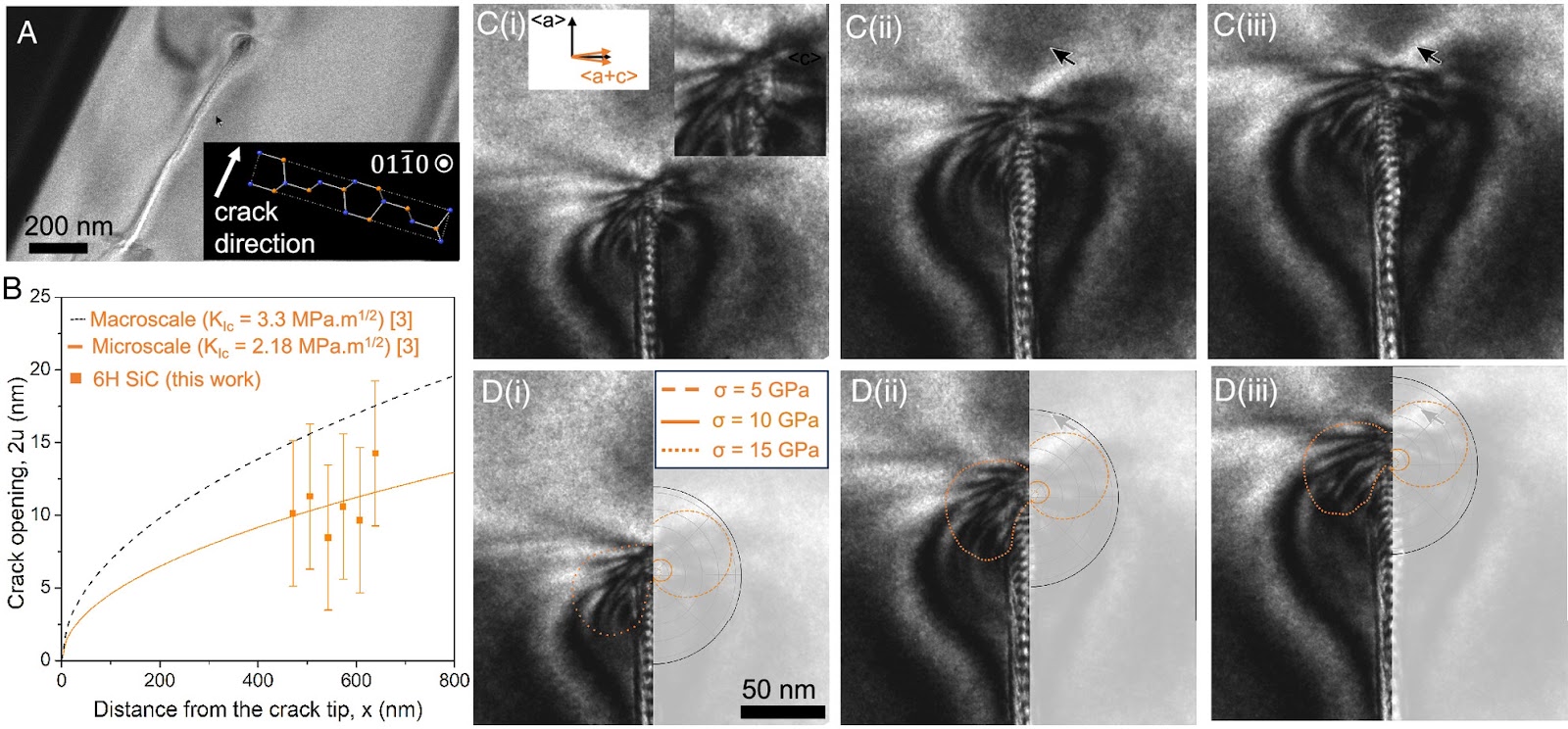
# gst: monitoring of stable crack growth; crack tip behavior at the nanoscale (during ceramic fracture).


<< To understand fracture and make brittle materials more ductile, (AA) rely on modeling what happens at a crack tip. However, observing a crack tip in a brittle material is challenging: cracks propagate fast, and the events that (AA) are interested in observing occur at the nanoscale or below. Up to now, (They) were not able to observe what happens ahead of a moving crack tip. >>

<< In this work, (AA) show how by carefully performing fracture experiments inside a transmission electron microscope (They) can grow stable cracks while observing the nanoscale events happening at the crack tip. >>️

Oriol Gavalda-Diaz, Max Emmanuel, et al. Observing the crack tip behavior at the nanoscale during fracture of ceramics. PNAS. 121 (43) e2408292121. Oct 17, 2024.

Also: fracture, crack, behav in https://www.inkgmr.net/kwrds.html 

Keywords: gst, fracture, crack, behavior


lunedì 1 luglio 2024

# gst: the strangeness of networks, the hypothesis of a connection between the kinetics of networks and anomalous transport theory.

<< Many real-world networks change over time. Think, for example, of social interactions, gene activation in a cell, or strategy making in financial markets, where connections and disconnections occur all the time. >>

AA team << has gained groundbreaking insights into this problem by recasting the discrete dynamics of a network as a continuous time series (..). In doing so, the researchers have discovered that if the breaking and forming of links are represented as a particle moving in a suitable geometric space, then its motion is subdiffusive—that is, slower than it would be if it diffused normally. What’s more, the particles’ motions are well described by fractional Brownian motion, a generalization of Einstein’s classic model. This feat establishes a profound connection between the kinetics of time-varying or “temporal” networks and anomalous transport theory, opening fresh prospects for developing predictive equations of motion for networks. >>️

Ivan Bonamassa. Strange Kinetics Shape Network Growth. Physics 17, 96. Jun 17, 2024.

Evangelos S. Papaefthymiou, Costas Iordanou, Fragkiskos Papadopoulos. Fundamental Dynamics of Popularity-Similarity Trajectories in Real Networks. Phys. Rev. Lett. 132, 257401. Jun 17, 2024. 

Also: network, transition, in https://www.inkgmr.net/kwrds.html 

Keywords: gst, network, transition


mercoledì 3 aprile 2024

# gst: elastomers fail from the edge.


<< The performance of soft devices is limited by the fracture resistance of elastomers. (..) A key observation is that thicker elastomers can be significantly tougher than thinner ones. (AA) show that this surprising toughness enhancement in thick samples emerges from the 3D geometry of the fracture process. In contrast to the classical picture of a 2D crack, failure is driven by the growth of two separate “edge” cracks that nucleate early on at a sample’s sides. As loading is increased, these cracks propagate in towards the sample midplane. When they merge, samples reach their ultimate failure strength. In thicker samples, edge cracks need to propagate farther before meeting, resulting in increased sample toughness. (AA) demonstrate that edge-crack growth is controlled by the elastomer’s strain-stiffening properties. >>
Nan Xue, Rong Long, Eric R. Dufresne, Robert W. Style. Elastomers Fail from the Edge. Phys. Rev. X 14, 011054. March 22, 2024. 

Also: elastic, crack, in https://www.inkgmr.net/kwrds.html 

Keywords: gst, elastic, crack, elastomers, fracture


martedì 26 settembre 2023

# gst: apropos of transitions, three distinct new families of long-wave instabilities and potential new pathways to turbulence.


AA << reveal three previously unknown instabilities, distinct from the well-known Kelvin-Helmholtz Instability (KHI) and Holmboe Wave Instability (HWI), in that they have longer wavelengths (..) and often slower growth rates. >>

<< The circumstances under which turbulence can persist in strongly stratified flows remains a fascinating debate within the community. [AA] demonstrated that weakly unstable (very) long waves may trigger turbulence and mixing after long periods of time, even under initially very strongly stratified conditions. >>

Lu Zhu, Amir Atoufi, Adrien Lefauve, Rich R. Kerswell, P. F. Linden. Long-wave instabilities of sloping stratified exchange flows. arXiv:2309.10056v1 [physics.flu-dyn]. Sep 18, 2023.

Also: waves, instability, transition, turbulence, chaos, in https://www.inkgmr.net/kwrds.html

Keywords: gst, waves, instability, long-wave instability, transition, turbulence, chaos


giovedì 2 marzo 2023

# gst: when science meets poetry, an image of three-dimensional stepped cracks (bistability, and their transition to simple cracks)


<< Slow cracks may be simple, with no internal structure. The leading edge of a simple crack, the crack front, forms a single fracture plane in its wake. Slow cracks may also develop segmented crack fronts, each segment propagating along a separate fracture plane. These planes merge at locations that form steps along fracture surfaces. Steps are not stationary, but instead propagate within a crack front. Real-time measurements of crack front structure and energy flux reveal that step dynamics significantly increase energy dissipation and drastically alter crack dynamics. Simple and stepped cracks are each stable. By extending the use of energy balance to include 3D crack front structure, (AA) find that, while energy balance is obeyed, it is insufficient to select the energetically favorable crack growth mode. Transitions from stepped cracks to simple cracks occur only when their in-plane front lengths become equal and a perturbation momentarily changes step topology. Such 3D crack dynamics challenge our traditional understanding of fracture. >>

Meng Wang, Mokhtar Adda-Bedia, Jay Fineberg. Dynamics of three-dimensional stepped cracks, bistability, and their transition to simple cracks. Phys. Rev. Research 5, L012001. Jan 9, 2023. 

Also

keyword 'crack' in FonT

keyword 'rottura' | 'crepa' | 'frattura' | 'rugosa' in Notes
(quasi-stochastic poetry)


keywords 'meets poetry' in FonT

Keywords:  gst, transitions, dynamical phase transitions, crack, cracking,   fracture, roughness


venerdì 24 febbraio 2023

# gst: apropos of transitions, erratic, bursty growth processes in cellular sprawl

<< A new “bursty growth” model for organelles—internal components of biological cells—helps explain observed size fluctuations. >>

<< Biologists have identified within cells many specialized structures called organelles that carry out crucial tasks, but how cells regulate the size and the number of organelles has remained a puzzle. Now, using simulations backed by experiments, biophysicists have demonstrated that cells appear to produce organelles through a seemingly erratic, or “bursty,” growth process, which enables them to control average organelle sizes and numbers while also constraining organelle size variations within any cell. The work helps to build up a more fundamental understanding of the mechanisms of cellular function. >>️

<< We wondered if organelle growth, far from being an orderly ‘brick-by-brick’ assembly, might occur in more random bursts,  (..) The burst model can thus explain how cells balance organelle sizes and numbers while also keeping size fluctuations within a narrow window, >> Shankar Mukherji.

<< This “universal” behavior suggests that the burst mechanism underlies all organelle growth, despite the fact that each organelle has a unique building process. >>️
Mark Buchanan. Organelle Building Codes. Physics 16, 3. Jan 6, 2023. 

Kiandokht Panjtan Amiri, Asa Kalish, Shankar Mukherji. Robustness and Universality in Organelle Size Control. Phys. Rev. Lett. 130, 018401. Jan 6,  2023. 

Also

keyword 'growth' in FonT

keyword 'erratico' | 'erratica' in Notes
(quasi-stochastic poetry)


keyword 'erratic' in FonT

Keywords: gst, cell, cell assembly, growth, erratic growth, transition


martedì 21 febbraio 2023

# gst: towards (insights into) intermittency and inhomogeneity of turbulent mixing

<< Fluid elements deform in turbulence by stretching and folding. In this work, by projecting the material deformation tensor onto the largest stretching direction, the dynamics of folding is depicted through the evolution of the material curvature. Results from direct numerical simulation (DNS) show that the curvature growth exhibits two regimes, first a linear stage dominated by folding fluid elements through a persistent velocity Hessian which then transitions to an exponential growth driven by the stretching of already strongly bent fluid elements. This transition leads to strong curvature intermittency at later stages, which can be explained by a proposed curvature-evolution model. The link between velocity Hessian to folding provides a new way to understand the crucial steps in energy cascade and mixing in turbulence beyond the classical linear description. >>

Yinghe Qi, Charles Meneveau, Greg Voth, Rui Ni. Folding dynamics and its intermittency in turbulence. arXiv: 2301.10341v1 [physics.flu-dyn]. Jan 24, 2023. 

Also

keyword 'intermittency' in FonT

keyword 'turbulence' in FonT

keyword 'turbolento' | 'turbolenza' in Notes (quasi-stochastic poetry)


keyword 'transition' | 'transitional' in FonT


keyword 'transition' | 'transizion*' in Notes (quasi-stochastic poetry)


Keywords: gst, intermittency, turbulence, transition


giovedì 22 dicembre 2022

# gst: breakthrough in unstable growth processes, shorter branches can revive when a striking transition of the leading branch reaches the boundary of the system.

<< Transport networks, such as vasculature or river networks, provide key functions in organisms and the environment. They often emerge as a result of unstable growth processes, in which growing branches compete for the available flux. This leads to effective repulsion between the branches and screening of the shorter ones. (AA) show that a striking transition in growth dynamics takes place as the leading branch reaches the boundary of the system. The shorter branches revive then and grow toward the leading one forming loops. These effects are observed both in living and inanimate systems. >>

Stanisław Zukowski, Annemiek Johanna Maria Cornelissen, et al. Finger revival and reconnections near breakthrough in unstable growth processes. arXiv: 2212.08878v1 [physics.flu-dyn]. Dec 17, 2022.

Also

keyword 'transition' in FonT

keyword 'transizione' | 'transition' in Notes (quasi-stochastic poetry): 


Keywords: gst, transition, growth, growth dynamics, transport networks, spatial networks


martedì 20 dicembre 2022

# gst: slow dynamics of a interacting mobile impurity (in a bath of localized particles)

AA << investigate dynamics of a single mobile impurity immersed in a bath of Anderson localized particles and focus on the regime of relatively strong disorder and interactions. In that regime, the dynamics of the system is particularly slow, suggesting, at short times, an occurrence of many-body localization. Considering longer time scales, (AA) show that the latter is a transient effect and that, eventually, the impurity spreads sub-diffusively and induces a gradual delocalization of the Anderson insulator. The phenomenology of the system in the considered regime of slow dynamics includes a sub-diffusive growth of mean square displacement of the impurity, power-law decay of density correlation functions of the Anderson insulator and a power-law growth of entanglement entropy in the system. (AA) observe a similar regime of slow dynamics also when the disorder in the system is replaced by a sufficiently strong quasi-periodic potential. >>

Piotr Sierant, Titas Chanda, Maciej Lewenstein, Jakub Zakrzewski. Slow dynamics of a mobile impurity interacting with an Anderson insulator. arXiv: 2212.07107v1 [cond-mat.dis-nn]. Dec 14, 2022. 

Also

keyword 'particle' | 'quasiparticle' in FonT


keyword 'particelle' in Notes
(quasi-stochastic poetry)


Keywords: gst, particles, impurity, disorder, sub-diffusive growth, transition, entanglement entropy